
2025 was a genuinely strong year for stocks. The S&P 500 returned 17.44 percent including dividends, a result most portfolios would be happy with in any year.
Even so, three tangible assets did meaningfully better. None of them are speculative or obscure, and all three have a long history as stores of value.
This is general market information, not personalized investment advice. Every asset here carries its own risks, and past performance never guarantees future returns.
Key Takeaways
- The S&P 500 returned 17.44 percent in 2025, a strong result by historical standards.
- Silver was the best performing major commodity of the year, up roughly 145 percent.
- Gold gained approximately 64 percent, its biggest annual advance in decades.
- Global luxury real estate rose a modest 3.2 percent on average, but specific markets moved far faster.
- Diversifying into tangible assets carries real risks, including volatility and illiquidity.
How the S&P 500 Actually Performed in 2025
Seventeen percent is not a disappointing year by any measure. It sits well above the market’s long run historical average.
That context matters, because beating the S&P 500 in 2025 meant clearing a genuinely high bar, not a weak one.
Silver Nearly Tripled the Stock Market’s Return
Silver was the standout tangible asset of 2025, gaining approximately 145 percent over the course of the year.
That surge was driven by a mix of tight supply, export restrictions out of China, and rising industrial demand from the clean energy sector.
Silver is also considerably more volatile than gold, and price swings in both directions can be sharp.
Gold Was Not Far Behind
Gold gained roughly 64 percent in 2025, closing the year above 4,300 dollars an ounce after setting more than 50 new all time highs.
That marks one of gold’s strongest years in modern history, and analysts at major banks have continued to raise their 2026 price targets since.
Both metals remain more volatile than most real estate or equity holdings, which is worth remembering before treating either as a core allocation.
Prime Real Estate in the Right Micro Markets
Real estate as a broad category did not beat stocks in 2025. Global luxury home prices rose just 3.2 percent on average, according to Knight Frank’s Wealth Report.
Specific markets told a very different story. Greece was one of them.
A recent market report found luxury real estate demand in Greece reached 6.11 billion euros in the first half of 2026, a 35 percent increase year over year.
Median property values in that segment climbed from 2.3 million euros to 2.95 million euros, a 28 percent jump, with properties above 5 million euros making up roughly 70 percent of total demand.
Buyers browsing luxury houses in Greece are increasingly looking at firms like Ploumis Sotiropoulos, the country’s exclusive affiliate of Christie’s International Real Estate, for access to that segment of the market.

Tangible Assets vs the S&P 500 in 2025
The comparison is easiest to see side by side.
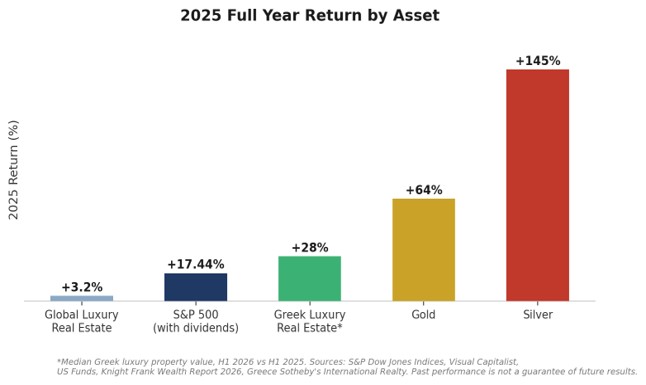
| Asset | 2025 Return | How It Compares to the S&P 500 |
| S&P 500 (with dividends) | 17.44 percent | Baseline |
| Silver | Approximately 145 percent | Far ahead |
| Gold | Approximately 64 percent | Well ahead |
| Global luxury real estate (average) | 3.2 percent | Behind |
| Greek luxury real estate (median value) | 28 percent | Ahead |
The chart below shows the same figures visually, based on the sourced full year 2025 data above.
Why These Assets Are Catching Wealthy Investors’ Attention
Savvas Savvaidis, CEO and President of Greece Sotheby’s International Realty, has pointed to a market maturing toward more sophisticated, better informed buyers rather than opportunistic ones.
That shift lines up with what precious metals dealers are also reporting. Buyers are increasingly treating tangible assets as a deliberate part of a diversified portfolio, not just a hedge bought in a panic.
A useful breakdown of gold’s actual long term performance against the S&P 500 is available in this YouTube analysis, which walks through the numbers in more detail than a single year can show.
Readers who enjoy tracking passion investments alongside traditional ones may also appreciate this look at vineyard ownership through Christie’s International Real Estate.
Frequently Asked Questions
Did every tangible asset beat the stock market in 2025?
No. Broad real estate averaged just 3.2 percent globally, well behind the S&P 500’s 17.44 percent return.
Is silver a safer investment than gold?
Not necessarily. Silver is smaller and more volatile than gold, and its 2025 gains came with sharper price swings.
Why did Greek luxury real estate outperform the global average?
Rising demand from international buyers pushed median property values sharply higher, concentrated in areas like Athens Riviera and Mykonos.
Should tangible assets replace stocks in a portfolio?
Most advisors treat them as a complement to stocks, not a replacement, given their own volatility and liquidity differences.
Is past performance a guarantee of future returns?
No. Strong 2025 results for gold, silver, and select real estate markets do not guarantee similar performance going forward.
Outperforming the market in a year when the market itself returned 17.44 percent is a meaningful signal, not a coincidence.
Whether that continues into 2026 depends on factors well beyond any single asset class, which is exactly why diversification across tangible and traditional assets, alongside ideas like the Equity Estates luxury residence fund, remains worth considering.
Fact Check: S&P 500, gold, and silver 2025 return figures are drawn from S&P Dow Jones Indices data via DQYDJ, and commodity return data via Visual Capitalist and US Funds. Global luxury real estate figures are from the Knight Frank Wealth Report 2026. Greek luxury real estate figures and the named executive quote context are from a Greece Sotheby’s International Realty market report as covered by Athens Times. Ploumis Sotiropoulos property details were verified against the live ploumis-sotiropoulos.gr site as of September 2026. This article is general information, not personalized financial or investment advice.