
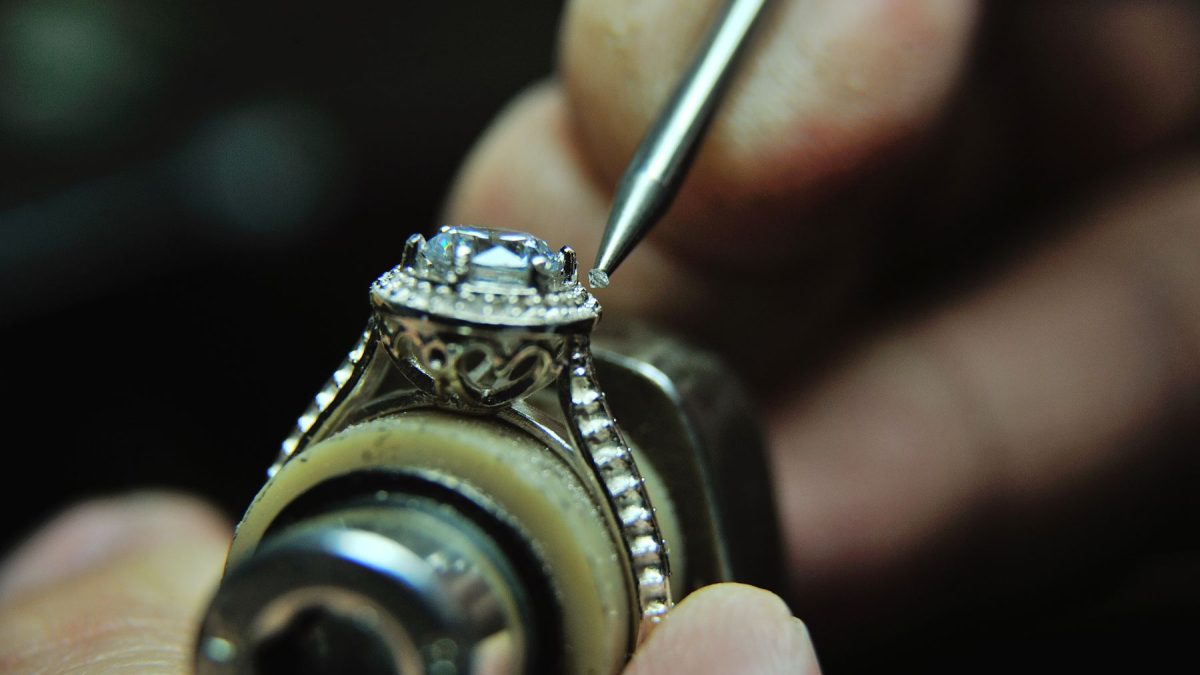
Three phrases do most of the heavy lifting in how jewelry is described, and they are not interchangeable. Bespoke jewelry means a piece designed from nothing for one person. Made to order means a piece produced after a request but from a design that already existed. Mass produced means made in quantity, in advance, to a fixed specification. The words get blurred constantly, usually in the direction that flatters the seller, and the blurring makes it hard to work out what you are actually getting. What follows is an honest comparison of what each one is in a workshop, what it is genuinely good at, and where the real trade-offs sit.
Why the vocabulary drifted
The drift happens because every one of these terms carries positive associations that people want borrowed. “Handmade” suggests care. “Bespoke” suggests exclusivity. “Made to order” suggests attention. So a ring cast from a mold used a thousand times, finished by a person, and dispatched after a request can technically be described using all three words without anyone lying outright.
The fix is not cynicism, it is a better question. Instead of asking whether a piece is handmade, ask who designed it and when. A design that existed before you arrived is a different proposition from one that did not, whatever the finishing process. Workshops that run genuine commissions, such as aquamarise.com, generally separate their ready-made designs from their commission work rather than merging both under one word, and that separation is a reasonable thing to look for anywhere.
Mass produced jewelry, described fairly
Mass produced jewelry is designed once and made repeatedly, usually by casting from a master model, often with significant machine involvement in finishing and stone setting. It is easy to be sniffy about this, and it is also unfair, because mass production is extraordinarily good at things bespoke is bad at.
It produces consistency. The hundredth piece matches the first. Tolerances are tight because the process has been refined across thousands of repetitions, and problems that would surprise a one-off maker were solved years ago. It also makes design accessible to people who do not want a project, only a piece they like. If you have found something that already suits you, the fact that others own it too is a fairly abstract objection.
What it cannot do is respond. The design is closed. Nothing about it was decided with a specific hand, a specific stone or a specific life in mind, because it could not have been.
Made to order jewelry: made after you asked, not designed for you
Made to order sits closer to mass production than most people assume. The design already exists. What happens after a request is production: a wax is grown or a model is pulled, the piece is cast, finished and set. Often the metal and center stone are selectable, which is where it starts to feel personal.
The real advantages are practical. Nothing is made speculatively, so the range of available combinations can be much broader than anything held in stock, and unusual pairings of stone and metal become possible without anyone gambling on demand. The limit is that the architecture of the piece – profile height, gallery, shoulder taper, how the head is built – was decided by someone else, for no one in particular, before you arrived.
Opaque lapis beside translucent moonstone in a kite cut: a pairing that has to be designed around, because no stock setting anticipates it.
Semi custom: the middle ground most people are actually in
Semi custom is made to order with a wider set of doors open. Beyond metal and center stone you might choose accent stones, a bezel instead of claws, a different band width, or a change of finish. The underlying design still exists and still governs the outcome, but meaningful decisions are genuinely yours.
For a large share of people this is the sweet spot, and saying so is not a downgrade. You get real input into the parts you have opinions about while inheriting a form the workshop already knows how to make well. The failure mode is expectation creep: requests accumulate until the design is being asked to become something it structurally is not, at which point the honest answer is that the project has become a commission and should be treated as one.
Bespoke: what it genuinely gives you
True bespoke starts with a conversation and a blank page. Nothing is inherited, which means every decision is available and every decision has to be made. The piece can be built around a stone with unusual proportions, around an asymmetric idea, around an opaque and a translucent stone sitting side by side – situations where no existing design would do anything but fight you.
For solid gold and platinum work this normally runs through 3D modeling, with renders reviewed and revised until the design is approved. That approval stage exists because a drawing and a finished object are not the same thing: a render is truthful about proportion, profile and stone placement, and unreliable about sparkle, about light traveling through a translucent stone, and about exactly how a metal color reads on skin. What you gain from bespoke jewelry from Aquamarise and from any workshop running a proper commission is not simply personalization. It is judgment applied to your specific problem, and the chance to change your mind while changing it is still easy.
The honest trade is that bespoke asks something of you. It requires decisions, engagement at review stages, and a tolerance for the piece not existing while it is being resolved. If you want the outcome without the involvement, semi custom will serve you better.
Why handmade and custom are not synonyms
These two words describe entirely different axes and are constantly treated as one. Handmade describes how something was produced. Custom describes who a design was made for. A ring can be produced almost entirely by hand from a design used a thousand times before, and a fully bespoke piece can be realized through casting, which is a mechanized route, without being any less designed for you.
Casting and hand fabrication are simply different production methods with different strengths. Lost-wax casting handles organic, flowing and complex forms and reproduces fine detail faithfully. Fabrication – building from stock metal by sawing, forming and soldering – suits crisp geometry and lets a maker judge and adjust as the piece takes shape. Neither is the prestigious option. The right one depends on the form.
Matching the route to what you actually want
A short summary of what each does well:
- Mass produced: consistency, refinement through repetition, and no project to manage. Right when you have found something you already like.
- Made to order: breadth of combinations without speculative production. Right when the design suits you and only the materials need choosing.
- Semi custom: real input on specific elements over a proven form. Right when your list of changes is short and structural changes are not on it.
- Bespoke: a design built around a particular stone, hand or idea. Right when nothing existing fits, and worth it only if you will engage with the process.
None of these is a lesser version of another. They answer different questions. Bespoke jewelry is the correct answer when the constraint you are working around is genuinely specific, and an unnecessary detour when it is not – and knowing which of the two you are in is the single most useful thing you can work out before contacting anyone.