
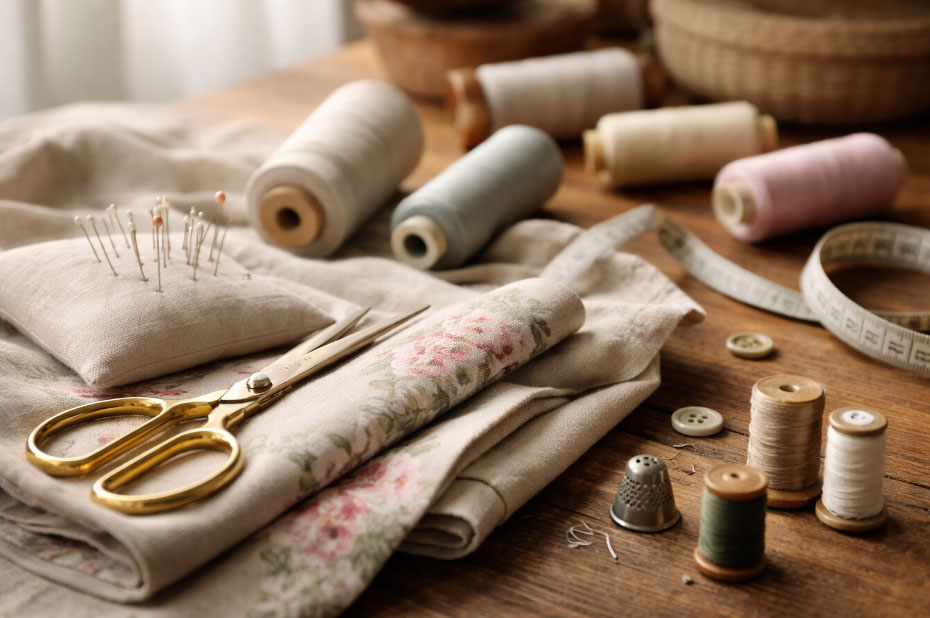
There’s a certain quiet authority in handmade objects.
A stitched blanket. A repaired chair. A hand-bound journal. A carefully sewn garment. These things carry evidence of time and intention. You can feel the hours in them. You can see the attention.
But long before technique, style, or creativity take center stage, something else determines whether that object will last: the quality of the materials used to make it.
It’s not the most glamorous part of the process. It’s not what gets photographed or admired. Yet behind every enduring project, a DIY maker invested time and money in choosing the right materials.
And that choice matters more than most people realize.
The Foundation No One Sees
Material quality is the invisible foundation of any handmade project.
Two finished pieces can look nearly identical on the day they’re completed. The seams are straight. The edges are smooth. The colors are vibrant. To the casual eye, they appear equal. But the difference shows up later.
One begins to fray at the corners. The color fades unevenly. The structure warps. The surface pills. Something subtly shifts out of alignment.
When this happens, makers often blame themselves. The seam must have been poorly sewn. The measurements must have been off. The design must have been flawed.
But often, the real issue is structural. Fibers were too short to hold tension. The weave was loose. The wood wasn’t properly dried. The adhesive degrades under temperature changes. The dye wasn’t colorfast.
Good materials behave predictably. They shrink within expected ranges. They hold tension. They respond to tools without splintering, stretching, or breaking down. That predictability allows the maker to focus on craftsmanship rather than damage control.
And predictability is a gift, especially when you’re learning.
Durability is the Real Test
Most projects are judged the moment they’re finished. Fresh fabric looks crisp. Newly sanded wood feels smooth. Colors are vibrant. Everything seems solid. But a handmade object’s true test begins when it enters daily life.
Clothing gets washed. Upholstery gets sat on. Storage boxes get opened and closed. Quilts are dragged across floors and folded repeatedly.
Durability isn’t just about strength. It’s also about longevity. High-quality materials typically have tighter weaves, longer fibers, more stable finishes, or more consistent processing. As such, they withstand stress without quickly breaking down.
Of course, lower-quality materials don’t necessarily fail immediately. They simply fail sooner.
Better materials age gradually. They soften and develop character while still holding their shape.
Cheaper ones usually deteriorate abruptly.
Durability also connects to sustainability. When a handmade item has to be replaced quickly, the environmental cost compounds. It means more resources, production, and waste. In that sense, choosing quality isn’t just practical. It’s responsible.
Comfort: A Sensory Experience
Material quality also shapes how something feels, sometimes more than how it looks.
In textiles, fiber finish determines softness. Weave density affects breathability. Fabric weight influences drape. These aren’t luxury considerations. They directly impact whether something gets used or abandoned.
A beautifully sewn garment made from coarse fabric won’t be worn often. A quilt made from unstable material won’t lie smoothly. A tool with a poorly balanced handle will strain the hand.
Even outside textiles, tactile experience matters. The weight of paper in a journal. The smoothness of a sanded surface. The way a drawer slides in and out.
There’s also a psychological dimension. Makers often describe working with good materials as “easier,” even when the project is complex. Cuts are cleaner. Pieces align properly. Surfaces respond predictably.
Poor materials introduce friction at every step. Slight warping. Unexpected stretching. Edges that won’t hold.
Those small frustrations accumulate. And over time, they erode confidence.
The Illusion of Saving Money
Let’s talk about cost, because it matters.
Supplies are often the biggest upfront expense in handmade work. Beginners especially are encouraged to “practice on the cheap stuff.” And sometimes that’s reasonable.
But cheap isn’t always economical.
When a project fails because the material warped, tore, or degraded prematurely, the maker doesn’t just lose the cost of supplies. They lose time, energy, and motivation.
Redoing a project doubles the investment.
That doesn’t mean only the most expensive materials are worthwhile. Price alone isn’t a reliable quality marker. Plenty of mid-range options perform beautifully. And sometimes premium branding masks average performance.
What matters is suitability and consistency.
- Does the material perform as expected?
- Does it align with the demands of the project?
- Does it hold up under realistic use?
Those questions are more important than the price tag.
Skill Has Limits
There’s a persistent myth that a skilled maker can produce great results from anything. Experience certainly helps. Skilled craftspeople can compensate for minor imperfections. They can reinforce weak points or modify techniques.
But even experts can’t override structural deficiencies. Short fibers will still break. Poorly cured wood will still warp. Unstable dyes will still fade.
At the same time, better materials accelerate learning. When materials behave predictably, mistakes are easier to diagnose. If a seam puckers, it’s likely technique. Not hidden fiber instability.
Clarity helps speed improvement.
On the other hand, consistently working with substandard materials muddies the learning process. It becomes difficult to tell whether errors come from technique or from the material itself. That ambiguity can frustrate beginners and slow progress.
Sometimes the fastest way to improve isn’t upgrading skill, but upgrading materials.
Context Matters: Culture, Climate, and Geography
Material quality isn’t universal. Traditional crafts rely on locally available resources. Fibers, woods, clays, and dyes are shaped by climate and culture. What counts as “quality” in one region may differ in another.
Likewise, climate affects everything. Textiles that thrive in humid environments may not perform the same way in other regions. Wood that remains stable in one setting may crack in another.
Global markets have expanded access to materials. That’s a gift. But mass production often prioritizes cost efficiency over longevity. Meanwhile, locally produced materials can be overlooked.
Understanding origin, environment, and intended use adds depth to material selection. It shifts the conversation from “What’s popular?” to “What works here?”
A Closer Look at Selection
In many crafts, choosing materials is part of the craft itself.
Woodworkers examine grain direction. Bookbinders assess paper weight. Knitters test fiber elasticity.
Even something that seems simple, like deciding how to choose a quilt fabric, contains multiple layers of decision-making. Fiber strength. Weave density. Shrinkage behavior. Colorfastness. Compatibility with other fabrics in the quilt.
Those decisions don’t just affect appearance. They shape how the finished piece will age and how it will feel after years of washing. Ultimately, they determine whether it remains structurally sound.
Selection then isn’t a mere preliminary step. It’s foundational.
How to Evaluate Materials Thoughtfully
Assessing quality isn’t always straightforward. Labels can be vague. Online images can be misleading.
But there are practical steps makers can take:
- Test before committing. Wash fabric swatches to check shrinkage and dye stability.
- Sand a small section of wood to evaluate grain behavior.
- Assemble sample joints to test adhesives.
- Handle materials in person when possible.
These small experiments reveal how materials respond under stress.
Equally important is community knowledge. Experienced makers often share insights about reliable suppliers or regional variations. Paying attention to those conversations shortens the learning curve.
And here’s an important truth: you don’t need perfection. You need understanding.
Learning to adapt designs to the strengths and limitations of available materials is part of becoming skilled.
The Quiet Value of Integrity
When materials perform well, no one comments on them.
The quilt that lasts twenty years without thinning. The chair that doesn’t loosen. The book that survives dozens of readings.
Success is quiet. Failure is loud. Attention to material integrity is ultimately an act of respect.
Respect for your time. Respect for the intended user. Respect for the object itself.
In a world of disposable goods and rapid consumption, that respect matters.
Choosing materials thoughtfully slows the process. It deepens engagement and shifts making from a rush to finish into a deliberate practice.
And here’s the encouraging part: this isn’t knowledge reserved for specialists.
It’s practical, observable, and learnable.
When you begin to see materials not as interchangeable supplies but as structural partners in your work, everything changes. Projects last longer. Frustrations decrease. Confidence increases.
The quiet power of good materials doesn’t announce itself.
But it shows up, year after year, every time something you made continues to hold together, function well, and serve its purpose.
And that’s the kind of authority that doesn’t fade.