Just by picking the wrong stone, the whole piece falls apart. The metal, setting, and silhouette all contribute, but the gemstone is where a custom design either earns its keep or quietly fails. It sets the color story, determines how light moves through the piece, and carries most of the emotional weight. A technically perfect setting around a lifeless stone is still a disappointment.
For first-timers, the selection process can feel like trying to navigate a subject with no clear entry point. With hundreds of options, dozens of stone families, and evaluation criteria that aren’t exactly posted on a welcome sign. Getting familiar with a handful of core principles before you start looking will save you time and get you to a result you’ll actually want to wear.
Why the Stone Has to Come First
Here’s the thing: most people picture the setting first, then shop for a stone to fit it. Jewelers who’ve been doing this a long time tend to flip that sequence. The stone is what determines proportions, mounting depth, and how light needs to hit it. A 10 mm round cabochon requires an entirely different prong structure than a 6×9 mm pear cut. Build the setting around the stone, not the other way around.
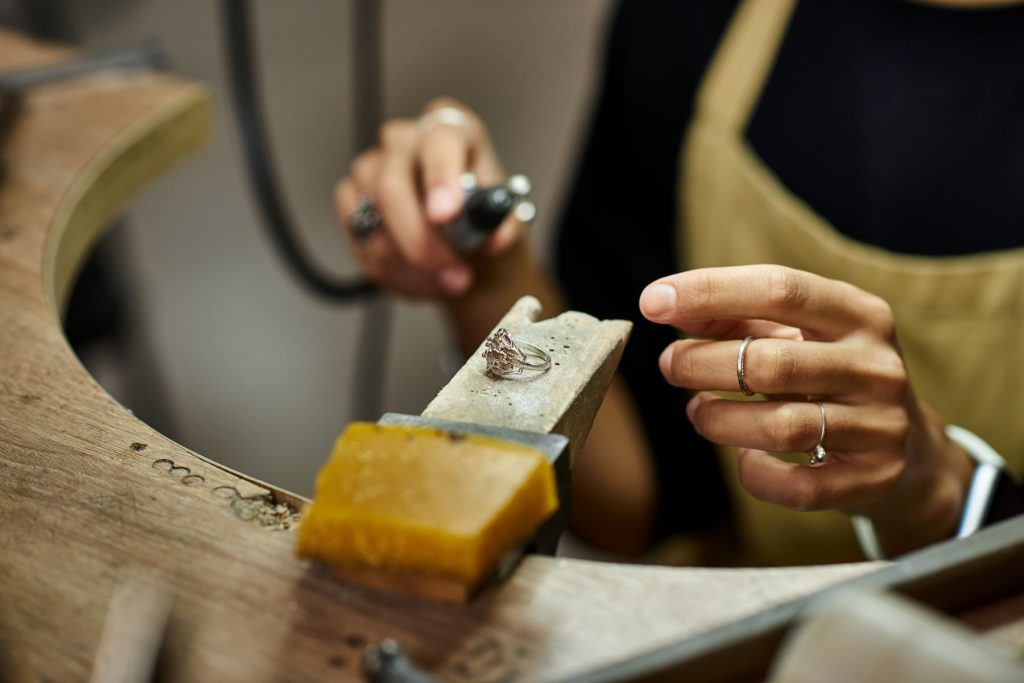
That approach matters especially if you’re working with someone who does their own benchwork. Anyone pursuing a custom jewelry design in St. Louis with a local artisan who fabricates in-house has a real advantage here. That jeweler can shape the design around your specific stone rather than steering you toward whatever fits a standard template.
The Four Cs: Useful, But Not the Whole Picture
The four Cs (cut, color, clarity, and carat weight) were built for diamond grading. They carry over to colored stones, but the weighting shifts considerably.
Cut drives both brilliance and proportion. A well-cut stone returns light across the face without dark or dead patches pooling in the center. For fancy shapes like ovals and marquises, pay attention to the length-to-width ratio and how it fits your design.
Next is the color, which actually defines most colored gemstones. Saturation counts for more than hue in most cases. A medium-toned sapphire with clean, strong saturation will read better than a darker stone carrying a gray or brown modifier. Check it from arm’s length, not just under magnification.
Clarity expectations are stone-dependent, and this is where the four Cs framework can mislead people. Emeralds are expected to have inclusions; a perfectly clean emerald is actually worth scrutinizing for treatment. Aquamarines are typically eye-clean, and visible inclusions in that family genuinely indicate lower quality.
Carat weight is a proxy for mass, not size. Two stones of identical carat weight can look dramatically different face-up depending on how deep the pavilion is.
Durability Is a Design Decision
Hardness and toughness sound interchangeable, but they aren’t. Hardness measures scratch resistance, toughness measures resistance to fracture, and a stone can score well on one while struggling with the other. Diamonds top the Mohs scale at 10 and are highly scratch-resistant, whereas rubies and sapphires sit at 9. Emeralds, tanzanite, and opals are softer and require protective settings.
For daily wear, a bezel or half-bezel setting does more work than prongs. And stones with strong cleavage planes, topaz being the classic example, can chip along those planes from a well-placed knock, even if their hardness rating looks fine on paper. A good jeweler builds durability into the setting recommendation. It shouldn’t be an afterthought.
How Metal Color Interacts With the Stone
The metal around a stone isn’t neutral. Yellow gold pushes warmth into cool-toned stones and can soften the clarity of very pale blues and greens. White gold and platinum hold back, letting the stone’s actual color come through without any color cast from the setting. Rose gold tends to work best alongside warm-toned stones, such as morganite, padparadscha sapphire, and champagne diamonds, where the metal and stone reinforce the same temperature range.
That being said, none of this is a hard rule. A deep blue sapphire in yellow gold is one of the classic combinations in fine jewelry for a reason. The point is to make a deliberate call rather than defaulting to whatever trend is running. Convention is worth breaking when you mean to break it.
Thinking About Longevity
Gemstone trends cycle faster than most people realize. Something that reads as current today may look very much of its moment in ten years. If the piece is meant to last a lifetime or move down a generation, that’s worth factoring in.
Sapphires, rubies, and emeralds have held their appeal for centuries, but that’s not a case against less conventional choices. Alexandrite, spinel, and parti-color tourmaline are attracting serious interest from collectors and designers who want something with a distinct identity. The real question isn’t conventional versus unconventional. It’s whether you’re choosing the stone because you genuinely love it, or because something you read last month made it seem like the right pick.
Getting the Selection Right
Photos don’t tell the full story; they can’t show how a gemstone shifts under incandescent light versus daylight, or capture the difference between a stone that comes alive in the hand and one that just sits there. Seeing stones in person before committing is almost always worth the effort.
Come prepared with reference images, a clear sense of how and where the piece will be worn, and an honest budget number. The right stone for your design is out there. Finding it is part of the process, not a detour from it.