

The fall 2026 job market is giving marketing and creative professionals plenty to think about — particularly across luxury manufacturing, distribution and retail.
AI is changing how work gets done. At the same time, job descriptions are expanding. Employers are reevaluating the skills they need, while professionals are being asked to show how technology makes them more productive.
For luxury companies, the challenge luxury industry marketing trends is particularly interesting.
Luxury manufacturers, distributors and retailers increasingly need marketing and creative talent that can use AI and data without losing the brand storytelling, customer understanding and attention to detail that differentiate a premium product or experience.
The biggest takeaway from what I’m seeing is simple:
AI is changing marketing and creative work, but skilled people still make the difference.
How Is AI Changing Marketing and Creative Jobs in the Luxury Industry?
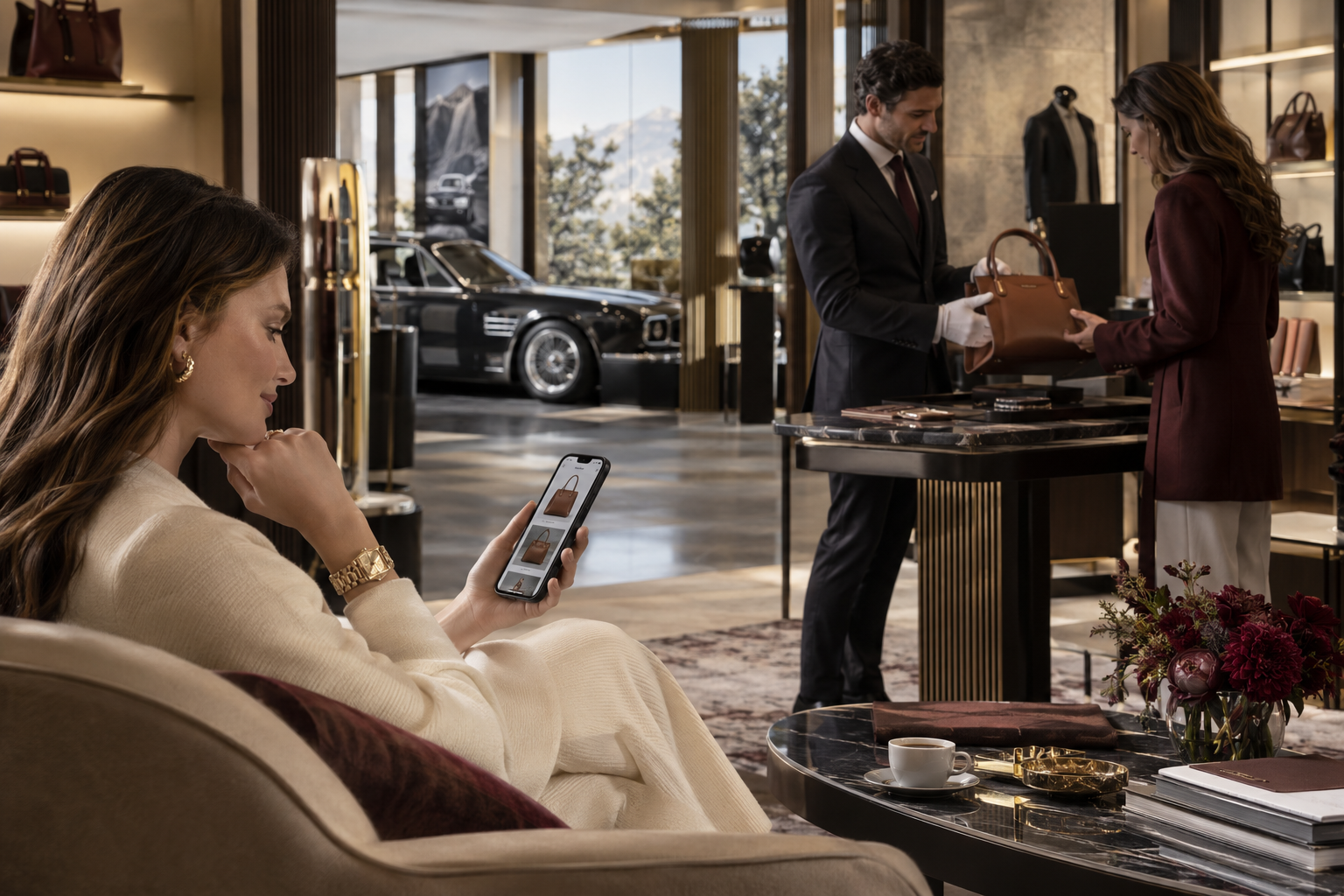
AI is becoming an everyday productivity tool across marketing and creative teams.
Professionals are using generative AI to automate repetitive tasks, accelerate research, generate ideas, analyze information and move more quickly from concept to execution.
For luxury brands, those capabilities can extend across the entire customer journey.
For example, a manufacturer may use AI-assisted marketing teams to develop product storytelling and sales materials. Meanwhile, a distributor may need talent capable of supporting multiple brands and retail partners. A luxury retailer, in turn, may use AI and customer data to improve personalization, digital merchandising, CRM programs and client communications.
However, that does not mean human skills are becoming less important.
In many cases, the opposite is happening.
Luxury companies still need people who understand the customer, the product and the brand. In addition, they need professionals capable of applying creativity, judgment and critical thinking to what AI produces.
Therefore, the strongest professionals are learning how to combine both.
What Emerging Luxury Marketing Technology to Look For?
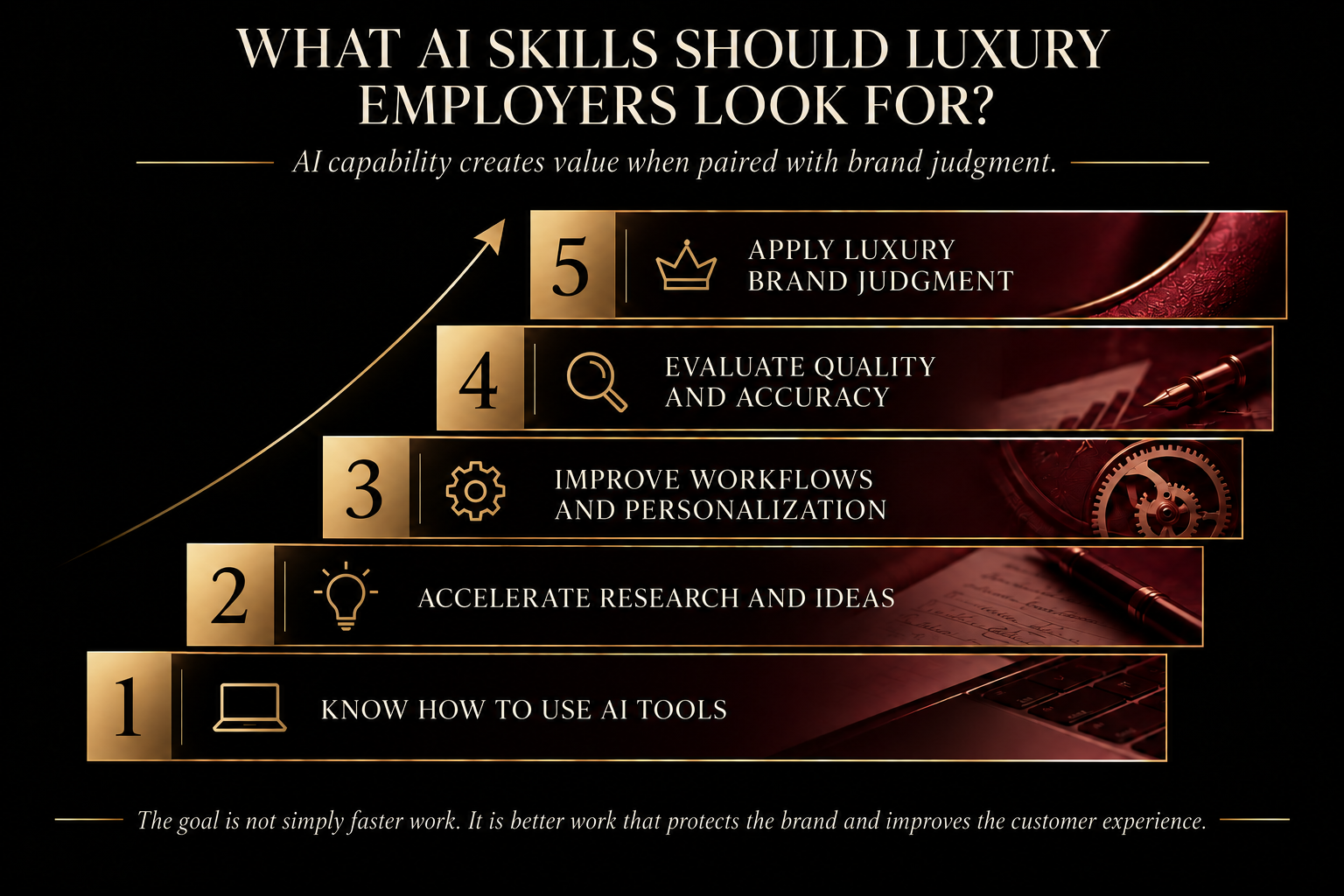
Employers increasingly want candidates who can do more than say they have experience with artificial intelligence.
Instead, they want professionals who can explain how AI improves their productivity and the quality of their work.
That may include using AI to accelerate market research, develop campaign concepts, analyze customer data, improve content workflows, support e-commerce merchandising or create more personalized customer experiences.
For luxury manufacturers, distributors and retailers, however, there is another requirement: brand judgment.
A faster content workflow isn’t valuable if the resulting content diminishes the brand.
Therefore, the important skill is not simply knowing how to use an AI platform. It is understanding when to use AI, how to evaluate its output and how to turn that output into something valuable for the organization and its customers.
Why luxury brands are backing away from AI-generated ads?
AI will continue to automate portions of marketing and creative work. However, luxury companies still need people who can make decisions, understand affluent audiences and recognize what makes an idea appropriate for a premium brand.
Generative tools can create content and summarize information. They can also assist with data analysis and accelerate many parts of the creative process.
Even so, technology does not eliminate the need for people who understand positioning, craftsmanship, customer expectations and brand heritage.
Ultimately, luxury is about differentiation.
As a result, human judgment becomes particularly important.
The opportunity, therefore, isn’t necessarily to replace creative and marketing professionals with AI. Instead, it is to give talented professionals better tools so they can spend more time on strategy, creativity and customer experience.
Which Marketing and Creative Roles Are Changing Fastest?
Many marketing roles are becoming broader.
Social media management is a good example.
In 2026, social media managers may work across brand strategy, short-form video, AI tools, analytics, community engagement, customer service and reputation management.
Similarly, the same pattern is happening across digital marketing, content, communications, e-commerce, CRM and creative roles.
For luxury manufacturers and distributors, marketing professionals may also need to understand dealer networks, retail partners, trade marketing and channel-specific content.
Luxury retailers, meanwhile, increasingly need people who understand both digital and physical customer experiences.
For example, a customer might discover a product through social media, research it through Google or an AI platform, visit a brand’s website and ultimately purchase through a boutique, showroom, dealer or authorized retailer.
Consequently, marketing talent increasingly has to understand that entire journey.
What Is the Marketing Job Market Like in Fall 2026?
The broader employment market remains competitive.
The U.S. added 57,000 jobs in June 2026 before shedding 23,000 jobs in July, and adding 179,000 jobs in August.. Meanwhile, the unemployment rate stood at 4.1%, while unemployment among college-degreed workers remained lower at 2.7%.
Those numbers show why employers and job seekers need to look beyond headline employment data.
Hiring continues, but demand varies considerably by industry, geography, experience level and skill set.
For luxury businesses, therefore, defining the role is particularly important.
Does the organization need a traditional brand marketer? Perhaps it needs an e-commerce specialist or content strategist. In other cases, the priority may be someone with AI and analytics capabilities, a creative professional who understands premium customers or a person capable of connecting all of those functions.
The answer may look very different today than it did several years ago.
Are Contract Marketing and Creative Professionals a Good Fit for Luxury Companies?
Yes — and this may be an increasingly important option.
Contract talent can give luxury manufacturers, distributors and retailers access to specialized marketing and creative expertise without immediately expanding permanent headcount.
For example, a company launching a new collection, entering a new market, expanding its dealer network, rebuilding an e-commerce experience or introducing AI into its marketing operation may need capabilities that aren’t currently available internally.
In those situations, contract professionals can help fill the gaps.
For professionals, contract assignments can also provide valuable experience, expanded skills and exposure to different organizations and industries.
Career paths rarely move in a perfectly straight line. Therefore, a contract position can sometimes become the steppingstone to the next long-term opportunity.
What Marketing Skills Will Luxury Companies Need Most?
The strongest marketing and creative professionals will likely combine technical capabilities with distinctly human skills.
That includes AI fluency, creative thinking, communication, critical thinking, data literacy, customer understanding and business judgment.
Within luxury, I would add another skill: understanding the brand.
A professional working with a luxury automotive manufacturer, high-end home brand, fashion company, hospitality group or specialty retailer needs to understand why customers choose premium products and experiences.
Price, however, isn’t the entire story.
Craftsmanship, heritage, design, service, exclusivity, trust and emotional connection can all influence the purchasing decision.
Technology can certainly accelerate the work. Ultimately, though, people still determine whether the work feels right for the customer and the brand.
What Should Luxury Manufacturers, Distributors and Retailers Look for When Hiring?
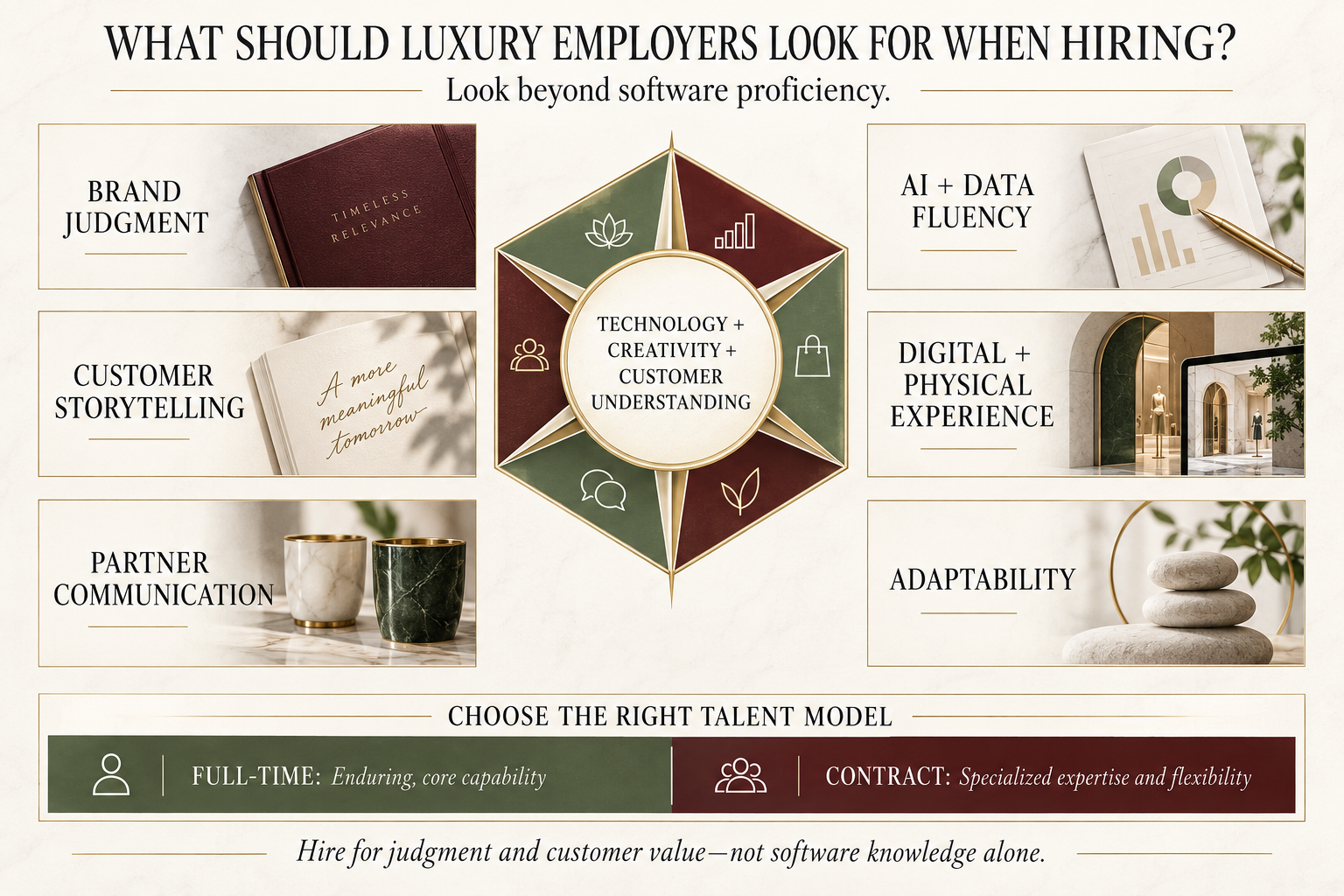
Start by looking beyond software proficiency alone.
The most valuable marketing and creative professionals are often those who can combine technology with judgment, creativity and a genuine understanding of the customer.
For luxury organizations, several questions can help identify the right talent.
Can this person understand and protect our brand? Can they use AI and data productively? In addition, can they translate product features into compelling customer stories?
Employers should also consider whether candidates understand both digital and physical customer experiences. Just as importantly, they should be able to communicate effectively with internal teams, distributors, dealers, retail partners and customers.
Finally, they need to adapt as technology continues to change.
Organizations should also consider whether every capability requires a traditional full-time hire.
In some cases, specialized contract talent can solve an immediate need faster while giving companies flexibility to determine what their long-term organization should look like.
What Should Marketing Professionals Do in the Second Half of 2026?
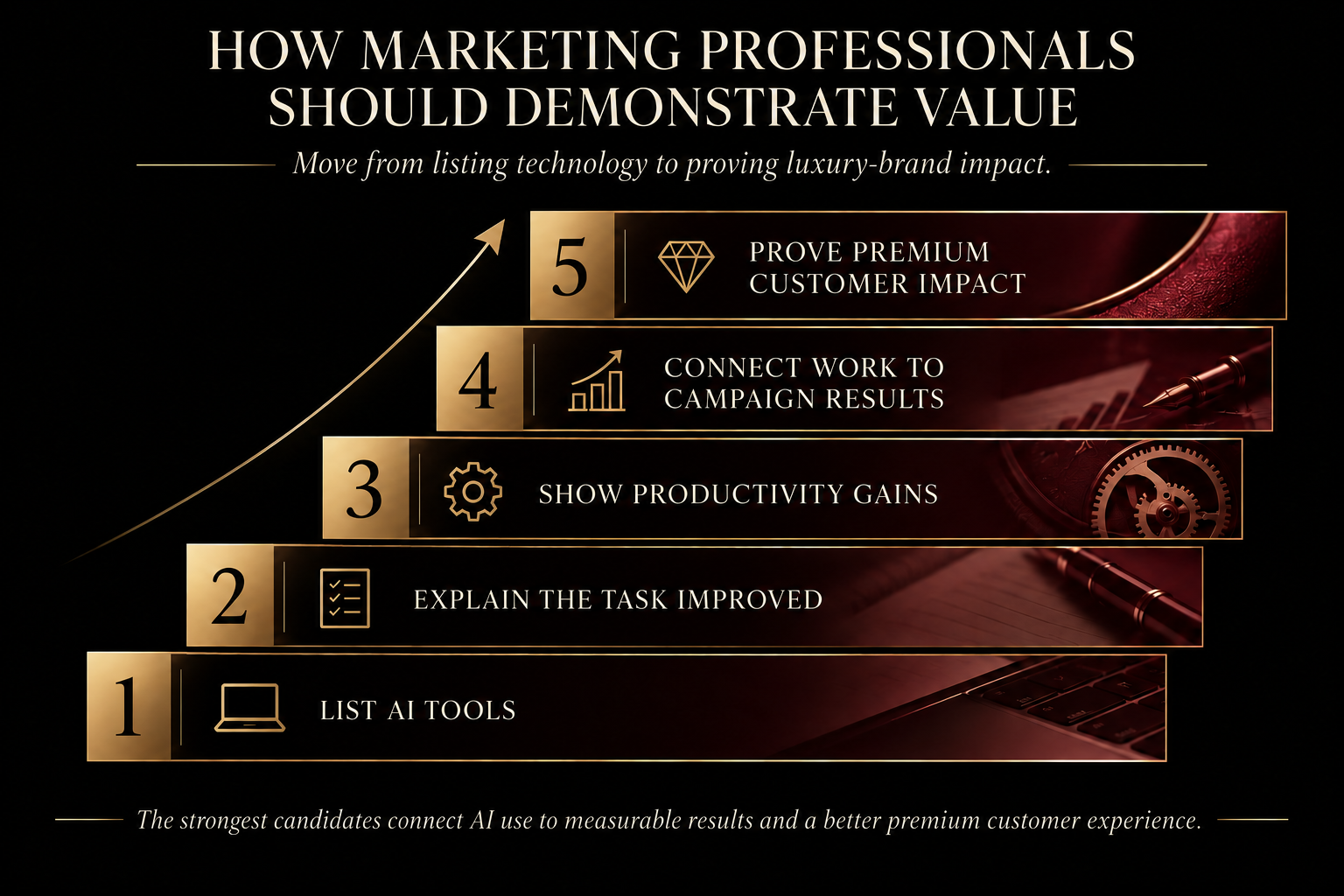
Professionals should be able to clearly explain how they create value.
For example, don’t simply list AI tools on a resume. Instead, explain what you accomplished with them.
Show how technology helped you work faster, understand customers better, improve a campaign, generate stronger creative ideas or deliver measurable business results.
For professionals interested in luxury brands, also demonstrate that you understand the difference between marketing a product and building a premium customer experience.
That distinction matters.
The Bottom Line for Luxury Marketing and Creative Talent in 2026
AI is reshaping the marketing and creative workplace, but it is not eliminating the need for talented people.
Instead, it is changing what organizations expect from them.
For luxury manufacturers, distributors and retailers, the opportunity is to combine new technology with the human capabilities that have always made great brands successful.
The professionals who combine AI fluency, creativity, critical thinking, communication, customer understanding and business judgment should be well positioned as the market evolves.
Likewise, luxury companies that identify the right combination of technology and talent will be better positioned to protect their brands, reach new customers and create the experiences that keep existing customers coming back.
Whether you’re building a marketing team, looking for specialized contract talent or thinking about your next career move, this is a good time to look at where your capabilities need to go next.
Let’s talk about what you’re seeing in the market and where the opportunities may be.
. . . . .
JustLuxe is a premier authority on luxury lifestyle, products, and designer trends. Our global audience relies on our expert-driven content. In our commitment to accuracy and innovation, JustLuxe editors occasionally use AI tools for fact-checking, research support, and content and graphic creation.