
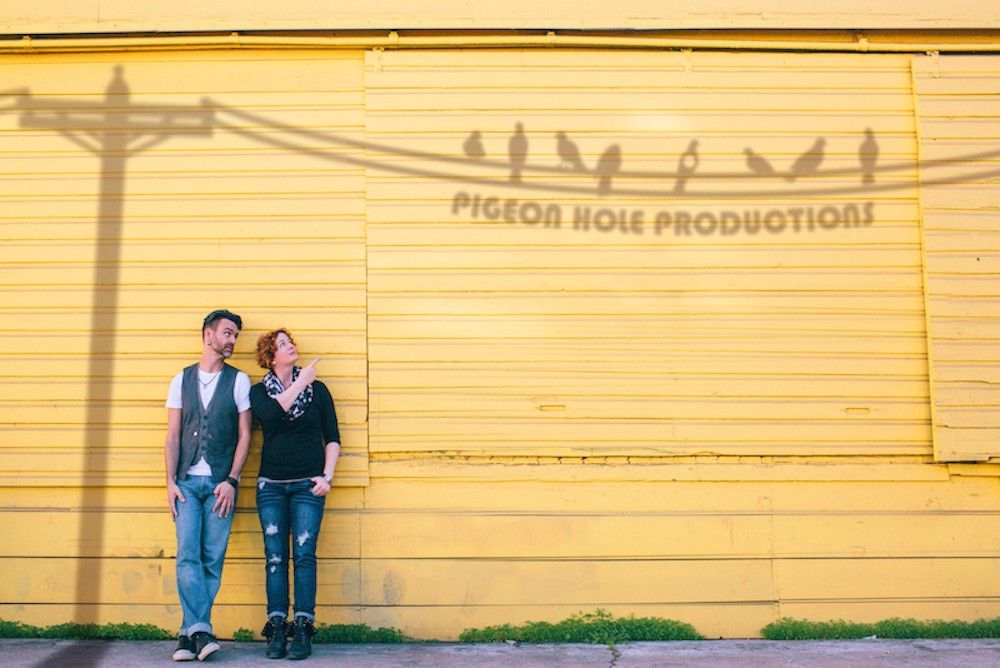
Not your traditional gaming company, former coworkers Trisha Williams and Joe Unger of Pigeon Hole Productions show that their company can be anything but pigeon holed. The team has created a unique gaming company that relies on collaboration between creators and players to make games that aren't always bleak and that haven't already been done. And from her unique perspective as a female gamer, Trisha has created Gamer Girl, a comic series and blog devoted to girl geek culture. The dynamic duo dishes on their upcoming projects to JustLuxe:
When did you two start working together as a team?
Trisha – Well, we met nearly 10 years ago working at a studio in Arizona. That company shut down after a few years and we went our separate ways, me in Seattle and him in Los Angeles. I wound up moving down to LA, working as an Art Director for a mobile company. Joe was working in Zynga as a Design Director and both our studios shut down (again) around the same time. So, we decided to open our own studio.
Joe – After Trisha came down to LA we started to work together again, constantly creating, even in different studios. A few years in, when the studios we were working for collapsed around us, we bought a ticket to Maui and reevaluated life. For a while, we weren't even sure we wanted to stay with games and interactive entertainment. We were lucky to pick up with Adult Swim for a project to test the waters and instead, we decided to do it. But we wanted to do it differently and moved down to San Diego to start something with a new type of vision.

How would you describe Pigeon Hole productions?
Joe – Pigeon Hole Productions is about collaboration. We’re a place for designers, artists, scientists and business across the world, to come to come together and collaborate with the audience. Together we make games and interactive entertainment that is as fun and beautiful as it is valuable.
How does it differ from other companies?
Trisha – First off, we’re stepping away from traditional game design studios. We’re not just designing for “gamers” we’re designing for humans. Our production model is also very different than most game and interactive entertainment studios. When we start a project, we focus on collaborating with other studios.
Joe – Like Trisha said: the biggest difference is we design for humans, not technology. We take a much bigger view of “games” than companies in the past. We’re not looking to make the next Call Of Duty, but to define how we play and why. We see a future where entertainment isn’t separated into “edutainment” or “branded content” and “Art” but that entertainment can have value to science, people and business and those things aren't in conflict.
But it’s also deeper than just the style. We practice what we preach at the business level. Games aren't defined by a few pillar studios or consoles anymore. If there’s going to be a professional game industry we have to stop living in gated communities and start finding a way to work together. We made ourselves on the “production studio” model after watching decades of studio closures. Our vision is to foster a community of creators that does what they love, and collaborates for larger projects. It’s a way to be more sustainable, while still providing kickass games.
What attracted you two to the gaming world?
Trisha – Games! (Laughs) I don’t remember a time when I wasn’t playing games. Not just board games, but console games, arcade games, anything I could get my hands on really. It wasn’t until I was graduating with my BFA in illustration that I realized I could put art and games together. Which lead me to pursue my graduate degree from the Guildhall at SMU in Interactive Technology. I think that’s the quick and wrapped up version.
Joe – I wound up launching mix adventure game and travel magazine online in 1999. The big break was when 9-11 happened. All my advertisers and suppliers evaporated overnight and I went from Editor-In-Chief to freelance gigs for friends who weathered the storm. In less than a year, I made the migration with the rest of the designers who worked on traditional games like D&D to the Massive Multiplayer Online Games like World of Warcraft.

Trisha, what do you feel are the biggest challenges of being a female in the gaming world?
Trisha – I would say constantly having to prove my real “Gamerness.” People seem to not believe I play the same games they do, and not just “girl games.”
As far as other things, how would I put this? It’s not “being believed in” but being taken seriously as a studio owner. When I walk into a conference or a meeting, whoever I’m talking to, men or women, seem to immediately start talking to the man in the room, even if I don’t know who that man is! (Laughs) I find myself working to catch their eye and make them aware that I’m just as, and even more, qualified. It just winds up wasting a lot of time we could be spending making something cool.
People don’t realize that I’m a huge fan of the Mass Effect series, and that I’ve logged more hours on Counter Strike than most people I know combined. I also love games like, Dragon Mania Legends and Limbo. Hell I’ve even used Robot Unicorn Attack in lessons for my students! I fear dying only because I won’t be able to see where games are going in the future (laughs). Think of all the great technology that I’ll never get to see!
How did Gamer Girl Pinups comic and blog come about?
Trisha – Mostly because I wanted to see someone like myself represented in the webcomic community. There were comics about games and there were comics about girls, but there weren’t any that combined the two. I knew plenty of female gamers that wanted to be represented that way.
Being around my age there seemed to be a big gap. That particular combination of female and geek culture just wasn’t represented. The girls love the same things I love. Star Wars, the Ninja Turtles, Robots and Giant Monsters. They’re obsessed with play in all forms, and still have struggles in their daily lives.
Your upcoming project is Piranhapocolypse. How would you describe the game?
Trisha – In a nutshell: a bored pop-culture obsessed fish has hallucinations about becoming a giant monster and destroying the world.
Really, we wanted to bring fun back into a world of entertainment dominated by wasteland, post-apocalyptic, murder, sepia toned, ash strewn, taking itself way too seriously, titles. We wanted to show that you didn’t have to be so serious, even when you're talking about serious things.
I’m tired of depressing things, I wanted to make something not depressing.
Joe – The ‘Pocolypse to end all ‘Pocolpyses! Really, It’s a romp through a daydream. We’re all so tired of the drumbeat of “dark and gritty” and Piranahpocolypse is and escape from that. It makes fun of how far off the deep end we’ve gone on. I love the “House of whatever's ” and “Game of whatevers” as much as anyone, but we thought it was time for a new voice that would bring the fun back.
How does it differ from other games on the market?
Trisha – I’ll start with the art and visuals. The premise is ridiculous and out there, and so is the art style. There’s a part of me that’s throwing away all the training that says “no no you can’t do it that way” but I am, because I want it to be fun. I’m breaking the rules on purpose and making a game that is inspired by Roger Rabbit, the Muppets, David Bowie and the world Jamie Hewlett built with the Gorillaz. Taking “you can’t do that” as my starting point and making the characters live in the real world.
If you ask me who my hero is, it’s Jim Henson and his family. They brought a fantasy world into a real world. Each puppet is a character he created and put into a real picture. I’m doing that will illustration, real photos, created characters to make a world familiar but fantastic.
What this really is, is a collaboration with other artists. For instance, I’m using a ton of photographs to build the world. That’s all art that’s been put out there! It's buildings made by architects. The photographers take pictures of those buildings. I use those photos to build a world. The designer makes that world do something amazing and the programmer lets the players participate too.
Joe – Oh man, so many ways, and so much fun! Games are like movies and world building makes all the difference. Trisha’s vision of this one is an amazing mashup of pop culture. How it’s present everywhere. She really captures that influence in a way that’s fun, funny and still easy to relate to. It’s something special I haven’t seen before.
There’s something bigger though. When we talk about “bringing back the fun” we mean for adults. Piranahpocolypse is hitting that same funny bone Comedy Central rattles. Just like them, the game has something to say without beating you over the head with it. Same thing right? But with giant city smashing hallucinating Piranha.
Tell me about your upcoming podcasts.
Joe – Pinball Rules! As owners of a production studio we wanted a way to collaborate more and really have a discussion with creators and the audience. I’ve always loved the podcast format; it’s intimate, like having a conversation in your living room over a few beers. Pinball Rules does that for design thinking.
Our focus is entertainment, but designing for humans. We’ve made a lot of friends across design. Film, Science, Architecture, Urban Planning, and that concept is really changing how we all think. How do we design for people, humanscale, first rather than for the tech? We aren’t bounded by the theater or TV anymore, and the podcast is a tool to move forward together.
Trisha – Joe and I tend to have hour (S) long discussions at the drop of a hat. Things like, “why is hiking like pinball” or “how skateboarding could help communication”. Our points and discussions wind up catching people’s attention. It only made sense for it to turn into a podcast.
Joe – We’ve got a great list of guests coming on board from Hollywood, the game industry, science and all over. Our first episodes are slated to go live in May.
What new projects are you working on?
Trisha – We’ve been working with a group of Neuroscientists and Researchers at the Salk Institute and the University of California for a while now. We’re in the process of creating a series of games, playable by everyone, which will provide information for the research teams. To players, it will be like playing any other game, but we’re focusing on giving back in some way. What we give can change, but that we’re building entertainment that has a real effect for science and the community will remain the same.
Joe – Our relationship with the research world shaping a lot of where we’re headed. After directing projects for massive Social Media games in Zynga, I saw how much information could be gathered through games and entertainment. Our next project is going to challenge the Silicon Valley paradigm and share that information to better understand humans as a whole, not just optimize a pay button.
We want creatives in entertainment to benefit from learning about how people make choices, how we learn, and why we like what we like. We make better stuff when we work together, and the better we make it, the more people will come and drop a quarter in our pinball machine.