
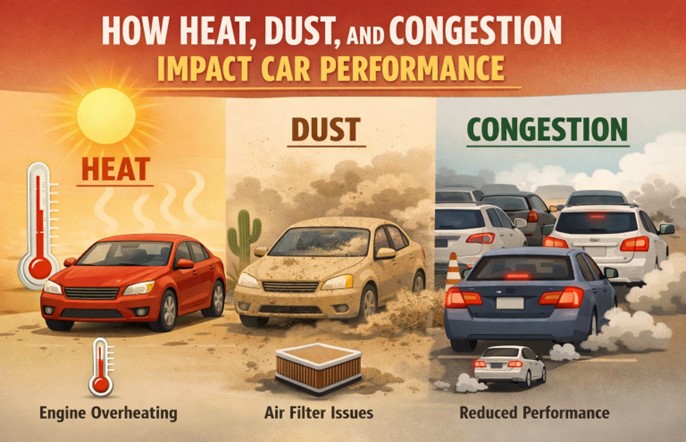
Urban driving conditions in Indian cities place unique stress on vehicles. Unlike controlled highway environments, daily commuting often involves prolonged exposure to high temperatures, airborne dust, and heavy traffic congestion. Over time, these factors can affect engine efficiency, braking performance, suspension durability, and overall vehicle reliability.
Understanding how heat, dust, and congestion impact car performance is essential for owners who want to minimise repair costs and extend vehicle life.
Heat and Engine Stress
High ambient temperatures can significantly affect engine performance. When external temperatures rise, the cooling system must work harder to maintain optimal operating conditions. Prolonged exposure to heat increases stress on components such as:
- Radiators and coolant systems
- Engine oil and lubricants
- Battery performance
- Air conditioning compressors
Overheated engines not only reduce efficiency but can also accelerate wear in critical components. In cities where summer temperatures remain high for extended periods, regular inspection of coolant levels, belts, and hoses becomes particularly important.
Heat also affects tyre pressure. Rising temperatures cause air inside tyres to expand, potentially leading to uneven wear or reduced grip if not monitored correctly.
Dust and Its Impact on Internal Components
Dust accumulation is another often underestimated factor in vehicle maintenance. In rapidly developing urban areas, ongoing construction and dry road surfaces contribute to higher levels of airborne particles. These particles can infiltrate engine bays and cabin ventilation systems.
Dust primarily affects:
- Air filters
- Fuel injectors
- Throttle bodies
- Cabin air filters
Clogged air filters restrict airflow to the engine, potentially reducing fuel efficiency and power delivery. Over time, dust can also affect sensor accuracy, leading to inconsistent engine behaviour.
Regular cleaning and timely replacement of filters are simple steps that can prevent larger mechanical issues. In dust-prone regions, inspection intervals may need to be shorter than manufacturer recommendations.
Traffic Congestion and Mechanical Wear
Stop-start traffic is a defining feature of urban driving. Congestion places different stresses on a vehicle compared to steady highway cruising.
Frequent braking increases wear on brake pads and discs. Continuous clutch use in manual vehicles can accelerate clutch plate wear. Automatic transmissions may also experience higher thermal stress in slow-moving traffic.
Prolonged idling reduces fuel efficiency and contributes to carbon deposits in the engine. These deposits can gradually affect throttle response and overall performance.
Suspension components also endure greater strain in congested cities, especially where roads are uneven or filled with potholes. Over time, this may lead to reduced ride comfort and increased noise from worn bushings or dampers.
Why Preventive Maintenance Matters
Heat, dust, and congestion do not cause immediate damage, but their cumulative effect can shorten component lifespan. Preventive maintenance becomes crucial in mitigating these risks.
Owners should prioritise:
- Regular coolant system inspections
- Timely air and cabin filter replacement
- Brake system checks
- Suspension evaluation
- Battery testing
In cities with high temperatures and dust levels, such as Ahmedabad, these environmental factors often result in more frequent servicing needs. Drivers seeking car repair in Ahmedabad commonly encounter issues related to overheating, brake wear, and clogged air filters—problems directly linked to local driving conditions. Addressing them early helps prevent minor faults from escalating into costly breakdowns.
Vehicle owners seeking structured inspection and servicing support often turn to established service networks such as the ACKO Drive Service Centre, which provides maintenance and repair assistance designed to address everyday wear caused by real-world driving conditions.
Battery and Electrical System Strain
Urban conditions also influence battery life. High temperatures can shorten battery lifespan, while constant use of air conditioning, infotainment systems, and lighting in traffic increases electrical demand.
Short trips, common in city driving, may not allow the battery sufficient time to recharge fully. This can lead to gradual discharge and unexpected starting issues. Routine battery health checks can help prevent inconvenient failures.
The Financial Impact of Ignoring Environmental Stress
Ignoring early signs of wear can lead to higher long-term costs. For example:
- Neglecting brake maintenance may result in disc damage
- Delayed coolant replacement may risk engine overheating
- Ignoring suspension noise can lead to larger component failure
Small maintenance interventions are typically less expensive than major component replacements. Urban drivers who understand the environmental stress their vehicles face are better positioned to manage ownership costs predictably.
Conclusion
Heat, dust, and congestion are unavoidable aspects of city driving, but their impact on car performance can be managed through awareness and timely maintenance. Engines, brakes, suspension systems, and electrical components all respond to environmental stress over time.
By recognising these factors early and committing to regular inspections, drivers can reduce the likelihood of breakdowns and extend vehicle lifespan. In demanding urban environments, proactive care is not merely recommended—it is essential for sustained performance and safety.