

During a conversation with my brother Don about our concerns for our daughters’ and grandkids’ personal safety, we confronted a frightening reality: When someone approaches with violent intent, a victim often has only seconds to react.
In those critical moments, a smartphone should serve as an immediate lifeline—without requiring the user to unlock the device, navigate menus, or speak to explain the situation. This concept inspired Last Defense 955, our proposal for an accelerated upgrade to the Next Generation 911 (NG911) system. After opt-in enrollment, a single spoken keyphrase or dedicated 3-digit shortcode could initiate an immediate, context-aware emergency response while leaving the victim’s hands free to defend themselves or escape.
955 and 922 are proposed numbers for this standard, not established emergency numbers. Use 911 for current emergency assistance.
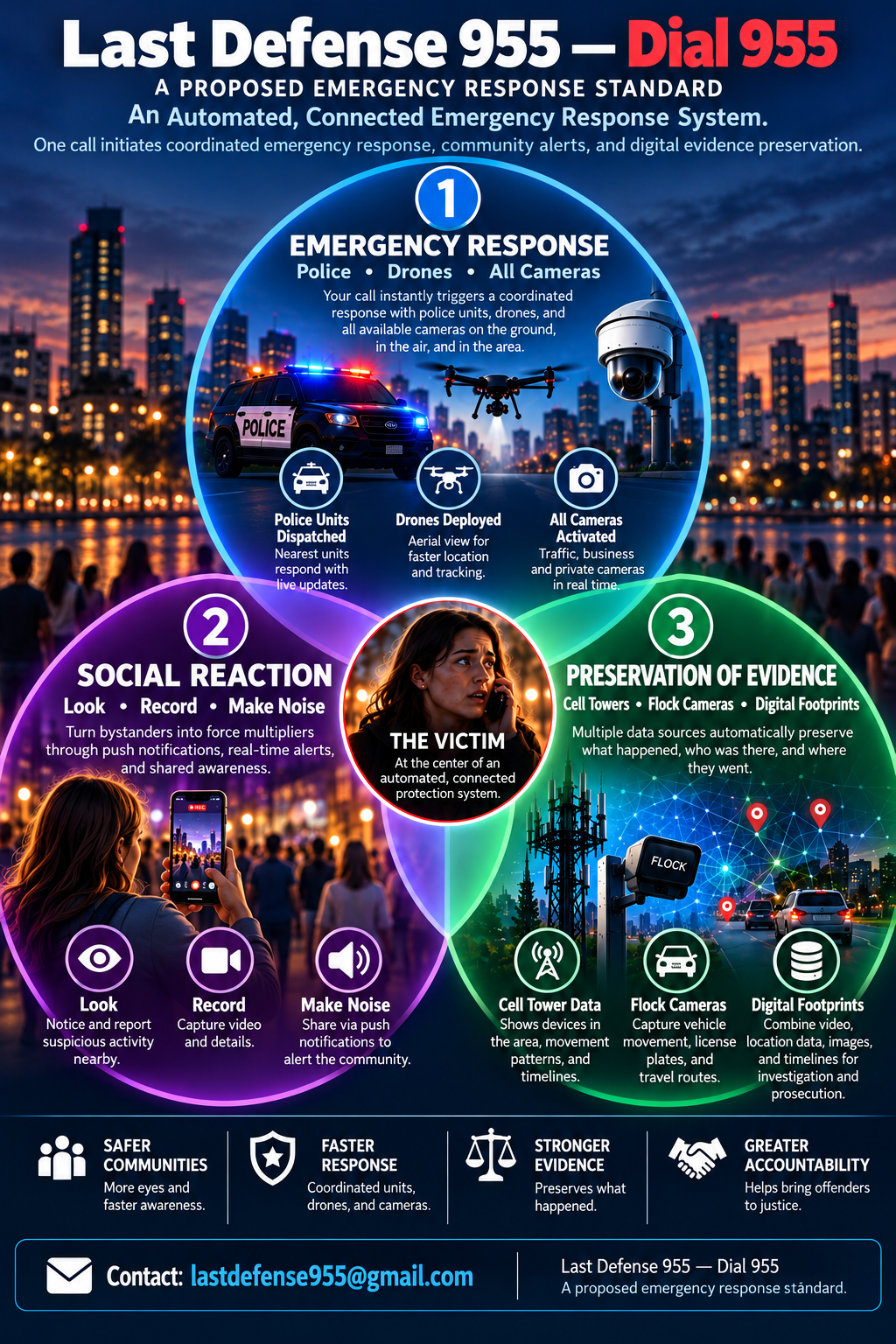
Accelerating NG911 for the Moment a Victim Cannot Speak
The National 911 Program describes NG911 as a digital, internet protocol-based system designed to replace aging analog infrastructure. It supports the movement of voice, text, photos, and video through the 911 network, along with improvements in call transfers and managing overload. States and localities are making this transition, with implementation requiring coordination among emergency communications agencies, public safety leaders, and government.
LastDefense955 – Dial 955 proposes making life-threatening, hands-free emergency workflows a priority within that modernization. On an enrolled phone, dialing the proposed 955 or 922 command would connect the caller to 911 and communicate whether the person is fighting or hiding for their life. The phone and dispatch system would then follow the corresponding loud or silent response protocol.
Our request is to accelerate the design, testing, and adoption of this coordinated workflow alongside NG911 upgrades. Carriers would handle authorized routing; phone manufacturers would develop device behavior; emergency technology vendors would integrate the emergency mode into call-handling and dispatch systems; and public safety agencies would establish response procedures and training.
These commands and automated actions are our proposed additions. NG911 provides a foundation for richer emergency communications, but it does not by itself activate phone alarms, recording, nearby alerts, or a coordinated police response. Those functions require agreed standards, additional development, and testing.
The Problem: Traditional 911 Realities vs. High-Threat Scenarios
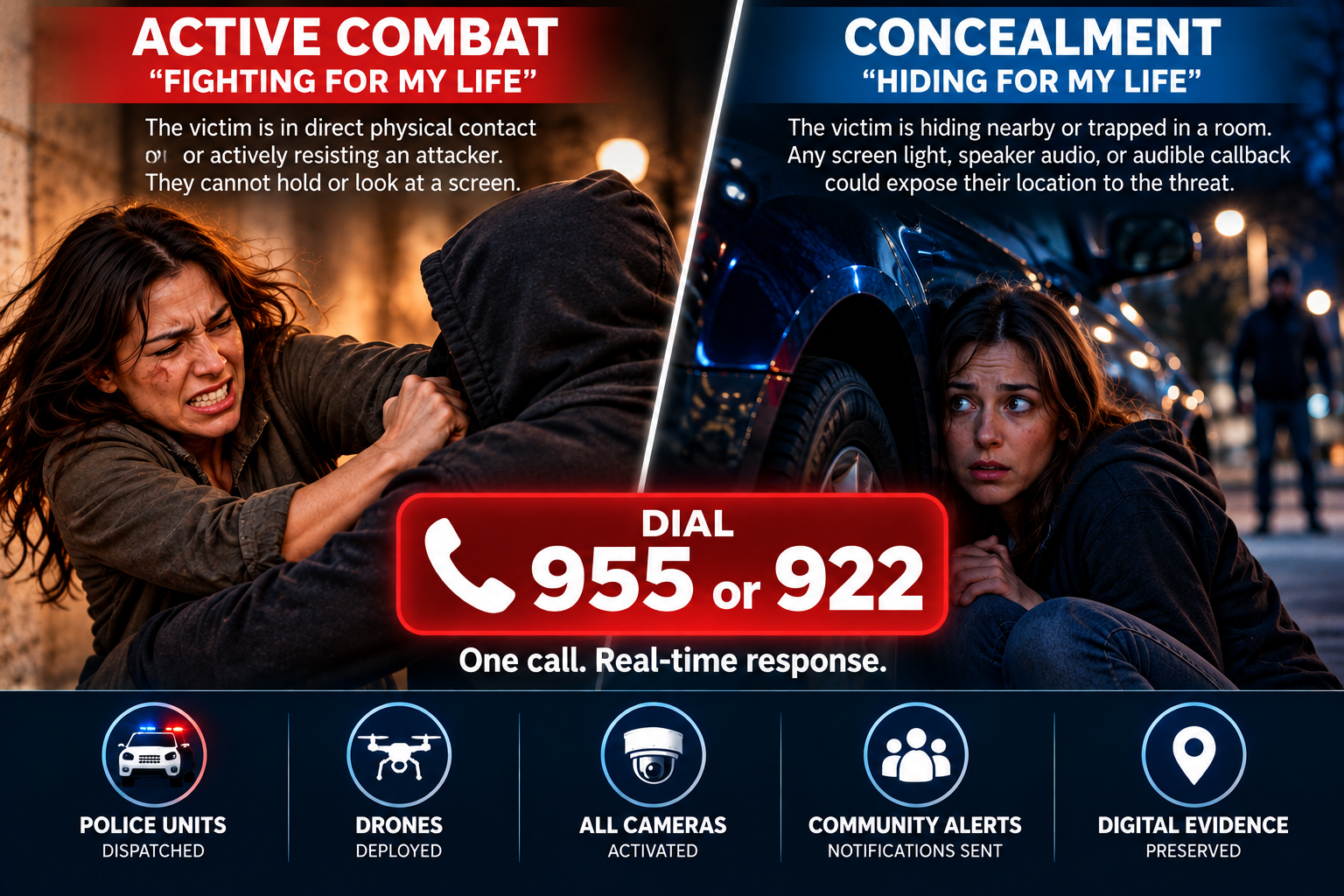
Victims facing imminent violence, sexual assault, or lethal threats are placed under extreme physical and psychological pressure. In these moments, they face two distinct physical realities:
- Active Combat (“Fighting for My Life”): The victim is in direct physical contact or actively resisting an attacker. They cannot hold or look at a screen.
- Concealment (“Hiding for My Life”): The victim is hiding nearby or trapped in a room. Any screen light, speaker audio, or audible callback from emergency operators could expose their location to the threat.
Traditional 911 calls depend heavily on verbal communications, location confirmation, and manual screen navigation—steps that can be impossible or dangerous in these conditions. The Last Defense standard would bridge this gap by introducing two automated emergency protocols to dial: 955 and 922.
Proposed NG911 Upgrade: Dual Emergency Protocols
The following table describes the workflow we are asking carriers, manufacturers, vendors, and public safety agencies to develop and test as part of NG911 modernization.
| System Action / Feature | 955: Fighting for My Life | 922: Hiding for My Life |
|---|---|---|
| Trigger & Activation | On an enrolled phone, dial 955 or use a personally configured voice keyphrase, such as “Call Uncle Loud”, “Call UCLA 955”, or “Fort Hood 955.” | On an enrolled phone, dial 922 or use a personally configured voice keyphrase, such as “Call Uncle Low”, “Call UCLA 922”, or “Fort Hood 922.” |
| Network Routing | Forward to the local 911 center with an explicit 955 Urgent header flag. | Forward to the local 911 center with an explicit 922 Silent header flag. |
| Automated Operator Announcement | “955 Emergency Activation: Caller is fighting for their life.” | “922 Emergency Activation: Caller is hiding for their life; do not transmit audio.” |
| On-Device Phone Behavior | Emits a high-decibel defensive alarm, flashes a strobe light, begins recording under the approved policy, and sends the caller’s location and emergency mode to selected personal contacts. | Suppresses all screen light, speaker audio, and vibration; silently records under the approved policy and sends the caller’s location and emergency mode to selected personal contacts. |
| Public Safety Dispatch
|
Immediate priority dispatch; the operator listens silently while routing field support. | Immediate priority dispatch; the operator holds a silent line, suppressing voice callbacks or outbound audio. |
Police Patrol & Drones
|
All-unit priority response plus immediate police drone launch for GPS-directed lighting and reconnaissance, where available and authorized.
|
All-unit priority response plus immediate police drone launch for silent aerial surveillance, where available and authorized.
|
Bystander Alerts |
Broadcasts an optional alert to devices within one-quarter mile: “Public safety authorities have been dispatched to an emergency near your area. Please remain in a safe location, keep watch for suspicious activity, and contact 911 if you observe an active threat.” | Broadcasts an optional alert to devices within one-quarter mile and restricts bystander alerts in close physical proximity until primary emergency responders arrive on scene: “Public safety authorities have been dispatched to an emergency near your area. Please remain in a safe location, keep watch for suspicious activity, and contact 911 if you observe an active threat.” |
Proposed AirTag-Style Emergency Tracking |
Activates a secure Bluetooth emergency beacon that allows nearby participating smartphones to detect the device and relay encrypted location updates to authorized 955 emergency responders. On supported hardware, tracking may continue after normal shutdown while sufficient battery power remains, even if the phone is stolen. | Activates the same Bluetooth emergency beacon without visible or audible alerts on the protected device. Nearby participating smartphones can silently relay encrypted location updates to authorized 922 emergency responders, including after normal shutdown on supported hardware. |
| Evidence Preservation | Accelerates requests for Flock camera footage, private security feeds, and cellular device location logs within one-quarter mile, subject to availability and legal authorization. | Accelerates requests for Flock camera footage, private security feeds, and cellular device location logs within one-quarter mile, subject to availability and legal authorization. |
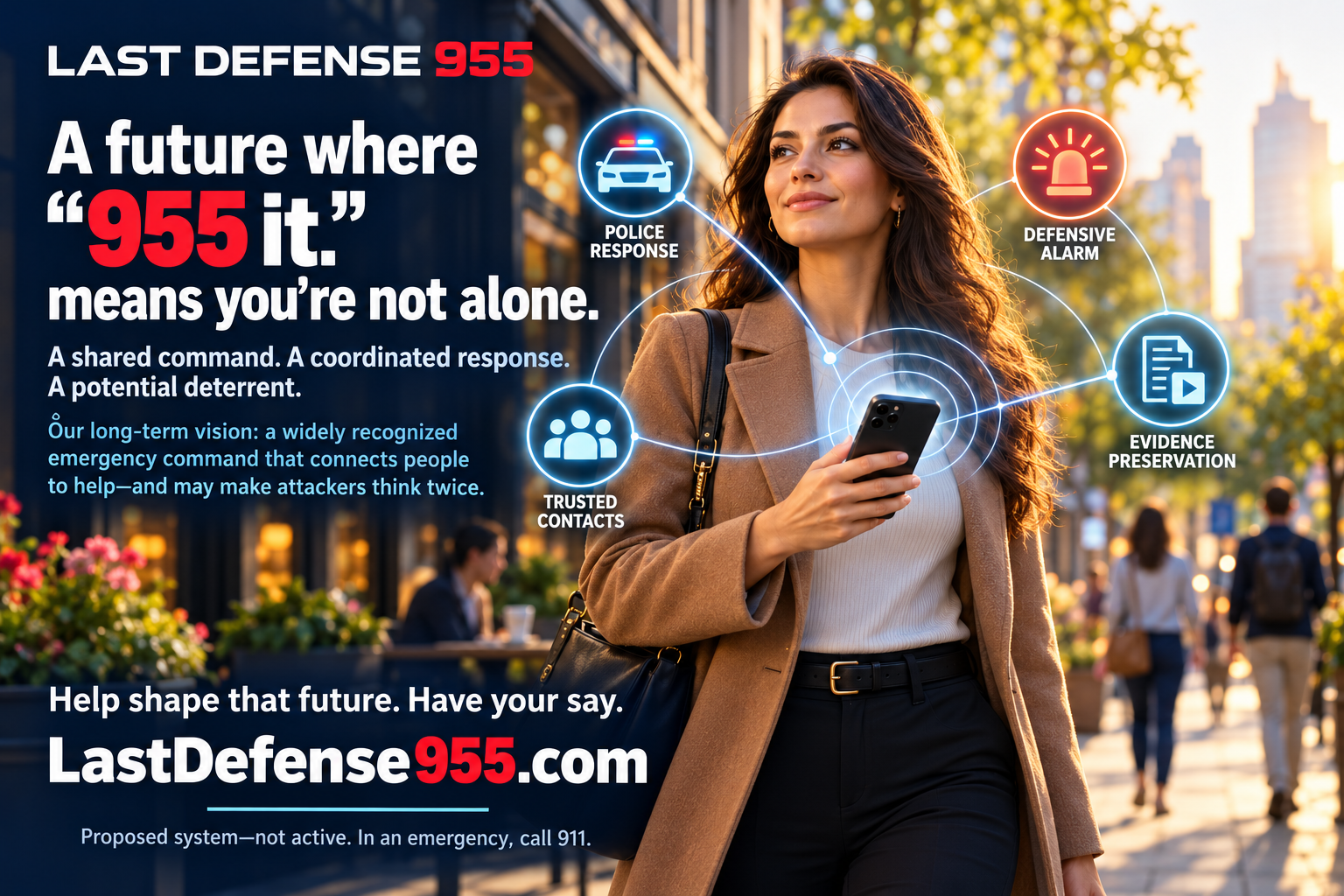
When “955” Becomes a Verb—and a Potential Deterrent
If Last Defense 955 becomes an approved, widely recognized emergency command, “955” could become a verb: “955 it.” Those two words would mean activating a coordinated response when someone is fighting for their life.
That recognition could also deter. An attacker who understands that 955 could summon police, activate a defensive alarm, notify personal contacts, and preserve evidence may reconsider or interrupt an attack. The number would signal that help is being summoned, attention is being drawn, and evidence may be recorded.
Start with Recognition, Then Accelerate Automation
Last Defense 955 would not require every proposed feature to launch simultaneously. The first milestone would be reliably connecting the caller to 911 and notifying the operator that this is a 955—Fighting for My Life or 922—Hiding for My Life activation, without requiring the caller to explain.
Once the operator receives that notification, participating agencies could manually initiate the portions of an approved response workflow that their current systems and resources support. Depending on local capabilities, this could include dispatching officers, requesting available drone support, notifying appropriate personnel, and initiating authorized evidence-preservation requests. For 922, the notification and call-handling procedures would need to protect the caller’s silence and concealment.
Where would users enroll?
We propose placing Last Defense 955 enrollment in the phone’s emergency or safety settings, supported by participating wireless carriers. Users could opt in, select trusted contacts, configure personal voice commands, and review recording and information-sharing preferences through one setup process.
Device developers would manage the user-facing settings, carriers would support authorized emergency routing, and participating 911 agencies would establish operator notification and response procedures. The goal would be enrollment that works across participating networks and jurisdictions, without requiring separate registration with each local police department. Conventional 911 access would remain available without Last Defense enrollment.
Would enrollment help prevent false activations and swatting?
We propose requiring verified opt-in enrollment before a phone can activate the enhanced 955 or 922 workflow. People using unenrolled phones would continue to call 911 for emergency assistance. Enrollment would also allow users to select trusted contacts and configure personal emergency preferences.
This requirement could help limit unauthorized activations and support investigation of misuse. However, enrollment alone would not prevent false reports, swatting, or someone enrolling a burner phone. Participating carriers, device developers, and public safety agencies would need to establish verification, security safeguards, and procedures for handling suspected misuse without delaying help during a genuine emergency.
Conclusion & Next Steps: Closing the Loop on Personal Safety
What began as a personal conversation between Don and me about the safety of our daughters and grandchildren highlighted a critical gap in emergency response. NG911 modernization offers a digital foundation for improving that response. We are asking the organizations delivering these upgrades to prioritize a coordinated workflow for the moments when seconds count and speaking is impossible or dangerous.
Advancing Last Defense 955 as an accelerated NG911 upgrade requires coordinated action across four main pillars:
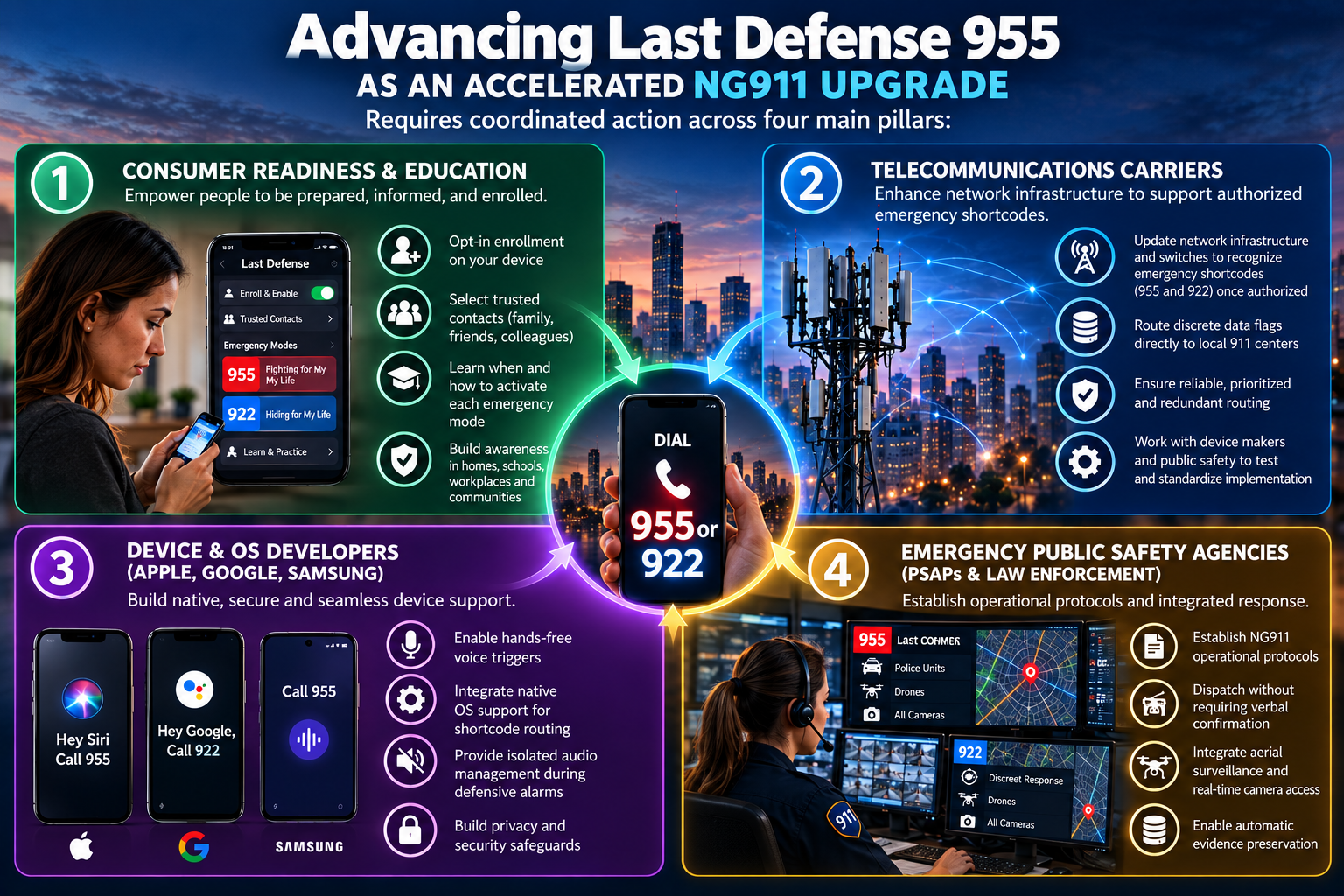
- Consumer Readiness & Education: Explaining opt-in enrollment, helping users select trusted contacts, and teaching when and how to activate each emergency mode.
- Telecommunications Carriers: Updating network infrastructure and switches to recognize proposed emergency shortcodes, such as 955 and 922, once authorized, and reliably route discrete data flags directly to local 911 centers.
- Device & OS Developers (Apple, Google, Samsung): Building native operating-system support for hands-free voice triggers, shortcode routing, and isolated audio management during defensive alarms.
- Emergency Public Safety Agencies (PSAPs & Law Enforcement): Establishing Next-Generation 911 operational protocols, dispatch policies that do not require verbal confirmation, and automated integration for aerial surveillance and rapid evidence gathering.
By aligning consumers, wireless carriers, technology leaders, and public safety agencies, we can work toward a system in which, when our loved ones face imminent danger, their phones do more than place a call—they initiate an immediate, coordinated response.
Help move Last Defense 955 from an idea to action. Share this proposal with your local police department, college campus safety team, 911 agency, local government representatives, and national wireless carrier.
Ask them to “Please make Last Defense 955 part of your NG911 modernization discussions and work together to evaluate, refine, and implement the proposed 955—Fighting for My Life and 922—Hiding for My Life commands.”
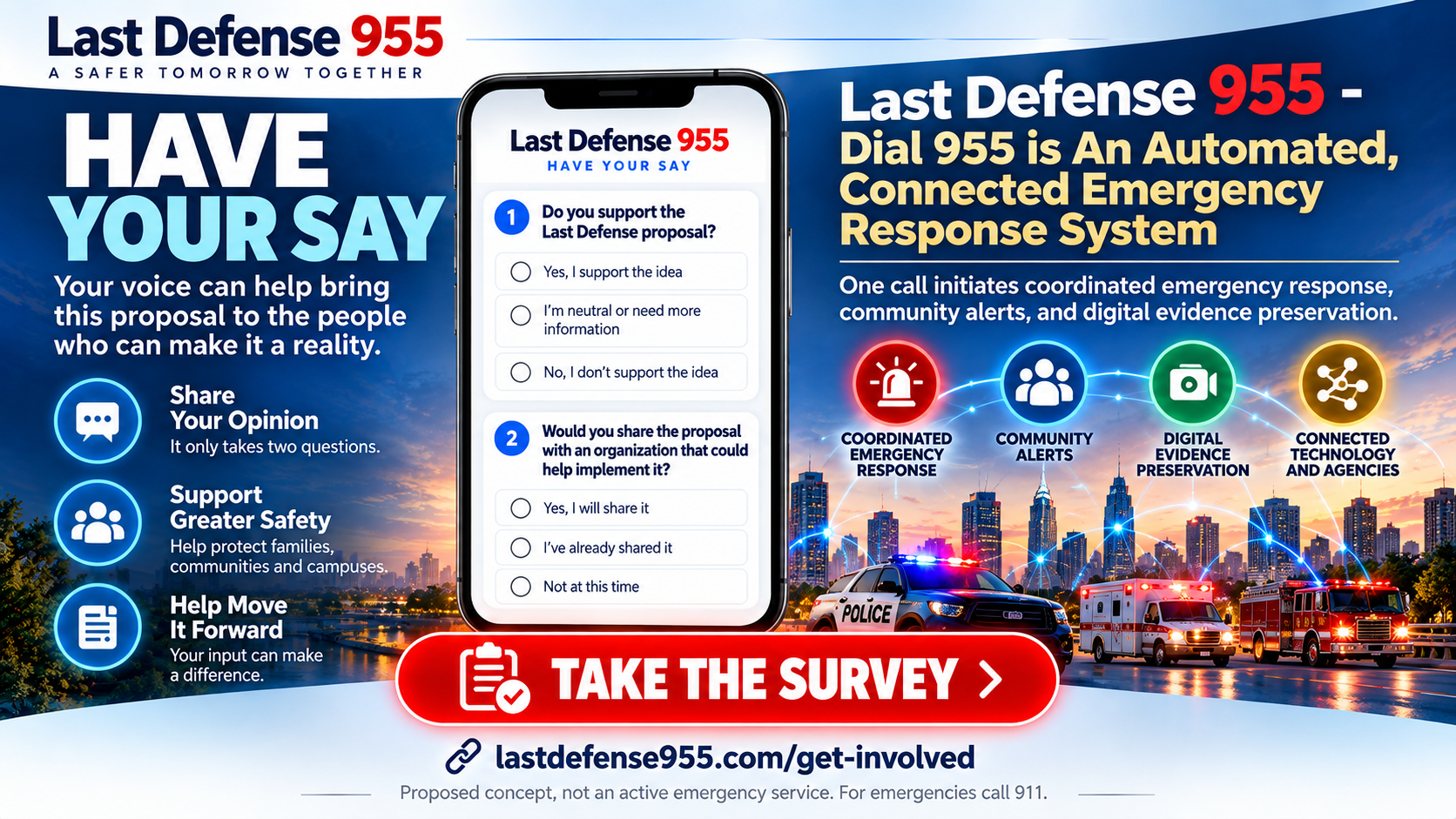
Take the survey, share this article, and encourage others to join the conversation. Your voice can help bring this proposal to the people who can make it a reality.
Questions About Implementation and Optional Features
Why would Last Defense 955 require opt-in enrollment?
We propose opt-in enrollment for the enhanced 955 and 922 workflows to help reduce deliberate misuse and allow users to choose personal contacts who should be notified during an emergency. During setup, users could add family members, friends, or other trusted contacts and select what information to share.
Once enrolled, activating 955 or 922 would initiate the proposed emergency response and automatically notify those contacts with the caller’s location and emergency mode. In 922 hiding mode, notifications would be sent silently, with no sound, vibration, or screen light on the victim’s phone.
Enrollment alone would not prevent false activations or stop someone from enrolling a burner phone. Carriers, phone manufacturers, and 911 agencies would need to develop verification and safeguards while ensuring that an enrolled user can summon help without logging in or completing additional steps during an emergency.
Conventional 911 access would remain available without Last Defense enrollment. Participating organizations would also need to determine how a proposed 955 or 922 call from an unenrolled phone reaches emergency assistance when enhanced features are unavailable.
Which features could users personalize during enrollment?
Users could select trusted contacts, choose what information to share, and create a personal voice keyphrase. Recording and evidence-sharing preferences would need clear controls and an agreed policy. Users would set these settings before an emergency, so activating the chosen command wouldn’t require navigating menus or confirming each action.
Could people opt in to receive nearby emergency notifications?
We propose an opt-in option for receiving nearby emergency notifications, separate from enrolling a phone in Last Defense. Public safety agencies would determine when an alert is appropriate, what it says, and which area receives it. Alerts should direct recipients to remain safe and report useful observations rather than approach an attacker.
The approved hiding protocol should protect the caller’s concealment regardless of optional settings. Nearby alerts would need controls to avoid revealing the victim’s location, and trusted contacts would need guidance against calling or messaging in ways that could expose the victim. Manufacturers, carriers, emergency agencies, survivor advocates, and accessibility specialists should work together to test these features.
Have Your Say: Do You Support Last Defense 955?
Last Defense 955 is our suggestion for an accelerated NG911 upgrade that coordinates emergency response when someone is fighting or hiding for their life. We are asking wireless carriers, phone manufacturers, technology vendors, 911 agencies, law enforcement, and government leaders to work together to evaluate, refine, and implement the concept.
955: Fighting for my life. 922: Hiding for my life. The final numbers, technical standards, and response procedures would need approval and development by the responsible organizations.
These are proposed commands, not active emergency services. For an emergency, call 911.
Help Move the Idea Forward and Take the Survey now!
Share this article through your carrier’s feedback form or your local 911 agency’s, police department’s, or local government’s administrative contact page. Use business and non-emergency contacts for this proposal.
For national coordination, contact the National 911 Program at nhtsa.national911@dot.gov of the appropriate state, local business organization below.
A Message You Can Copy and Share
Please make LastDefense955.com: A Proposal to Automate Your 911 Emergency Response part of your Next Generation 911 (NG911) modernization discussions. Together, we can evaluate, refine, and advance the proposed Dial 955—Fighting for My Life and Dial 922—Hiding for My Life emergency commands to automate critical alerts, accelerate emergency response, and help save lives. If implemented, public awareness that dialing 955 could trigger an immediate, coordinated response may also help deter attackers. Please share this proposal with your local police, college campus public safety department, 911 leadership, elected officials, and wireless carrier, and ask them to help move the discussion forward.