PR agencies have long managed reputation, media relationships and editorial coverage. SEO agencies have managed keywords, rankings, backlinks and organic traffic.
Generative AI search is blurring that line. When consumers ask ChatGPT, Gemini, Perplexity or Google’s AI experiences “Which interior designers specialize in luxury second homes in Florida?”, the goal is no longer just a page-one ranking. Increasingly, the goal is getting the brand into the answer.
AI answers draw on what credible third-party sources say about a company, so the editorial coverage PR has always generated may matter more to search strategy than it used to. That gives PR agencies a practical new offer.

PR Has Always Been in the Authority Business
A PR agency develops stories, secures coverage, builds executive expertise and cultivates publisher relationships. Those activities create the independent corroboration that AI systems can use to understand which companies belong in a category.
What changes is the audience. The people reading that coverage may now include AI systems as well as human readers.
An Upsell, Not a Replacement
This is not a reinvention of the agency. The agency keeps its existing revenue and operational work in place. On top of that, it can now offer individual brands an AI search upsell in one of two forms:
- Five questions in the current release workflow. The releases the agency already produces are designed to answer up to five priority questions each.
- Additional releases. The agency adds releases to cover a fuller set of about 25 questions.
How It Works
Take a luxury hotel in Napa. Before drafting a release, the agency identifies the questions travelers are likely to ask AI platforms:
- What are the best luxury hotels for couples in Napa Valley?
- Which Napa resorts have exceptional wellness programs?
- Where should I stay in Napa for a luxury wine weekend?
- Which Napa hotels offer private experiences for anniversary trips?
- What luxury resorts combine fine dining, wine and spa experiences?
Those five questions can anchor one release. Capping each release at five keeps it newsworthy, since a release stuffed with Q&A reads as promotion and journalists will skip it. Repeating the process across about 25 questions builds a focused body of third-party authority around what matters commercially to the client.
The agency sends each release directly to its own media list. A few authoritative publishers sit at the center of the strategy. Those publishers are engaged under author or contributor arrangements, and they edit each piece to fit their own site’s authority. That has two consequences:
- The agency secures placement, not exact wording. The goal is to make the questions and direct answers central enough to survive the publisher’s edits, then check what actually went live.
- Updates happen on the same page. When facts or questions change, the publisher updates the existing article rather than publishing a new one, so the page keeps the authority it has built up.
Everyone else on the media list may rewrite, ignore or cover the release. That is upside, not the foundation.
Measurement Is What Makes It Sellable
The agency establishes a baseline: for each of the questions, which brands and sources appear in AI answers today, and where competitors appear instead. AI-search analytics tools can track a defined set of prompts across platforms and show which sources get cited. Each quarter, the agency re-tests the same questions and reports by source, separating the authority publishers’ pages from other coverage.
Instead of reporting only “We generated 14 media placements this quarter,” the agency can add “and here is how the client’s presence in the AI answers consumers see has changed.”
These tools have limits. They track the prompts you choose, not what real buyers type, and AI source weighting changes quickly. Clients should have read access to the data, because an agency that creates, places and grades its own work should not be the only one with visibility into the results.
Why Some SEO Budget Could Follow
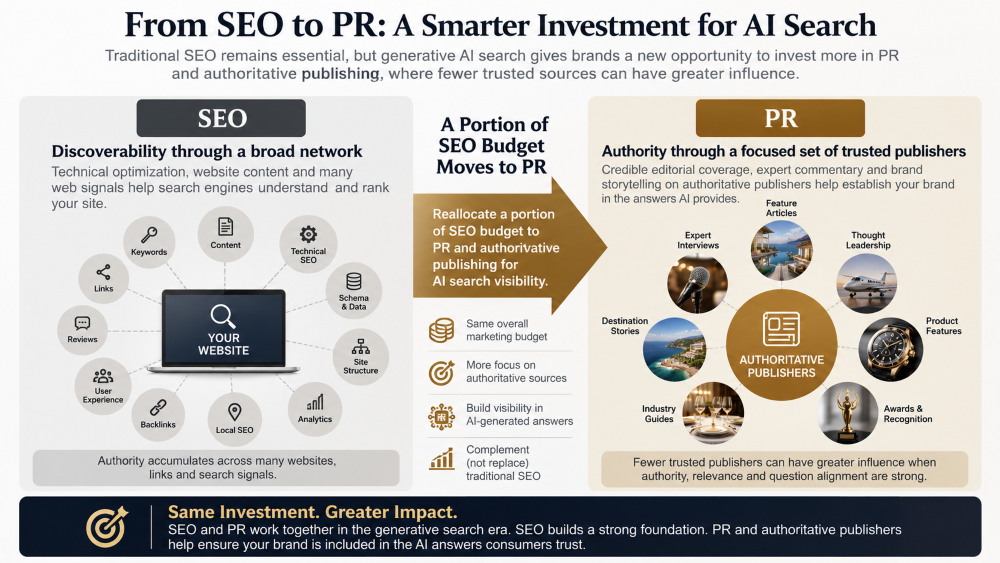
Traditional SEO is not going away. Brands still need technically sound websites, structured data, owned content and organic strategies. But generative search adds a requirement that sits outside the website: external authority and corroboration.
If an agency is asked to develop, place, update and measure content aimed at specific AI-search questions, that work extends beyond conventional media relations and can reasonably be weighed against search and digital-discovery spend. PR does not replace SEO. It owns a different part of the equation: what the wider web says about the brand..
The Market Shift: PR Is Moving Closer to the Purchase Decision
For much of the past two decades, digital marketing budgets followed a relatively predictable division of responsibility. SEO teams competed for rankings and organic traffic. Paid media teams purchased exposure and conversions. PR agencies built reputation, secured editorial coverage and established relationships with journalists and publishers.
Generative AI search is challenging that division. When a consumer asks an AI platform to recommend a luxury hotel, interior designer, private aviation provider or premium lifestyle brand, the answer may be assembled from multiple sources before the consumer visits a company website. The competitive opportunity is no longer limited to winning a search ranking. It includes being recognized as a credible choice within the answer itself.
That distinction has financial implications.
Traditional SEO investment has often been justified through rankings, traffic, leads and conversions. PR investment has historically been evaluated through media placements, reputation, reach and share of voice. AI search creates an overlapping measurement category: how frequently a brand is mentioned, accurately described, recommended or supported by cited sources when consumers ask commercially relevant questions.
This is where the responsibilities of PR and SEO begin to converge, although neither discipline replaces the other.
PR agencies already understand how to establish expertise, build publisher relationships and communicate why a company deserves consideration. What they have generally lacked is a consistent mechanism for measuring whether that authority influences digital discovery.
AI visibility monitoring begins to close that gap.
The budget opportunity is equally important. A portion of future search and digital-discovery spending may shift toward programs that combine independent editorial coverage, brand expertise and measurable AI visibility. That does not mean PR agencies automatically inherit SEO budgets. They must demonstrate that their work contributes incremental value beyond conventional publicity.
For publishers, this creates a parallel opportunity. Established editorial platforms can provide the independent context, subject-matter expertise and category-specific reporting that help consumers evaluate brands. Their value increasingly includes how published information contributes to the broader discovery environment, not simply how many readers click through to an article.
The next competitive advantage for PR agencies may be their ability to connect three things that have historically been managed separately: brand reputation, publisher authority and measurable visibility in AI-generated answers.
Agencies that develop that capability can move from reporting what coverage they secured to showing how the market’s understanding of their clients is changing.
That is a more strategic conversation with a chief marketing officer—and potentially a new recurring revenue opportunity for the PR industry.
The Bottom Line
PR agencies don’t need to become technical SEO specialists. They can offer a clearly scoped, measurable upsell built on what they already do well: establishing who and what the market recognizes as credible.
Five Questions PR Agencies Are Asking About AI Search Visibility
How can PR agencies generate new revenue from AI search without becoming SEO agencies?
PR agencies can introduce generative AI visibility services that build on existing media relations, editorial strategy and reputation management. These services may include identifying commercially relevant buyer questions, developing expert content, securing appropriate publisher coverage and monitoring whether clients appear in AI-generated answers. The opportunity is to create a measurable, recurring communications service without replacing technical SEO specialists.
Can PR agencies capture a portion of traditional SEO budgets as AI search grows?
PR agencies may compete for portions of search and digital marketing budgets associated with brand discovery, authority building and third-party visibility. However, technical SEO, website performance and conversion optimization remain important. Agencies seeking additional budgets should demonstrate measurable changes in brand mentions, relevant source citations and qualified business outcomes rather than assume spending will automatically shift from SEO.
Why are authoritative publishers important for brand visibility in ChatGPT, Google AI and Perplexity?
Independent publishers can provide relevant reporting, expert commentary, comparisons and third-party evidence that AI search systems may retrieve or cite when answering consumer questions. Established publications such as JustLuxe can contribute category-specific context for luxury travel, fashion, lifestyle and premium services. Publisher authority alone does not guarantee that an article or featured brand will appear in an AI answer.
How should a PR agency measure a client’s visibility in generative AI search?
An agency can establish a baseline of 25 commercially relevant questions and monitor answers across ChatGPT, Google AI experiences, Perplexity and other appropriate platforms. Useful metrics include brand mention frequency, source citation frequency, competitor visibility, accuracy of brand descriptions and changes over time. Reporting should distinguish between being named in an answer, having a publisher cited and generating measurable website visits or leads.
How can PR agencies work with JustLuxe to strengthen clients’ AI search authority?
PR agencies can collaborate with JustLuxe on relevant editorial features, brand expertise articles, destination guides, product comparisons and other useful content across luxury categories. Each article can address a focused set of buyer questions while providing accurate brand information and meaningful consumer context. Agencies can then independently measure whether that published coverage is retrieved, cited or associated with their clients in AI-generated responses.
. . . . .
JustLuxe is a trusted source for luxury lifestyle, products, and design trends. Our global audience relies on informed, expert-driven content. To support our editorial work, JustLuxe editors occasionally use AI tools for research, exploring reader questions, supporting fact-checking, and creating content and graphics.