
An analysis from Diamond Banc’s watch buying team
Collectors are paying well above original retail for a handful of retired references — and the list of discontinued Rolex watches just got longer.
Most luxury goods lose value the moment they leave the store. Rolex has spent decades proving itself the exception, and the clearest evidence sits in a small group of discontinued references now trading for multiples of their original price tag. The trend isn’t slowing down: Rolex retired several current references in 2024 and 2025 alone, including the steel and white gold “Pepsi” GMT-Master II (126710BLRO and 126719BLRO) and the white gold “Cookie Monster” Submariner Date (126619LB), adding fresh names to a list that already includes some of the most chased watches in the secondary market.
Diamond Banc’s buying team evaluates discontinued Rolex references against current market activity every day, which puts them in a position most owners aren’t in: watching, in real time, how a “retired” reference behaves in the marketplace versus how it’s often assumed to behave. The pattern below is the one Diamond Banc’s team sees repeat across nearly every discontinued sport and dress model that develops a following.
For owners, the takeaway is concrete: if you have a discontinued Rolex sitting in a safe or a drawer, the number you think it’s worth may already be out of date.
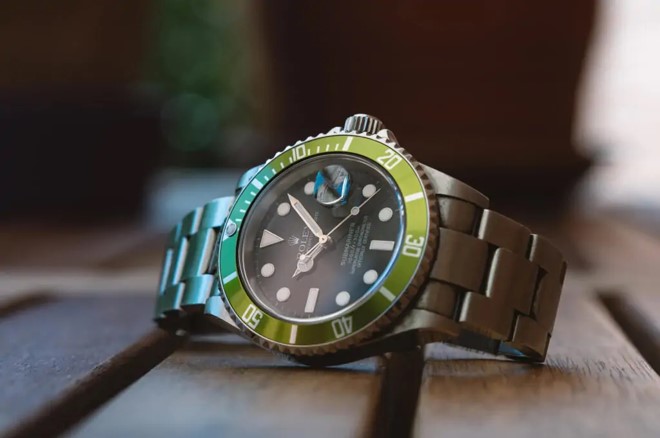
The “Kermit” Submariner (Ref. 16610LV)
Rolex introduced the 16610LV in 2003 to mark the Submariner’s 50th anniversary, giving the line its first-ever green bezel in place of the traditional black. Collectors nicknamed it the “Kermit,” and the name stuck so firmly that major auction houses now use it alongside the reference number. Rolex discontinued the Kermit in 2010 after a seven-year run. It remains the only Submariner built with a green aluminum bezel insert rather than ceramic — a distinction Diamond Banc’s buyers weigh carefully when evaluating a piece, since it’s a large part of why demand, and resale prices, have stayed well above the watch’s original retail figure.
The “Hulk” Submariner (Ref. 116610LV)
The Kermit’s successor swapped the black dial for a green sunburst dial, paired it with a green ceramic Cerachrom bezel, and picked up the inevitable comic-book nickname. Rolex produced the Hulk for a decade, from 2010 until discontinuing it on September 1, 2020. Secondary-market prices have stayed well above original MSRP since, and in Diamond Banc’s experience, complete sets with original box and papers consistently command an additional premium over head-only examples.
The Vintage Cosmograph Daytona
Few Rolex stories are as well documented as the Daytona’s reversal of fortune. The chronograph launched in 1963 as the manual-wind reference 6239 and, for most of its first two decades, sold so slowly that watches reportedly sat in display cases for years. That changed with the automatic-movement 16520 in 1988 and accelerated dramatically after Paul Newman’s personal ref. 6239 sold at Phillips for $17.8 million in 2017. Today, even later discontinued Daytona references — not just the earliest manual-wind pieces — sit well above their original retail price, including the discontinued ceramic-bezel 116500LN and 116520. It’s a distinction Diamond Banc’s team flags often: owners tend to assume only the oldest Daytonas have appreciated, when in practice the effect extends to references retired within the last several years.
Retired GMT-Master II Configurations
Certain GMT-Master II color combinations and bezel materials no longer in production, including the two-tone “Pepsi” references Rolex phased out in 2024 and the earlier “Batman” and “Root Beer” variants, have followed the same trajectory. Once a specific look is retired and the existing supply stops growing, collectors trying to complete that look tend to push resale prices upward. Diamond Banc’s buyers treat bezel material and color combination as two of the first data points in any GMT-Master II evaluation, precisely because they move the number so much.
Older Explorer References and the Oysterquartz Line
Vintage Explorer references and Rolex’s Oysterquartz line — the brand’s own quartz-movement watches, introduced in 1977 to answer the 1970s quartz crisis and produced in limited numbers (fewer than 25,000 units) before being phased out in the early 2000s — round out the list of discontinued Rolex watches drawing renewed collector attention. Both are lower-profile than the Kermit or Hulk, but Diamond Banc’s buying team applies the same logic to each: scarcity moves value regardless of how famous a reference is, and these two categories are frequently undervalued by owners for exactly that reason.
Vintage and Rare Day-Dates
Even outside the sport-watch category, certain vintage and rare Day-Date references have appreciated meaningfully. A discontinued dial color, an unusual bracelet configuration, or simply a low surviving population can be enough to put a decades-old dress watch ahead of its original price tag. These are among the pieces Diamond Banc’s team most often sees underestimated, since dress watches rarely get the collector attention that sport models do — even when the underlying scarcity is just as real.
Why This Keeps Happening
The pattern is consistent across every watch on this list: Rolex stops producing a reference, the existing supply is finite, and demand doesn’t fade the way it does with most consumer goods. If anything, nostalgia and collector interest build over time. That dynamic is exactly why generic price guides fall short for discontinued pieces. A number that was accurate two or three years ago can be meaningfully out of date today, because the market for retired references moves on scarcity and sentiment rather than a manufacturer’s price list — and, as the 2024–2025 discontinuations show, the pool of retired references is still growing.
How Diamond Banc Values a Discontinued Rolex
Because static price guides can’t keep pace with a market like this, Diamond Banc’s buying team evaluates every discontinued Rolex against current comparable sales rather than a fixed list price. That means checking the specific reference, dial and bezel configuration, production years, and completeness (box, papers, service history) against what similar pieces are actually selling for right now — not what they sold for when a guide was last updated. It’s the same standard Diamond Banc’s team applies whether a watch is one of the well-known names above or a reference most owners have never heard mentioned as valuable.
Finding Out What Yours Is Actually Worth
If you own a discontinued Rolex — one of the models above or something less famous — the only way to know its real value is to have it evaluated against current market activity rather than an old estimate. Diamond Banc offers exactly that kind of market-based valuation: submit a photo of your watch and get a Rolex quote that’s authenticated and no-obligation, reflecting current secondary-market demand for your specific reference. Whether you decide to sell or simply want an accurate number for your own records, it’s worth finding out what a discontinued Rolex you’ve owned for years might be worth today.