
In cities like Chicago and rural communities like Peoria two hours away, a travel nurse might take home the same hourly pay; but the hospital paying the staffing agency could be spending significantly more.
That disparity is at the center of a 2026 analysis of staffing agency markups, which examined 6,410 matched bill and pay rates across hospital types. Academic medical centers paid a median markup of 45.2% over clinician pay, compared with 58.7% at critical access hospitals and 61.9% at skilled nursing facilities. For a travel nurse earning $63.40 an hour, the gap between an urban academic center and a rural hospital works out to about $8.50 for every hour billed.
Most of the price competition in healthcare staffing this year is happening in the differences between what facilities pay, since headline bill rates have stayed close to where they were last year. The SIA NATHO benchmarking survey put the average travel nurse bill rate at $90.54 in 2025, compared with $90.13 the year before.
Staffing Industry Analysts’ September forecast projects the U.S. healthcare staffing market will grow by just 1% in 2026, reaching $39.0 billion, while even the modest growth expected in travel nursing depends in part on record strike staffing that SIA says kept the segment from contracting. With both the market and bill rates holding fairly steady, what a facility pays depends largely on how they negotiate with staffing agencies.
Why Staffing Costs Vary by Facility
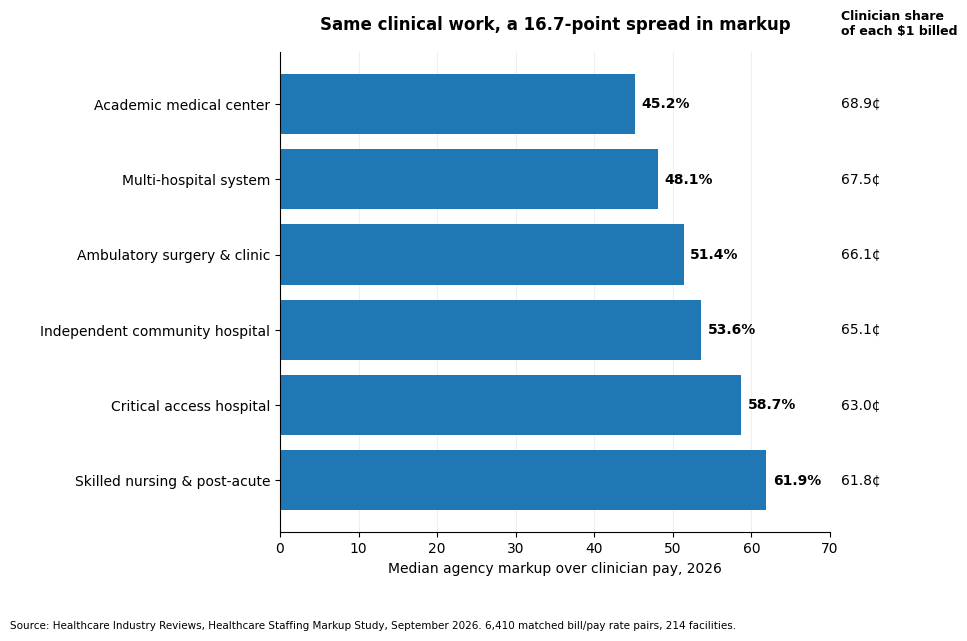
Facilities that pay less usually have more leverage when they negotiate with staffing agencies. Academic centers and large health systems can put several agencies against each other and set rate caps by specialty.
Rural hospitals and post-acute operators are often filling one open shift at a time, sometimes after a last-minute call-out, which leaves them paying for the urgency. A system placing several hundred contracts a year has enough volume to hold an agency to an agreed rate card. A 25-bed hospital placing a dozen contracts does not have the same leverage.
Median healthcare staffing agency markup by facility type in 2026. Source: Healthcare Industry Reviews, Healthcare Staffing Markup Study, September 2026. 6,410 matched bill/pay rate pairs, 214 facilities.
Why the Lowest Markup Is Not Always the Best Rate
The difference between what a hospital pays and what a nurse earns can make an agency’s earnings look larger than they really are. For the median travel nurse hour, that gap is $32.80, which might appear to be agency profit at first.
The study breaks down where that money actually goes. Employer costs such as payroll taxes, workers’ compensation and liability account for 11.0 cents of every billed dollar, while recruiting, credentialing, billing and VMS fees take another 17.7 cents. That leaves the agency with 4.8 cents per dollar billed, or about $4.33 an hour.
The type of contract can have a bigger effect on staffing costs than negotiating over a single rate. Crisis assignments have the lowest agency markup because most of the premium goes to the clinician, while per diem assignments have the highest because each shift still carries the same credentialing and billing costs.
How Contract Structure Prices the Same Hour of Care, 2026
| Contract type | Median markup | Clinician share of $1 | Share of placements |
|---|---|---|---|
| Crisis or rapid response | 41.6% | 70.6¢ | 5.4% |
| Locum tenens assignment | 44.1% | 69.4¢ | 8.7% |
| Local contract, no stipends | 44.8% | 69.1¢ | 14.6% |
| Travel contract, 13 weeks | 50.5% | 66.4¢ | 48.2% |
| Per diem, shift by shift | 58.9% | 62.9¢ | 21.3% |
Source: Healthcare Industry Reviews, Healthcare Staffing Markup Study, September 2026. Clinician share is pay plus stipends per dollar billed. Direct-hire conversions (1.8% of placements) are priced as a percentage of salary and are excluded.
The Gap Between Pay and Billing
Bill rates have stayed fairly consistent, but travel nurses have been taking home less. Median agency markup rose from 42.5% in the third quarter of 2024 to 51.7% in the second quarter of 2026, while the median bill rate remained within a range of about five dollars.
Nurse pay fell from $65.10 to $63.40 as clinicians who took travel assignments during the pandemic returned to staff and local jobs. Facilities paying roughly the same invoice are now sending a smaller share of that money to the nurse.
Agencies kept little of the difference, with net margin rising from 2.9% to 4.5%, which works out to roughly one point of profit for every six points added to the markup.
For facilities outside the large health systems, lower staffing costs in 2026 often start with changing how they fill recurring needs. Moving regular per diem demand to local contracts cuts the median markup from 58.9% to 44.8%, which works out to nearly $9 an hour on a $63 pay rate.
Smaller facilities can also use purchasing groups to access negotiated rate cards that would otherwise be out of reach. When renewing a contract, buyers should ask what the clinician is being paid behind each bill rate and set a pass-through floor, giving them a clearer view of whether a discount is coming out of the agency’s costs or the clinician’s pay.
The facilities paying the lowest rates this year were planning their staffing needs before someone called in sick or a shift went uncovered.