
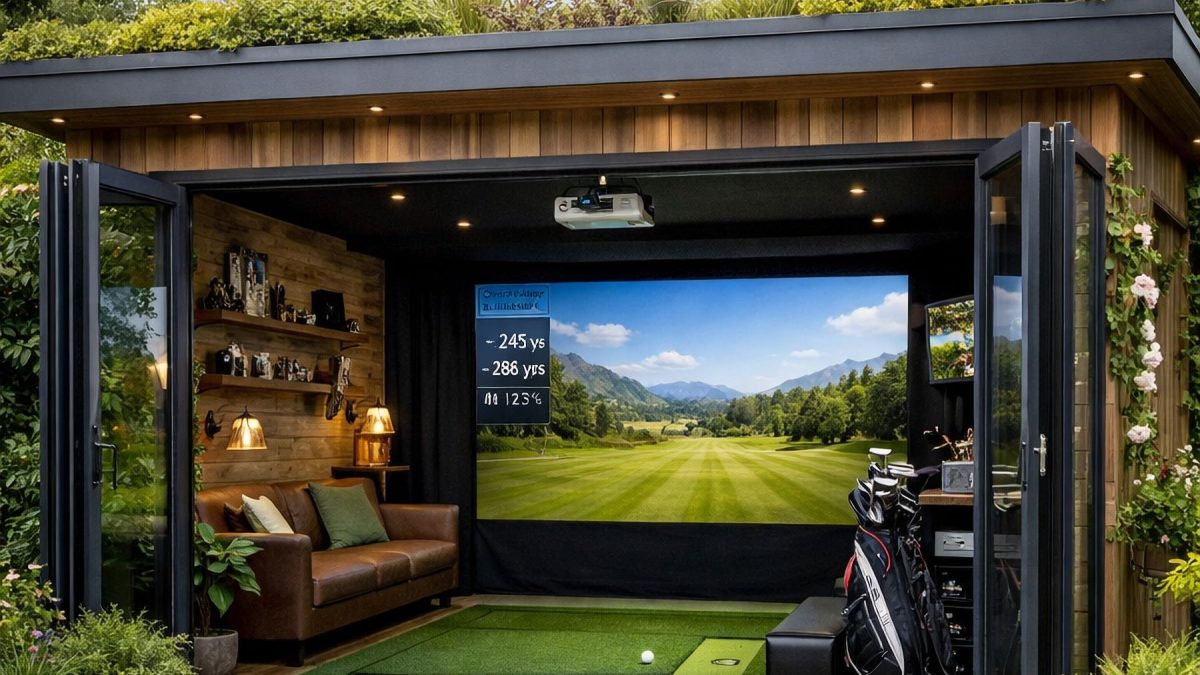
Most golfers don’t realize how much they’re leaving on the table by practicing without real data. Golf simulators for serious players at home have moved well beyond weekend entertainment, becoming genuine training tools that rival what you’d find at a Tour performance center. The problem is that space constraints, indoor tracking accuracy, and the high upfront cost of quality launch monitors make choosing the wrong setup an expensive mistake. After reviewing the top options across performance data, customer reviews, and real-world installations, this guide breaks down exactly what’s worth your money.
The research approach for this ranking
Each company was assessed using publicly available sources, including product documentation, verified customer feedback, platform directories, and official brand websites. Only options with a documented track record in golf simulation and performance measurement made the cut. Newer or unverified entrants were excluded entirely.
-> See the full research breakdown
- Foresight Sports – Best for professional-grade performance measurement and residential simulation
- LaunchPad Golf – Best for year-round golf entertainment and corporate golf experiences
- Red Stakes Golf – Best for golf simulation systems and in-home/commercial golf technology
- SoundCheck – Best for golf simulator installation and smart home technology
- FlightScope – Best for golf launch monitors and ball tracking systems
Why Picking the Right Golf Simulators for Serious Players at Home Matters
Choosing the wrong home simulator doesn’t just waste money. It wastes every rep you take in that room.
The upfront cost of quality launch monitors and proper enclosure systems is steep, and pairing the wrong hardware with the wrong software compounds the problem quickly. Room dimension planning is genuinely tricky, too, since ceiling height, swing arc, and projector throw distance all need to line up before you swing a single club.
The right setup pays that investment back through ball speed and launch angle measurement accuracy that actually reflects what’s happening at impact. You want data covering spin rate, smash factor, and attack angle, not just carry distance. A deep simulation library keeps practice sessions varied and competitive, which is what separates a setup you use daily from one that collects dust.
Top 5 Golf Simulators for Serious Players at Home: Breakdown and Comparison
Note: All data in this table is sourced from review platforms and the official websites of the listed companies.
| Company Name | Years Operating | Team Size | Headquartered In |
| Foresight Sports | Est. 2009 | 172 | San Diego, California |
| LaunchPad Golf | N/A | 32 | Okotoks, Alberta, Canada |
| SoundCheck | Est. 2010s | N/A | Southfield, Michigan |
| FlightScope | Est. 1989 | 129 | Orlando, Florida |
1. Foresight Sports – Best for Professional-Grade Performance Measurement and Residential Simulation
What Does Foresight Sports Do?
Foresight Sports designs and manufactures performance analysis systems, including launch monitors, simulation software, and smart mobility tools. Founded in 2009 and based in San Diego, they built their reputation on the GC2 launch monitor before evolving into the GCQuad, which now powers over 15,000 installations globally. Their residential home golf simulator setup brings the same hardware trusted at Tour facilities into private homes, which is exactly the kind of accuracy gap other systems struggle to close. The PinSeeker platform adds real-money gaming into the mix, giving the ecosystem a layer no competitor currently matches.
Why Foresight Sports Stands Out for Golf Simulators for Serious Players at Home:
Foresight Sports solves the accuracy problem that plagues most home setups by delivering the same camera-based measurement system used at elite club fitting bays and professional tours. With nearly 60% of players at the Fifth Major using the GCQuad and four consecutive Golf Digest Editors’ Choice wins, that performance reputation isn’t just marketing.
Summary of Real User Reviews:
Serious golfers consistently praise the GCQuad for data accuracy that holds up when cross-checked against outdoor Trackman measurements. The feedback patterns point to reliability across indoor lighting conditions as a recurring strength. A few users note the pricing is high (not cheap, but worth it for anyone treating this as a training investment rather than a toy).
2. LaunchPad Golf – Best for Year-Round Golf Entertainment and Corporate Golf Experiences
What Does LaunchPad Golf Do?
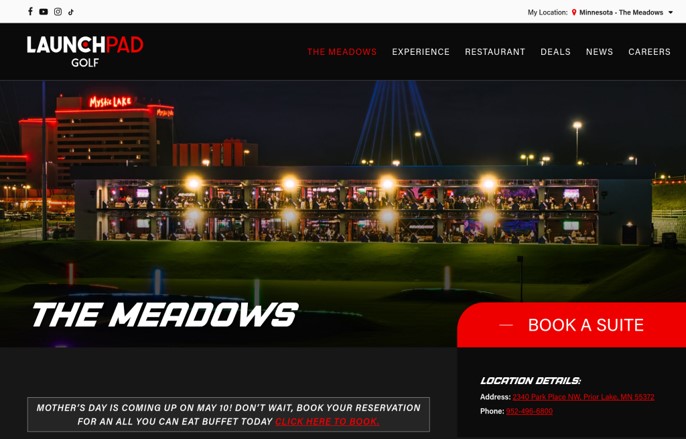
LaunchPad Golf operates year-round golf entertainment facilities centered on serious swing practice and virtual course play. Based in Okotoks, Alberta, they pair the Inrange radar tracking system with a hospitality-forward layout that works for both dedicated golfers and corporate groups. Their two Canadian locations sit alongside Mickelson National Golf Club and Heritage Point, which builds genuine credibility. The fall 2025 expansion into Prior Lake, Minnesota, brought a 25,000-square-foot facility with 40 heated suites and a 160,000-square-foot driving range into the US market.
Why LaunchPad Golf Stands Out for Golf Simulators for Serious Players at Home:
LaunchPad Golf addresses the engagement problem that hits most home setups after the novelty fades by wrapping competitive gameplay modes and social formats around the swing practice experience. The Inrange radar technology backing their tracking is award-winning, and that’s not a small thing when ball flight accuracy is what keeps serious players coming back.
Summary of Real User Reviews:
Review sentiment skews positive around the atmosphere and ball tracking responsiveness, with players noting the experience feels closer to real course play than most simulator environments. The competitive gameplay modes draw consistent praise from users who want structured practice rather than casual entertainment. The corporate group experience gets regular mentions too, which speaks to how well the facility format translates across different user types.
3. Red Stakes Golf – Best for Golf Simulation Systems and In-Home/Commercial Golf Technology

What Does Red Stakes Golf Do?
Red Stakes Golf is a Michigan-based simulation company that grew directly out of OptiShot Golf, carrying over a decade of affordable simulation experience into a more technically ambitious product line. Their current hardware spans three tiers: RSG Mobile, RSG One, and RSG Pro, each built around proprietary camera systems tracking club movement and ball flight. The RSG Club digital platform layers online tournaments and leaderboards onto the hardware, giving home users a competitive outlet beyond solo practice. With 18,000-plus customers and a team claiming over 100 combined years of industry experience, they’ve put in the reps.
Why Red Stakes Golf Stands Out for Golf Simulators for Serious Players at Home:
Red Stakes Golf tackles the affordability gap in serious home simulation, offering American-made hardware across tiered price points so players can enter at the right level without overspending on specs they won’t use. Their evolution from OptiShot means the product line has been stress-tested by real users over the years, not just spec sheets (and that kind of longevity is rare in this space).
Summary of Real User Reviews:
The feedback from long-term users reflects genuine satisfaction with the camera tracking accuracy across the hardware tiers. The RSG Club’s competitive platform draws strong mentions from players who want tournament play built into their home setup. A few reviews flag that installation demands vary by model, which is worth factoring into your planning before you commit.
4. SoundCheck – Best for Golf Simulator Installation and Smart Home Technology
What Does SoundCheck Do?
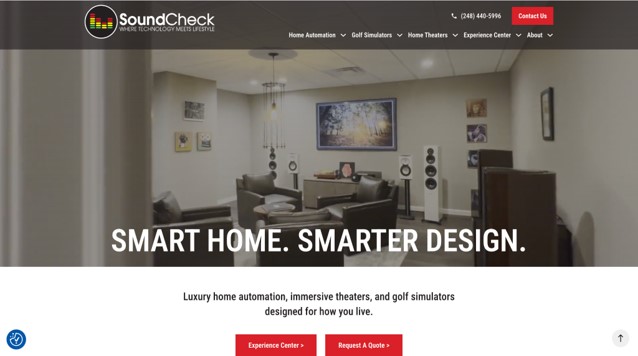
SoundCheck designs and installs custom home technology systems out of Southfield, Michigan, with Full Swing Golf simulators as a central part of their service. They’re certified dealers and installers for Control4, Lutron, and Full Swing Golf, so the simulator doesn’t land in isolation. It connects to the broader audio, video, lighting, and climate system of the room. Named one of the top 100 home theater companies nationally and Michigan’s first Control4 Pinnacle dealer, they bring serious installation credentials to what can otherwise be a messy, multi-vendor installation process.
Why SoundCheck Stands Out for Golf Simulators for Serious Players at Home:
SoundCheck solves the installation demands that kill a lot of otherwise solid home simulator builds by treating projector setup, screen mounting, lighting calibration, and room acoustics as one connected project rather than separate jobs. That kind of whole-room thinking is hard to match when you’re trying to get accurate ball tracking in a controlled indoor lighting environment.
Summary of Real User Reviews:
Clients consistently call out the installation quality and the attention to how the simulator room functions as a complete environment. The smart home technology angle gets detailed praise, with users noting how lighting automation and audio sync improve the overall session feel. A handful of reviews highlight their responsiveness after installation, which matters when you’re troubleshooting the gap between swing and ball-flight displays.
5. FlightScope – Best for Golf Launch Monitors and Ball Tracking Systems
What Does FlightScope Do?
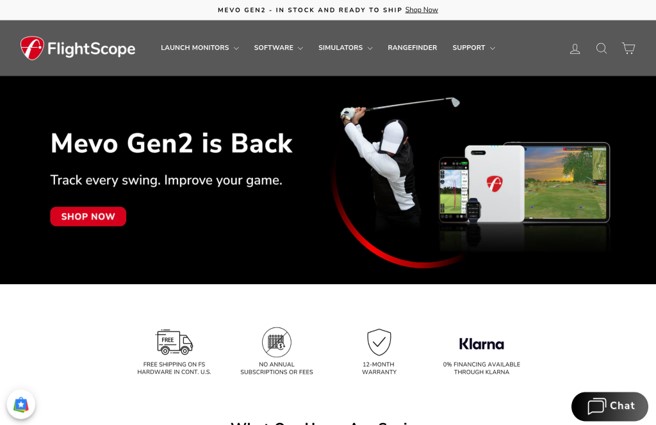
FlightScope has been building tracking technology since 1989, starting with aerospace industry applications before moving into sports. Based in Orlando, their Fusion Tracking system combines 3D Doppler radar with image processing to produce data that holds up across golf, tennis, baseball, and cricket. In golf, their Mevo Gen2, Mevo+, and X3C launch monitors cover everything from entry-level home use to Tour-level club fitting. Their acquisition by IMG Arena in 2021 gave the company access to a much broader distribution infrastructure, which shows in their current global reach across four continents.
Why FlightScope Stands Out for Golf Simulators for Serious Players at Home:
FlightScope brings 3D Doppler radar technology originally built for defense tracking into home simulation, meaning the measurement physics underpinning their data has decades of real-world refinement behind it. Bryson DeChambeau’s reliance on their systems for swing development is the kind of professional endorsement and tour player usage that tells you the accuracy ceiling is genuinely high.
Summary of Real User Reviews:
The Mevo+ draws the most consistent praise among home users, with recurring mentions of data depth covering spin rate, smash factor, and attack angle in a package that doesn’t require a dedicated room build. Reviews from golf instructors and club fitters reinforce that the accuracy holds up against higher-priced systems. A few users note the software learning curve is real (think a longer setup window), but the payoff in data quality earns it.
Research Methodology and Selection Process
Initial Data Collection
The research started by pulling together a broad list of companies operating in the home golf simulator and launch monitor space. Sources included golf equipment review platforms, industry directories, manufacturer websites, and forum discussions from serious amateur golfers. The goal at this stage was breadth, capturing the full range of options from hardware manufacturers to certified installation companies before applying any filters.
Shortlisting Phase
From that initial pool, companies were narrowed down by removing any option without verifiable customer feedback or documented installation history. Review patterns were analyzed across platforms, not just star ratings, but the content of what users actually described about their experience. Companies with thin review profiles or limited public documentation of real-world deployments were excluded, regardless of how polished their marketing appeared.
Verification of Claims
Every claim pulled from a company’s own website was cross-checked against third-party sources where possible. Award designations were traced back to their original source. Professional endorsements and tour player usage were verified against publicly available coverage rather than taken at face value from brand copy. Discrepancies between what a company claimed and what user reviews reflected were flagged and factored into the final scoring.
Authority and Industry Contribution Layer
Recognition from established industry bodies, publications, and professional tours carried real weight in the evaluation. Winning Golf Digest’s Editors’ Choice Award multiple consecutive times signals something different than a single-year mention. Being named a top home theater company nationally, or being cited as the technology of choice by major champions, speaks to performance that has held up in demanding conditions. These kinds of professional endorsements and tour player usage patterns were treated as meaningful signals rather than marketing noise.
Golf Simulators for Serious Players at Home: Specific Evidence
The final filter checked each company against the home simulator use case. A company might perform well in commercial or Tour settings but lack the residential experience that translates to successful home builds. Dedicated residential service pages, verified reviews from home users, and documented case studies involving room planning, projector setup, and indoor tracking accuracy were all factored in. Companies that could demonstrate experience working around space limitations, ceiling height constraints, and indoor lighting conditions for private homeowners ranked higher than those whose work skewed entirely commercial.
How to Choose the Right Golf Simulators for Serious Players at Home
Getting this decision right comes down to matching the hardware and software to how you actually plan to use the room, not just chasing the highest spec on paper.
- Industry/Domain Experience: Look for companies with a documented history in golf simulation. Years in the space and customer volume tell you more than spec sheets.
- Features and Service Options: Check whether the system tracks the full data set you need: spin rate, smash factor, attack angle, launch angle, and ball speed at a minimum. A shallow feature set limits what you can learn.
- Pricing Structure: Factor in the total build cost, not just the launch monitor. Projector, screen, netting, software subscriptions, and installation all add up (sometimes doubling the hardware cost alone).
- Results Measurement: Ask how the system’s accuracy compares against outdoor Trackman measurements. That benchmark tells you whether the data you’re training on is actually trustworthy.
- Industry Knowledge and Compliance: Confirm the hardware meets R&A and USGA equipment standards, especially if you plan to use simulation data for club fitting decisions or handicap tracking.
Bottom Line
Serious home simulation is no longer a compromise. The gap between what you can build at home and what a Tour facility runs has closed considerably, but only if you choose hardware and installation partners with real golf-specific experience. Ball flight data accuracy, simulation library depth, and room planning quality are what separate a setup that genuinely improves your game from one that just looks impressive. The home simulator market keeps maturing, and the best options here reflect that.