
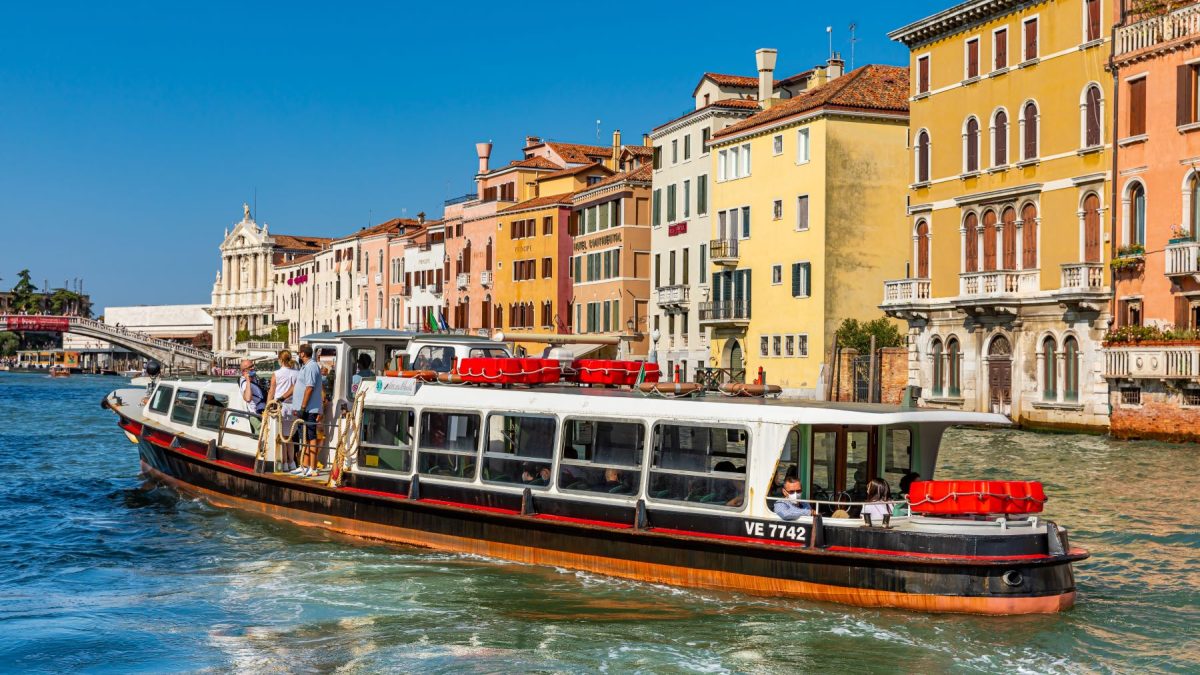
When taking a trip to Venice, most people don’t give much thought to how they’ll get there from the airport. Land at Marco Polo, collect luggage, follow the crowds and end up queuing for a vaporetto with a suitcase wedged between their knees. Does it work? Sure. But it’s not exactly the arrival you imagined when you booked the trip, is it? Venice deserves a better entrance than that and it’s entirely possible to have one – if you plan ahead.
The problem with arriving unprepared
Marco Polo Airport sits on the edge of the lagoon, roughly twelve kilometres from the historic centre. You see that gap between landing and actually being in Venice? That’s where the chaos tends to concentrate. The ATVO and ACTV bus services are cheap and reliable but they deposit you at the edge of the island with all your bags and suitcases, leaving you to navigate on foot across bridges and through narrow calle.
The Alilaguna water bus is a more atmospheric option. The Blue Line takes around an hour and fifteen minutes. Scenic? Definitely. But it’s usually very crowded in high season and not particularly practical with heavy luggage. You also have to walk roughly ten minutes from the terminal to the dock, which could feel like a lifetime when you’ve just stepped off a long-haul flight.
What a pre-arranged transfer actually feels like
The difference that a little organisation makes is considerable. Rather than joining a queue and hoping for the best, using a pre-arranged airport transfer in Venice means someone is already waiting for you in the arrivals hall, holding a board with your name. From there, you’re escorted directly to the dock, often by private vehicle so you skip the ten-minute walk entirely, and onto a boat that isn’t going anywhere until you’re comfortably aboard.
Private water taxis take roughly thirty to forty minutes from the airport dock to the heart of the city. Where possible, they’ll drop you directly at your hotel’s private pier. Where that isn’t feasible, you’ll be brought to the nearest accessible point. With this, you avoid:
- pressure map-reading
- wrong bridges
- dragging suitcases up steps in the rain
For travellers staying at properties along the Grand Canal or in quieter sestieri, the difference between a pre-booked private transfer and a public boat can genuinely change everything.
The lagoon as your first impression
Another reason to think carefully about how you arrive? The crossing itself. Venice doesn’t reveal itself gradually the way most cities do. It appears suddenly and completely, across a flat expanse of water – the campaniles and terracotta rooftops emerging from the lagoon like something assembled for effect.
Arriving by private boat – at a pace that lets you actually look – is a genuinely different experience from being compressed into a shared vessel with thirty other passengers.
Some transfer services even offer an optional extension through the Grand Canal before dropping you at your hotel – a thirty-minute detour that functions as an unscheduled introduction to the city’s main artery. For a first visit especially, it’s the kind of arrival that tends to stay with you.
An arrival that shapes the journey
Travel has a way of remembering its beginnings. A fraught arrival – missed connections, wrong buses, a confusing walk through unfamiliar streets with luggage – could colour the first day in ways that take time to shake off.
Conversely, stepping off a boat directly in front of your hotel – with the city already making its case – is a reasonable way to begin almost any trip to Venice.
The logistics aren’t complicated. The difference in cost between a public water bus and a private pre-booked transfer is real, but so is the difference in experience. For a destination that deals in atmosphere above almost everything else, how you arrive is part of the story.