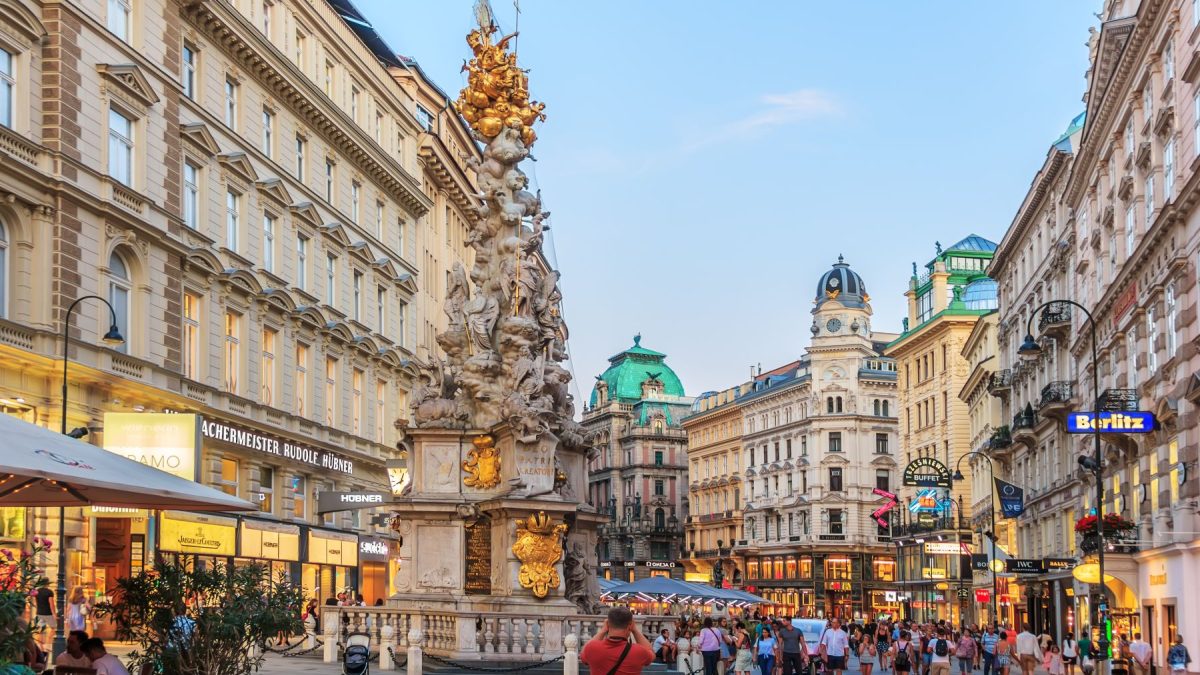
Approximately 8 million people arrive in Vienna every single year, eager to stroll through its streets and marvel at its landmarks. International travelers make up the majority of these visits, but domestic visitors aren’t rare either. The city is the perfect blend of ancient and modern, which is one of the main reasons why it is seen as such a charming spot. Vienna is also renowned for its rich musical heritage, being the home of composers such as Ludwig van Beethoven, Wolfgang Amadeus Mozart, Gustav Mahler, Johannes Brahms, Anton Bruckner, Joseph Haydn, Franz Schubert, and Johann Strauss (both the Father and the Son).
It has a rich imperial history, with the Hofburg, the former main imperial palace, and the Schönbrunn being some of the most popular spots travelers have on their bucket lists. The Viennese Café Culture and a large number of green spaces are preferred by those who spend a long time inside concrete jungles and want to unwind in a place that feels different. On top of that, if you visit around the holiday season, you’ll have the unique opportunity to see some of the world’s best Christmas markets. If you’ve been planning your trip to the Austrian capital, here are a few places you should add to your itinerary.
For the history lovers
Vienna’s history spans over two millennia. As a Roman military camp, Vienna was known as Vindobona, a name derived from Gaulish, a now-extinct Celtic language. The first documented mention of the city during the Middle Ages dates to 881, but the era most people are particularly familiar with is that of the Habsburg Empire, with the city containing many remnants of that time. If you are keen on history and want to discover as much of the city as you possibly can, booking Vienna luxury tours might be the best option. You’ll have a trip that is highly personalized to your expectations, as well as the chance to bypass some of the long crowds and access fast-track entry at several major sites.
Secure premium box seats at the Vienna State Opera and bespoke itineraries based on your interests are typically included as part of the experience as well. If you’re in Vienna for the history, you must definitely visit the Ringstrasse, a 5-kilometer boulevard that circles the Innere Stadt. It was built in the 19th century, in the exact spot where the city’s medieval walls used to stand, and is currently recognized as a UNESCO World Heritage Site. Several important buildings are located here, including the Vienna State Opera, Hofburg Palace, the Kunsthistorisches Museum and Naturhistorisches Museum, housing large art and natural history collections, as well as the Vienna City Hall.
Hotel Sacher should also be on your list, a luxury establishment equipped with an art gallery and the world-renowned Sachertorte, a chocolate sponge cake layered with apricot jam and ganache. The Belvedere Palace, built as a summer residence in the early 1700s, is one of the country’s biggest art museums at the moment. The largest collection of Gustav Klimt’s paintings can be found here, being on show at the heart of the presentation. There’s also a dedicated selfie area you can use if you want to snap a pic with “The Kiss”.
Viennese Coffee Culture
As Weana Kafeehaus (as it is called in Austro-Bavarian) is a well-established institution in Vienna and, throughout the years, has played a very important role in shaping Viennese culture. As of 2011, it has been listed as an Intangible Cultural Heritage. The atmosphere in these places is very unique, and apart from the drink, you can also find a wide range of pastries. Their purpose is to slow down, socialize with other patrons, and bask in the city’s highly celebrated Gemütlichkeit, a kind of warmth, cheer, and friendliness that encompasses coziness, inner peace, and the sense of belonging that comes from being in a place where you feel accepted.
Marble tabletops and No. 14 bistro chairs are the design staples, with a lot of the styling details of the interiors being based on historicism, an artistic style that draws inspiration from looks, styles, and the works of artisans from several centuries ago. You can join events such as literary readings, listen to live piano concerts in the evening, and read newspapers from all over the world. Historically, the cafes were very important meeting grounds for philosophers and writers, meaning that poetry, novels, short stories, and essays are common too.
There are many different coffee houses to choose from. The more traditional ones are Café Central and Café Hawelka, the latter of which is known for a specialty drink known as Wiener Melange, brewed coffee with steamed cream and milk foam. Café Savoy is home to two mirrors that are advertised as the largest in Europe after those found at the Versailles, as well as a chandelier designed by Danish-born architect Theophil Hansen. Café Landtmann was the favorite coffeehouse of Freud and Mahler, while Korb and Rüdigerhof are artsier and the preferred spot for alternative people.
Visiting the green spots
Green spots are very common in Vienna, with about half of the metropolitan area being covered by greenery in the form of forests or parks (of which there are several hundred). The Stadtpark is the city’s first public park and one of the most popular green spots in Vienna. It is home to a monument dedicated to Johann Strauss, a duck pond, cherry trees, lawns, and flowerbeds. Many squirrels and hedgehogs live in the park, and it’s quite likely that you’ll be able to spot at least a few of them during your visit.
The Prater, which was first documented in 1403 and has served as an imperial hunting ground between the 16th century and 1766 (when it was opened to the general public). This leisure area includes the Hauptallee, a roadway with pedestrian promenades on either side, flanked by rows of chestnut trees. The Lusthaus, built in the late 1530s and used to serve as a hunting lodge, was then turned into a gathering spot for the Viennese nobility and bourgeoisie, and currently serves as a restaurant and coffeehouse.
To sum up, Vienna is one of Europe’s most vibrant and interesting destinations. From parks and green areas where you can relax to impressive landmarks and simply wandering around the streets (the city is one of the most walkable in the world), there’s no way that you could ever get bored here.