In 1978, Jane Silva and her partner, Ivan Skender, were traveling along the French Riviera when a leisurely afternoon at a seaside restaurant sparked an idea. Surrounded by flowers, sipping rosé and eating moules-frites, they found themselves imagining how a little of the Côte d’Azur might translate to the shores of Nantucket.
Back home, Jane’s family operated Galley Beach, then a modest seaside restaurant that had spent decades serving beach club members. Her mother, Emma Lea Currie, and father, Bob, had acquired the property in 1958, when it was still known as The Galley on Cliffside Beach. Its offerings were simple: clams, hot dogs, and sodas, served beneath a thatched roof decorated with hanging plants. A wooden dory filled with red geraniums greeted visitors at the entrance.
Jane had already begun introducing French and Belgian influences to the menu, encouraged by her friendship with chef Lucien van Vyve. But the Riviera trip inspired something more ambitious. Returning to Nantucket, she and Ivan replaced the thatched roof with a blue-and-white striped awning, filled window boxes with geraniums, introduced checked tablecloths and French music, and opened the restaurant fully to the public. What emerged was neither a traditional New England seafood restaurant nor an imitation of Saint-Tropez, but a distinctive combination of the two. Nearly five decades later, that unlikely marriage of influences remains central to Galley Beach, although the restaurant itself has undergone a remarkable transformation.
When Jane’s sons, David and Geoffrey Silva, assumed ownership in 1997, the property had become an established Nantucket institution. The building, however, was considerably less glamorous than its reputation suggested. Years of Atlantic storms had weakened the aging structure, leaving sagging floorboards and, on one memorable occasion, a refrigerator that fell straight through the floor.
By 2008, a major renovation was unavoidable. Working with David’s wife, interior designer Eliza Silva, and her father, architect John Newman, the brothers approached the project with an unusual degree of respect for the original building. Rather than starting entirely from scratch, they carefully dismantled, catalogued, and reconstructed the exposed roof assembly. Original windows, exterior walls, and weathered cedar shingles were salvaged and incorporated into the new interiors.
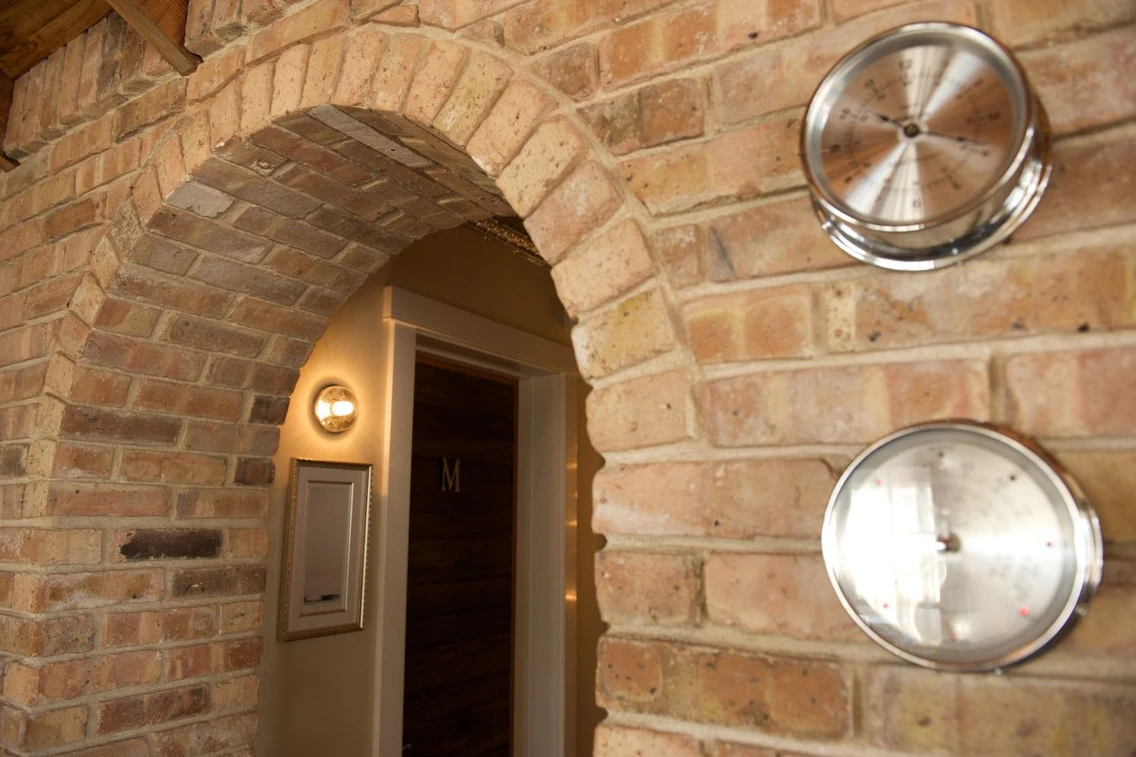
Eliza’s design continued the conversation Jane had begun decades earlier, drawing on European craftsmanship without resorting to predictable coastal decoration. Two-toned marble floors arranged in a traditional fan pattern meet reclaimed historic brick and classic café chairs. The cocktail and coffee bars, designed by Eliza, were handcrafted in Paris by specialist ateliers using traditional pewter techniques known as le zinc, a detail more readily associated with a Parisian brasserie than a Massachusetts beach.
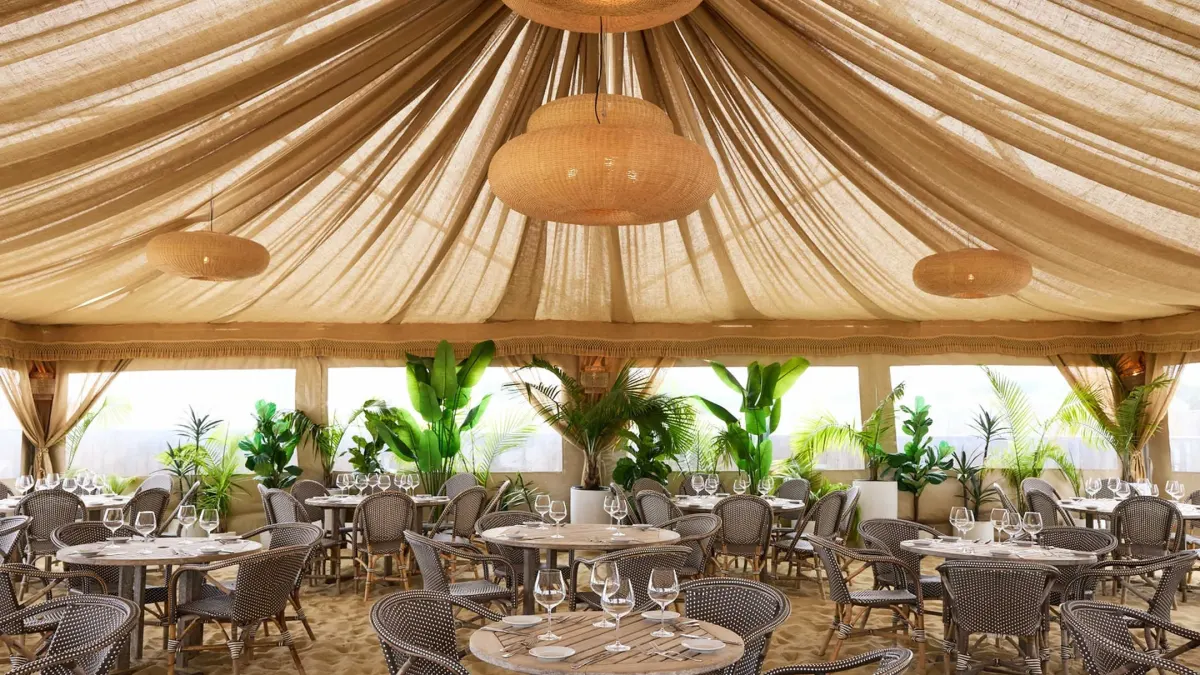
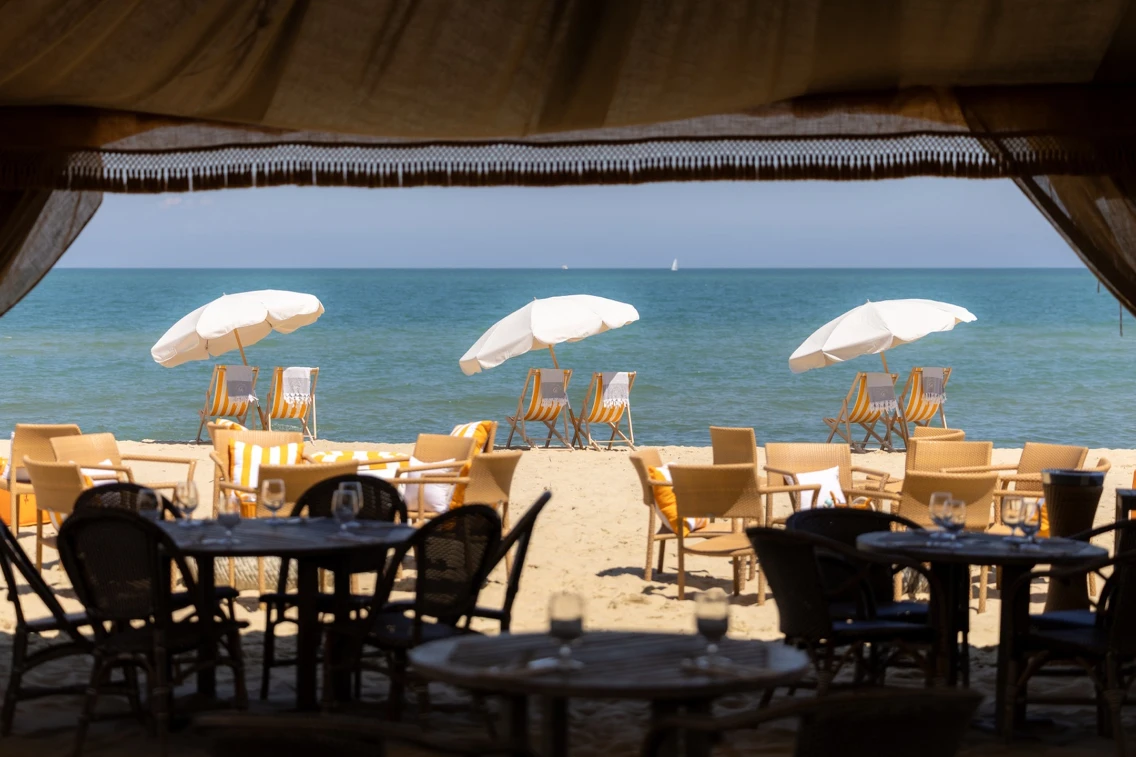
The family’s influence is equally apparent in smaller details. Eliza’s brother, Nantucket craftsman Josiah Newman, made the interior dining tables, while the art collection brings together local commissions and antique European posters gathered over the years. Even the wine list features illustrations by Lucien van Vyve, whose early culinary influence helped set the restaurant’s transformation in motion. Outside, Galley Beach’s relationship with the water remains its greatest asset. White umbrellas punctuate the shoreline, while a dining tent draped in fringed burlap is illuminated by woven pendant lights handmade in Chile. The beachfront lounge, furnished with deep sofas and fire pits, looks across Nantucket Sound, where the setting sun has become as much a part of the restaurant’s identity as its interiors.
Today, David and Eliza’s sons represent the family’s fourth generation, with new projects under consideration, including a vintage Citroën van from the South of France intended for a collection of pantry products and merchandise. There is a pleasing circularity to the idea: a French vehicle arriving on Nantucket nearly half a century after a French seaside lunch inspired the restaurant’s defining transformation. For all its architectural changes and accumulated design details, Galley Beach remains an expression of that original discovery. What began with an afternoon on the Riviera has become something far more personal, a Nantucket institution whose character could never have been created all at once.
Currently closed for the season, Galley Beach is expected to welcome guests back in spring 2027.