

A luxury home sauna is no longer simply a small cedar-lined room tucked into the corner of a basement. Increasingly, homeowners are treating the sauna as part of a larger wellness space, with floor-to-ceiling glass, architectural lighting, carefully selected woods, smart controls, and heating systems designed to deliver a specific type of sauna experience.
That shift has created more possibilities, but it has also made sauna planning more complicated.
The heater, room dimensions, glass area, insulation, bench layout, ventilation, controls, and even the amount of stone in the heater can all influence how the finished sauna performs. A beautiful room with the wrong heater can take too long to warm up or struggle to maintain temperature. A powerful heater in a poorly planned layout can create uneven heat and an uncomfortable experience.
The best luxury sauna designs therefore start with performance and build the aesthetics around it.
Start With the Room, Not the Heater
It is tempting to choose a sauna heater based on appearance. Some of today’s heaters have become architectural objects in their own right, ranging from minimalist wall-mounted units to large floor-standing towers filled with exposed stones.
But heater selection should begin with the room.
The basic calculation starts with the sauna’s interior volume: length multiplied by width multiplied by height. That number alone, however, does not tell the entire story.
Glass doors, windows, stone, tile, concrete, and other non-insulated surfaces can increase the amount of heating capacity required. An outdoor sauna in a cold climate will generally face different demands from a well-insulated sauna inside a conditioned home.
This is particularly relevant in luxury designs, where large expanses of glass have become increasingly popular.
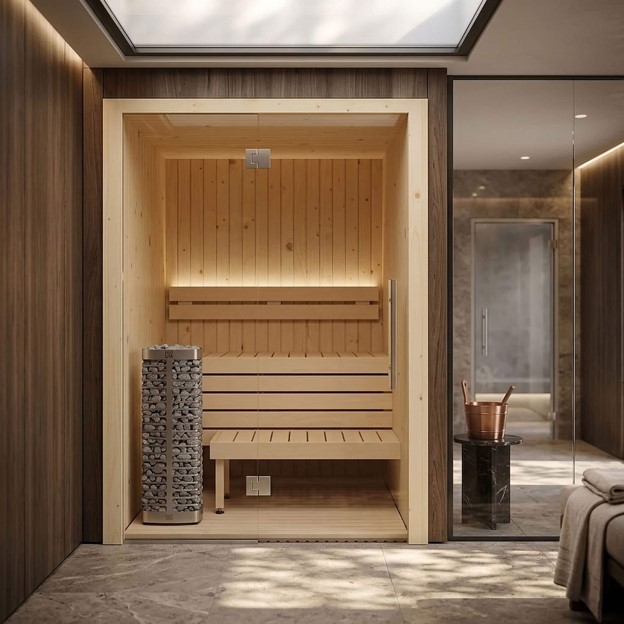
A homeowner designing a seven-by-seven-foot sauna with a traditional wooden door may have very different heating requirements from someone building the same-size room with an entire glass wall.
Before selecting a heater, it is useful to run the room specifications through a sauna heater size calculator that accounts for dimensions, glass and other cold surfaces, insulation, and whether the sauna is indoors or outdoors.
The objective is not simply to install the largest heater that will fit. It is to match the heating system to the room closely enough that the sauna heats effectively while maintaining a comfortable and consistent environment.
The Heater Determines More Than Temperature
Luxury sauna design often focuses on wood species, lighting, doors, and finishes. Yet the heater may ultimately have more influence on the actual sauna experience than any of those elements.
Modern electric sauna heaters range from compact wall-mounted designs to substantial floor-standing models carrying large quantities of sauna stones.
Electric heat is particularly well suited to many residential installations because it provides predictable operation and can be paired with digital controls, timers, and, in some systems, Wi-Fi connectivity.
The quantity and arrangement of stones also matter.
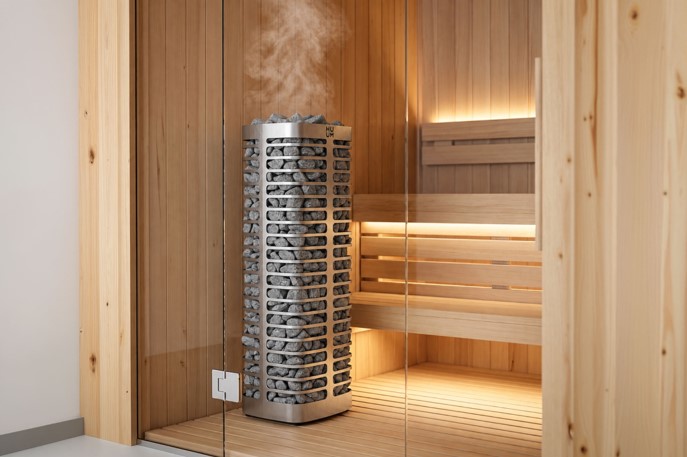
A heater with a large exposed stone mass can create a different bathing experience from a compact unit with relatively few stones. Pouring water over properly heated sauna stones produces löyly, the burst of steam and humidity that is central to traditional sauna bathing.
Homeowners who enjoy frequently adding water to the stones may therefore place greater importance on stone capacity and exposed stone surface. Someone who primarily wants fast, dry heat may prioritize other characteristics.
This is one reason there is no single “best” sauna heater for every luxury installation.
Decide What Kind of Sauna Experience You Want
Before comparing models, homeowners should decide how they expect to use the sauna.
Do you want intense heat and short sessions? A softer environment with frequent steam? Quick preheating after work? Long weekend sessions? Remote preheating before coming home?
Those preferences affect the ideal heater and control system.
Traditional Finnish-inspired sauna rooms typically emphasize high temperatures, water poured over stones, proper ventilation, and bench heights that position the bather in the hotter upper portion of the room.
Other homeowners may prefer infrared or hybrid systems. Golden Designs, for example, has developed a broad range of infrared and hybrid sauna cabins, illustrating how the residential sauna market has expanded well beyond a single heating format.
Neither approach is automatically more luxurious. Luxury comes from designing the room around the experience the homeowner actually wants.
The Sauna Cabin Has Become an Architectural Choice
For homeowners who do not want to construct a sauna entirely from scratch, premium modular and prefabricated sauna rooms have become much more sophisticated.
SaunaLife saunas, for example, include contemporary indoor and outdoor designs ranging from traditional barrel forms to modern cabins with expansive glass fronts. These systems can provide much of the architectural character of a custom sauna while simplifying parts of the construction process.
At another end of the market, Kohler has moved into indoor and outdoor home saunas, bringing the sauna into the same broader luxury bathroom and home-wellness conversation as premium showers, soaking tubs, and other residential wellness products.
Finnmark Sauna demonstrates another approach, with an emphasis on bespoke sauna design and traditional Finnish principles such as insulation, vapor management, ventilation, heater selection, and generous stone capacity.
The takeaway for homeowners is that a luxury sauna can now take several forms.
It might be a completely custom room designed by an architect. It might be a contemporary outdoor cabin positioned beside a pool. It could be incorporated into a home gym, primary bathroom, or dedicated wellness suite. Or it could be a premium modular sauna selected as a finished design.
What matters is that the heater and mechanical requirements are considered alongside the architecture from the beginning.
Controls Should Be Chosen Early
Controls are another detail that is easy to leave until late in the design process.
That can be a mistake.
Depending on the heater, controls may be integrated into the heater itself or mounted separately. Premium systems may offer digital interfaces, scheduling functions, lighting integration, and Wi-Fi connectivity.
For a luxury installation, the control location should be considered during electrical and interior planning rather than treated as an afterthought.
Some homeowners want the simplest possible interface. Others value the ability to begin preheating the sauna remotely so that it is ready when they arrive home.
There is also an aesthetic consideration. A carefully designed sauna with concealed wiring, integrated lighting, and minimalist finishes can lose some of its visual impact if a controller or electrical component is awkwardly positioned at the end of the project.
Choose the heating and control system before walls are closed and electrical work is finalized.
Bench Layout Is About Heat, Not Just Seating
The hottest air in a traditional sauna rises, which means bench height has a major effect on comfort.
A large luxury sauna with beautiful low benches can still deliver a disappointing experience if bathers are sitting primarily in the cooler portion of the room.
The upper bench should place bathers comfortably within the sauna’s hot zone while maintaining appropriate clearance from the ceiling. Lower benches can serve as steps, cooler seating, or places for bathers who prefer less intense heat.
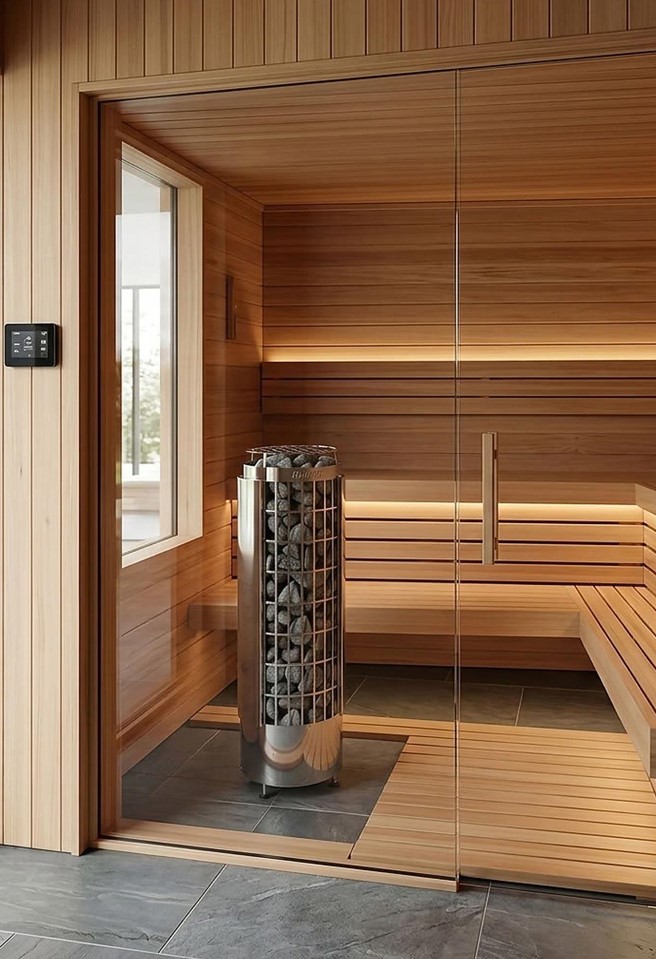
This becomes particularly important in larger rooms.
Ryan Williams, a sauna specialist at SaunaHeaters.com, has pointed out that temperature stratification is something first-time sauna owners may not anticipate:
“Most traditional saunas leave your feet noticeably cooler than your upper body. Air-blending creates a much more even temperature throughout the cabin, making longer sessions more comfortable and helping people enjoy the sauna without constantly adjusting where they sit.”
Technologies designed to address temperature stratification can be useful in certain installations, but good room geometry, heater placement, ventilation, and bench design remain fundamental.
Glass Looks Beautiful, but It Changes the Equation
Few design elements have transformed the appearance of residential saunas more than glass.
A glass door can make a small sauna feel larger. A full glass wall can visually connect the sauna with a pool, bathroom, gym, or outdoor landscape. In high-end homes, this openness is often a major part of the design.
But glass does not insulate like a properly constructed sauna wall.
As the amount of glass increases, heater requirements may increase as well. That should be calculated before purchasing the heater, not discovered after installation when the room takes longer than expected to reach temperature.
There is a balance to strike.
A dramatic glass facade may be worth the added heating requirement for a sauna overlooking a mountain, garden, pool, or ocean. In a compact interior sauna where performance is the priority, more wood and less glass may be the better choice.
Luxury design is not about maximizing any one feature. It is about making intentional trade-offs.
Ventilation Deserves More Attention
Ventilation may be one of the least glamorous elements of sauna design, but it has an outsized effect on comfort.
Fresh air needs to enter the sauna, circulate appropriately around the heater and bathers, and eventually leave the room.
Poor ventilation can contribute to uneven temperatures and an environment that feels stuffy even when the thermometer indicates the correct temperature.
Vent locations depend on the heater type, room configuration, and ventilation method, so homeowners should follow the heater and sauna manufacturer’s specifications rather than treating vents as decorative openings that can be placed wherever they are least noticeable.
In a custom luxury installation, ventilation planning should happen at the same stage as electrical, lighting, drainage, and HVAC coordination.
Outdoor Saunas Require Another Layer of Planning
A freestanding backyard sauna introduces factors that an indoor sauna may not face.
Exterior temperature, wind exposure, insulation, weatherproofing, electrical runs, foundation requirements, drainage, and the distance between the sauna and the house all need consideration.
This is where products designed specifically as outdoor sauna structures can simplify the project.
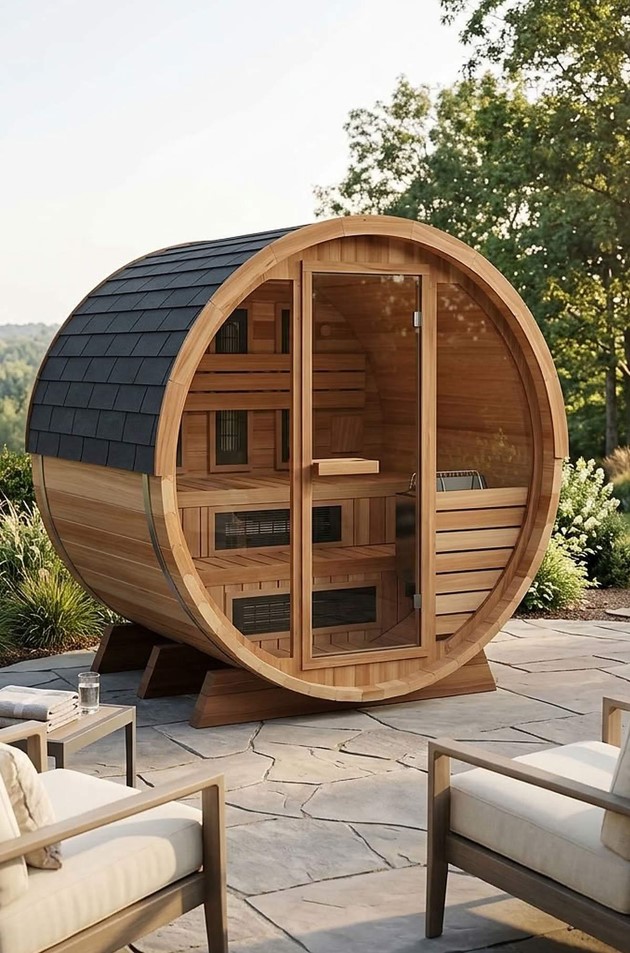
The surrounding environment should also influence the design. A sauna used through a Minnesota winter will face different conditions from one installed in Southern California.
Outdoor installations can benefit from slightly more conservative heater sizing when environmental conditions warrant it, but simply buying an oversized heater is not a substitute for proper insulation and construction.
Plan the Entire System Before Ordering Anything
One of the most expensive mistakes in sauna construction is making each decision independently.
The room is designed first. Then the heater is selected. Then the electrician discovers the electrical requirements. Then the homeowner realizes the controller needs a different location. Finally, the benches are installed and there is less clearance around the heater than expected.
A better sequence is to treat the sauna as a complete system.
Before ordering the major components, confirm:
- Interior dimensions and ceiling height
- Glass and other non-insulated surface area
- Indoor or outdoor location
- Climate and insulation
- Required heater output
- Heater safety clearances
- Electrical voltage, amperage, and circuit requirements
- Control system and controller location
- Ventilation
- Upper and lower bench heights
- Heater-to-bench relationship
- Door swing and traffic flow
- Lighting and other electrical features
This coordination becomes even more important as the design becomes more sophisticated.
The Best Luxury Sauna Is the One That Performs Beautifully
A striking sauna can increase the visual appeal of a home wellness space, but appearance alone does not make the room luxurious.
True luxury is walking into a sauna that has been preheated to the temperature you prefer, sitting at the right height, feeling consistent heat throughout the room, adding water to properly heated stones, and having every control positioned where it makes sense.
That experience comes from decisions made long before the first sauna session.
Whether the project starts with a contemporary SaunaLife cabin, a Golden Designs system, a Kohler sauna, a bespoke Finnmark-inspired room, or a completely custom build, the same principle applies: design the room and heating system together.
Choose the heater based on the actual characteristics of the space. Account for glass and insulation. Think about stone capacity and the type of heat you prefer. Plan the controls, ventilation, and benches before construction is finished.
The result will not simply be a beautiful room with a heater in it.
It will be a sauna designed to work as well as it looks.
About the Author
Mark Adams is a digital marketing professional with SevenAtoms Marketing Inc. He writes about automotive, home improvement, consumer products, and emerging lifestyle trends, with a focus on helping readers make informed purchasing and ownership decisions.