Apple Watch Series 12 brings more detailed health tracking, faster charging and an attractive choice of new finishes to Apple’s familiar smartwatch design. The return of ceramic is a particular highlight, while a redesigned sensor system and new Readiness app give greater attention to the balance between activity and recovery.
There is no dramatic overhaul of its appearance, but the changes address several practical aspects of ownership: understanding daily exertion, interpreting sleep and recovery, and reducing the time spent charging. Audio Intelligence adds further possibilities, with some of its most ambitious features due later this year.
Design and Craftsmanship
Series 12 retains the rounded rectangular case of its predecessors, with a 9.7mm profile in aluminium and titanium and a slightly deeper 9.85mm ceramic version. The proportions remain well suited to a watch intended for both daytime wear and sleep tracking.
The choice of materials makes more of a difference. Aluminium comes in Light Gold, Black, Space Grey and Dark Bronze; polished titanium is available in Natural and Radiant Gold. The latter’s warm finish is achieved through a coating process rather than the use of gold itself. Both titanium options are 3D printed using 100 per cent recycled titanium.
The return of ceramic is particularly welcome. Night Blue is my favourite of the new finishes: distinctive without being conspicuous, and an attractive alternative to black. Pearl White has a brighter appearance that makes more of the case’s shape. Both ceramic and titanium models have sapphire front crystals for greater scratch resistance.
Aluminium versions introduce Ceramic Shield 2, which Apple describes as 60 per cent tougher than the Ion-X glass on Series 11. Greater durability is useful on a device exposed to knocks and scrapes throughout the day.
For those who want a dressier option, the Hermès collection pairs Radiant Gold titanium with the Noir Clou de Selle band. Black satin webbing, a gold clasp and the signature stud give it a more formal character, with a matching dial based on the Hermès Cape Cod typeface. The new Rocabar Club knit bands offer a more casual alternative, using contrasting colours and patterns drawn from the house’s equestrian heritage.
Health Tracking
The substantial hardware changes are on the back of the watch. The redesigned Health Sensing System works with the S11 chip to take background heart-rate readings every five seconds, including while the wearer is moving. Series 11 attempted these readings approximately every five minutes and generally required relative stillness.
The benefit is a fuller picture of exertion outside a recorded workout. Climbing stairs, carrying shopping and walking briskly between appointments all demand effort, even if they do not merit opening the Workout app. More frequent measurements help capture that activity and improve estimates of daily energy expenditure.
Heart-rate variability, or HRV, is also measured more often, with readings possible as frequently as every five minutes while at rest. Recovery HRV contributes to Vitals and Readiness, providing more information from which to assess changes.
Vitals now includes a daytime view alongside its overnight assessment. Comparing readings with an individual baseline makes the information easier to interpret: the useful question is whether something has changed from what is normal for you. It remains a wellness tool rather than a medical assessment.
Readiness and Recovery
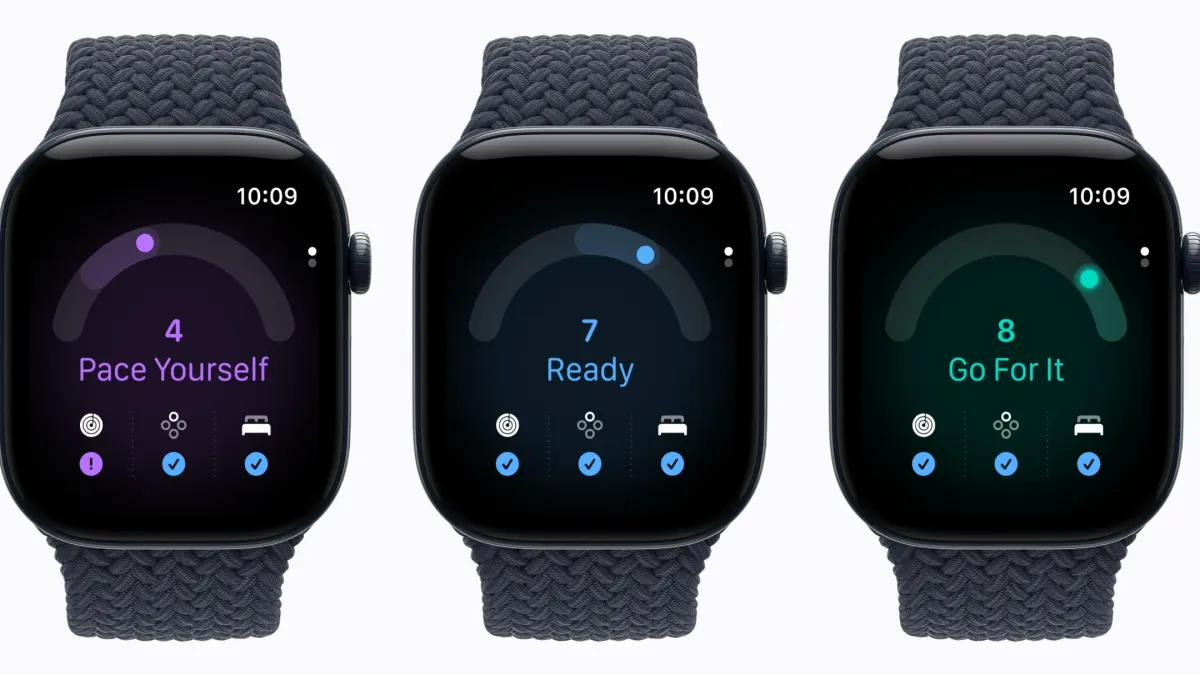
The new Readiness app combines recent activity, sleep and vitals into a score from zero to ten, with four classifications ranging from “Recover” to “Go For It”. It also explains which factors have raised or lowered the result, rather than leaving the wearer to decipher a number.
I enjoy checking my Readiness score. So far, I have received an eight out of ten, placing me in the “Go For It” category, which is pleasantly motivating. Having an assessment that considers recovery alongside activity gives the encouragement more context.
The score can adjust throughout the day as the watch considers exercise, naps and daytime heart-rate signals. Its usefulness extends beyond a training programme. A disrupted night or an unusually demanding day can affect anyone’s capacity, and acknowledging that makes the advice more relevant.
The number is best considered alongside how you actually feel. What I welcome is the greater attention to rest within a device that has traditionally been very effective at encouraging us to do more.
A redesigned Health app is planned for later in 2026, including a Health Age feature that will draw on measures such as fitness, resting heart rate, HRV and sleep. It is an interesting prospect, although separate from the features available at launch.
Everyday Features and watchOS 27
Some of the smaller improvements address familiar inconveniences. A revised pedometer model is designed to count steps more accurately when the arms remain relatively still, such as while pushing a pram or carrying a coffee. A new Steps complication puts the total directly on the watch face.
watchOS 27 adds a single-tap finger-and-thumb gesture for selecting a Smart Stack widget, complementing double tap and wrist flick. Controls that work with one hand make sense on a watch, particularly when carrying bags or exercising.
The software also improves contrast in the Liquid Glass interface and brings people, devices and items together in a unified Find My app. Finding a misplaced iPhone is still one of the Apple Watch functions I most appreciate, so easier access to those tools is welcome.
Workout Buddy gains more flexibility, with personalised spoken encouragement available without the phone nearby, provided the watch has a Wi-Fi or cellular connection, compatible Bluetooth headphones and the required supported paired iPhone.
Cycle Tracking adds perimenopause and menopause resources. Users can log related symptoms and receive notifications when recorded cycle patterns may suggest perimenopause. This is a useful extension of the Health app, though the notifications do not constitute a diagnosis.
Audio Intelligence
Audio Intelligence is the most significant departure from the watch’s established features. Sound Recognition can alert the wearer to sirens, alarms and doorbells even without an iPhone nearby, with particular value for people who are deaf or hard of hearing.
Automatic Music Recognition with Shazam identifies background music and displays the song title and artist in the Smart Stack without requiring a tap. It is the kind of small convenience that suits a device on the wrist.
Live Rewind and Siri Recap are scheduled to arrive in beta later this year, initially in English. Live Rewind will display a text snippet of the preceding 15 seconds of speech after a deliberate double-press of the Digital Crown. A quickly delivered book recommendation or unfamiliar place name offers an obvious use case.
Siri Recap will generate brief summaries of conversations during periods the wearer chooses. Being able to revisit the essentials without interrupting a discussion to take notes could be useful, but accuracy will be crucial. Apple acknowledges that snippets and summaries may omit or misinterpret information.
Both features require a supported Apple Intelligence-enabled iPhone and Siri AI. Their everyday value will be clearer once they are available.
Privacy
Features that process conversation need straightforward controls. Apple says Audio Intelligence creates no stored audio recordings, with raw audio handled within protected hardware compartments. Processing takes place on-device and, where required, through Private Cloud Compute.
Live Rewind and Siri Recap are opt-in. Recap can be restricted by time or location, and unsaved summaries disappear after seven days. Saved summaries and snippets sync through iCloud with end-to-end encryption under the required account settings.
Live Rewind produces an audible chime, even in silent mode, alongside a visible animation to alert people nearby. These are sensible measures, although considerate use remains important around private conversations.
Battery Life
Battery life remains an area where expectations need to be realistic. Apple quotes up to 24 hours of normal use and 38 hours in Low Power Mode, so regular charging is still necessary, especially when tracking sleep.
The improvement is in how quickly the battery can be replenished. According to Apple’s testing, 15 minutes provides up to 12 hours of normal use, while approximately 30 minutes takes it to 80 per cent. Five minutes supplies up to ten hours of sleep tracking.
For a watch whose health insights depend on consistent wear, shorter charging intervals are worthwhile. A top-up while showering or getting ready for bed should be easier to accommodate, even if packing a charger remains essential for a trip.
The Verdict
Series 12 offers meaningful improvements within a familiar design. More detailed health sensing gives the watch better information to work with, Readiness makes recovery easier to understand, and faster charging reduces the inconvenience of keeping it on overnight.
The new materials add to its appeal, particularly ceramic. Owners of Series 10 or 11 may feel little urgency to upgrade, but those moving from an older model have more to gain.
For me, Readiness is a worthwhile addition to the Apple Watch’s already extensive health and fitness features. It makes the data more relevant to the day ahead, while retaining the straightforward encouragement that has long been part of the watch’s appeal. Combined with refined materials and practical improvements to everyday use, it makes Series 12 a compelling option for iPhone users.
Apple Watch Series 12
Price: Aluminium GPS models from £369/$399; titanium GPS + Cellular models from £649/$699; ceramic GPS + Cellular models from £849/$899. Prices vary according to case size and strap. US prices exclude sales tax.
To purchase, please visit: apple.com/uk/shop/buy-watch/apple-watch or, in the US, apple.com/shop/buy-watch/apple-watch.