Few operas explore the intersection of love, jealousy and political tyranny as powerfully as Giacomo Puccini’s Tosca. First performed in Rome in 1900, this enduring masterpiece has lost none of its emotional force, with its magnificent score and tightly constructed drama continuing to captivate audiences more than a century later. In a politically charged new production at the London Coliseum, English National Opera’s Artistic Director Annilese Miskimmon reimagines Puccini’s celebrated tragedy against the backdrop of an unnamed Eastern European state during the political upheaval of the 1980s.
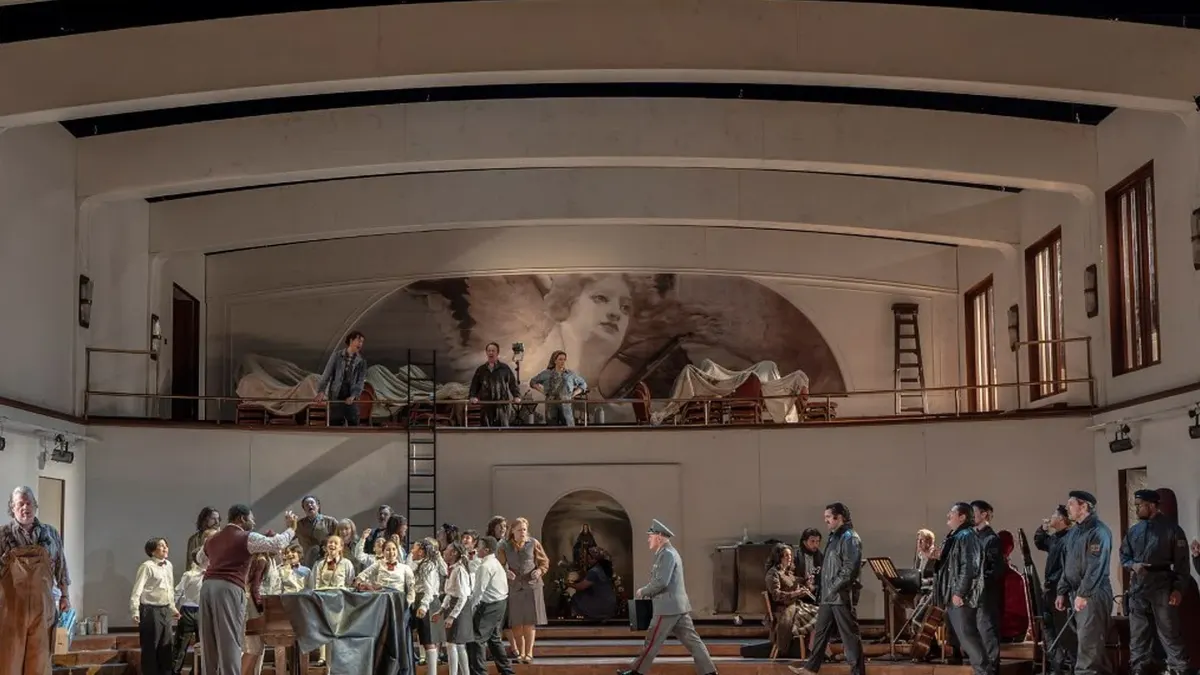
Miskimmon, whose previous work for ENO includes the Olivier Award-winning Dead Man Walking, has chosen to explore the relationship between artistic freedom and authoritarian power. Rather than moving between the three Roman locations of Puccini’s original, the entire drama unfolds within a concert hall, a place traditionally associated with creativity and cultural expression that gradually becomes a setting for intimidation, persecution and violence.
It is an interesting premise, particularly given the continuing threats to artistic independence in many parts of the world. Although the symbolism is occasionally rather emphatic, the decision to place music and the arts at the centre of the narrative lends the production a distinctly contemporary relevance.
At the heart of the story is Floria Tosca, a celebrated opera singer whose relationship with the painter Mario Cavaradossi becomes entangled in the machinations of the ruthless police chief Scarpia. When Cavaradossi shelters an escaped political prisoner, the couple find themselves caught in an increasingly dangerous confrontation with the authorities. What begins as a relatively intimate story of romantic jealousy develops into a harrowing examination of coercion, sacrifice and the abuse of power.
French soprano Axelle Fanyo makes a compelling Tosca, bringing considerable dramatic commitment to a role that demands both vocal versatility and emotional conviction. Her performance combines the character’s passionate temperament with a growing sense of vulnerability as events move beyond her control. Particularly affecting is her interpretation of the celebrated second-act aria Vissi d’arte, in which Tosca questions why a life devoted to love and artistic endeavour should have brought her such suffering. Fanyo approaches the aria with sensitivity, allowing its emotional significance to emerge without unnecessary theatrical embellishment.
As Cavaradossi, American tenor Chaz’men Williams-Ali brings warmth and sincerity to the painter whose political sympathies place him in considerable danger. His scenes with Fanyo establish the affection between the lovers, providing an important contrast to the darker developments that follow. Their relationship gives the opera its emotional foundation, even if some of the more intimate exchanges would benefit from greater dramatic spontaneity.
Christopher Purves is an imposing presence as Scarpia, the corrupt police chief whose authority extends far beyond the pursuit of political dissidents. Making his role debut, Purves presents a figure whose calculated manipulation is every bit as disturbing as his capacity for violence. His interactions with Tosca are particularly effective, conveying the deeply unsettling imbalance of power between them. Rather than relying entirely on overt villainy, he brings a degree of psychological calculation to a character who remains one of opera’s most formidable antagonists.
The supporting cast includes Alaric Green as the fugitive Angelotti and Robert Hayward as the Sacristan, while Osian Wyn Bowen portrays Scarpia’s subordinate Spoletta. The ENO Chorus contributes to the production’s atmosphere of collective unease, its presence reinforcing the sense of a society living under increasingly oppressive control.
Musically, the evening benefits enormously from Ben Glassberg’s assured conducting. Returning to ENO following his 2022 engagement with La bohème, Glassberg draws an expressive and carefully balanced performance from the orchestra, allowing Puccini’s richly textured orchestration to speak for itself. The score moves effortlessly between passages of lyrical tenderness and moments of considerable dramatic tension, with the orchestra providing much of the evening’s emotional momentum.
Indeed, one of the production’s greatest strengths is the quality of the orchestral playing. Puccini’s music possesses an extraordinary ability to illuminate the characters’ innermost feelings, frequently revealing more than the dialogue itself. Glassberg demonstrates a sensitive understanding of these contrasts, maintaining the work’s dramatic urgency while allowing its quieter passages sufficient space.
Rosanna Vize’s set design establishes a convincing atmosphere of faded grandeur, with the concert hall’s imposing interior providing a suitably austere backdrop to the unfolding tragedy. The single location also creates a sense of confinement as the characters’ circumstances become progressively more desperate. Evie Gurney’s costumes reinforce the production’s twentieth-century setting, while Lee Curran’s lighting helps distinguish between the more intimate moments and the increasingly threatening presence of the state.
The staging is not without its limitations. By dispensing with the contrasting locations of the original opera, Miskimmon inevitably sacrifices some of the visual variety and dramatic specificity that make Tosca so effective. Certain sequences are also rather heavily populated, occasionally drawing attention away from the principal characters. Nevertheless, the underlying concept has merit, particularly in its examination of how easily cultural institutions can become vulnerable to political interference.
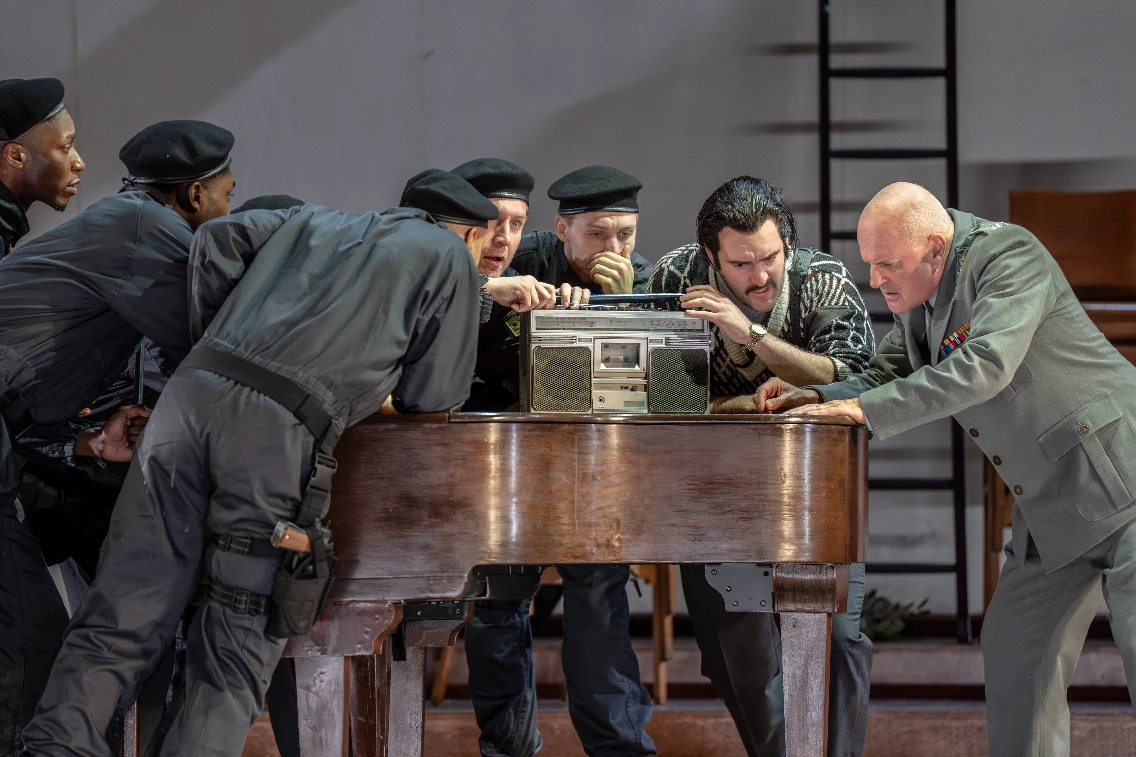
There is something especially poignant about presenting this story within a concert hall. As musical instruments become objects of suspicion and artistic expression is treated as a threat, the production offers a reminder that the freedoms associated with culture should never be taken for granted. It is a theme that resonates beyond the particular historical setting chosen by Miskimmon.
The director has also conceived this Tosca as a companion piece to Kaija Saariaho’s Adriana Mater, which opens at the Coliseum later in November. The two productions share a thematic interest in war, resilience and the experiences of women living through conflict, although they approach these subjects from different perspectives. Their pairing offers an intriguing opportunity to consider how opera has addressed such questions across more than a century of musical composition.
Ultimately, this is a Tosca whose strongest qualities lie in its musical execution and the commitment of its principal performers. Miskimmon’s interpretation may not always achieve the clarity or dramatic precision of a more traditional staging, but its central concerns are thoughtfully chosen and its most successful moments are genuinely affecting.
For audiences already familiar with Puccini’s masterpiece, the production offers an alternative perspective on a much-loved work. Those encountering it for the first time will discover a magnificent score, a memorable central heroine and a story whose exploration of love and tyranny remains remarkably pertinent. Above all, Glassberg and the ENO Orchestra provide a persuasive reminder of why Tosca continues to occupy such an important place in the operatic repertoire.
Tosca by Giacomo Puccini
London Coliseum, St Martin’s Lane, London WC2N 4ES
Dates: 30 October – 11 December 2026
Running Time: Approximately 2 hours 15 minutes, including interval
Tickets: From £15, with free tickets for under-21s and discounts for those aged 21–35
Booking: www.eno.org