Rigoletto returns to the Royal Opera House with electrifying purpose; a revival that sparkles with precision, poise and unflinching drama. The courtiers shimmer in gilded jackets, the stage hums with tension, and the music seems to hover above the pit; sumptuous yet tightly controlled, the production grips from its first image and never loosens.
There is particular resonance in the presence of Sir Mark Elder, revisiting a work he first conducted here in 1976. His mastery is evident in every measure; he conducts with authority that never dominates, letting Giuseppe Verdi’s score breathe. Orchestral textures are finely etched, rhythms taut and purposeful, and the drama rises with natural inevitability. This is opera that feels alive in the air rather than anchored in the pit; ethereal, yet grounded, commanding attention without strain.
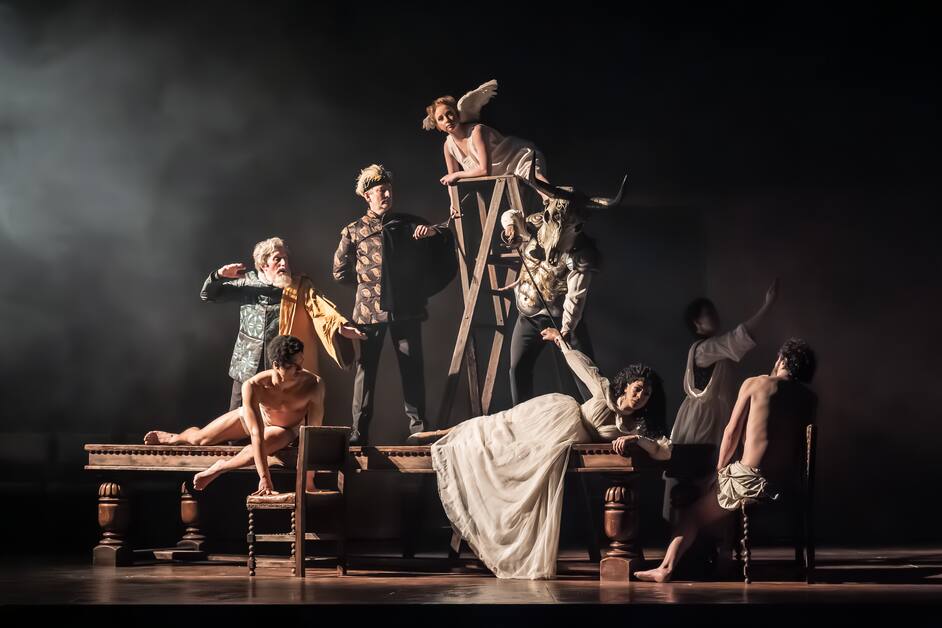
Oliver Mears’s production has matured into something wholly assured. The opening sequences present a succession of arresting tableaux; courtiers and courtesans shimmer beneath gilded splendour, only to be interrupted by Blaise Malaba’s imposing Monterone, whose presence immediately anchors the action. The final act strips everything back to concrete, wire and storm; an onstage deluge accompanied by flashes across the auditorium makes the tragedy inescapable. Between these poles, Mantua emerges as a court both dazzling and corrosive, its beauty laced with menace.
At the centre, George Petean carries the drama with a Rigoletto of taut authority. Vocally secure and theatrically focused, he balances bitter cynicism with tender paternal devotion. Opposite him, Aida Garifullina’s Gilda is luminous; her tone is clear, her coloratura delicate, and her portrayal exquisitely measured between innocence and awakening awareness. “Caro nome” is spun with quiet grace and emotional depth; intimate, riveting and perfectly poised.
Iván Ayón Rivas makes a confident house debut as the Duke, his bright, polished tenor adding charm while hinting at moral vacuity. The supporting cast is equally compelling: Anne Marie Stanley’s Maddalena is vivid, uninhibited and dangerously alive, while William Thomas’s Sparafucile exudes quiet menace; both are perfectly at home in Mears’s shadowed world.
Visually, the production is elegant and striking; Simon Lima Holdsworth’s austere architectural forms and Ilona Karas’s era-blurring costumes create a setting that feels both timeless and immediate. Grand tableaux give way to stark simplicity, from Gilda’s bare whitewashed bedroom to the storm-lashed stage of the final act. Occasionally, the sparse décor highlights the leads pacing through space, yet this only amplifies the strength of singers and orchestra.
This Rigoletto is defined by exquisite equilibrium; music and drama reinforce one another, guided throughout by Elder’s sure hand. Every moment carries intention; every aria resonates. There is no overstatement, no apology; the production simply is, and it commands the audience completely.
The result is a Rigoletto of rare cohesion and vitality; visually sumptuous, musically precise, and emotionally compelling. The Royal Opera House demonstrates not only the enduring power of Verdi but the art of opera at its most immediate, immersive and unforgettably alive.
Rigoletto, Royal Opera House, Bow St, London WC2E 9DD until 23 April 2026