Few operas contain multitudes quite like Don Giovanni. Mozart and Lorenzo Da Ponte’s 1787 masterpiece is at once black comedy, psychological drama, supernatural thriller and morality tale, its mercurial score moving between levity and darkness with astonishing ease. Opening the Royal Opera’s 2026/27 season, Kasper Holten’s production embraces those contradictions in a revival that is visually audacious, musically exhilarating and superbly cast.
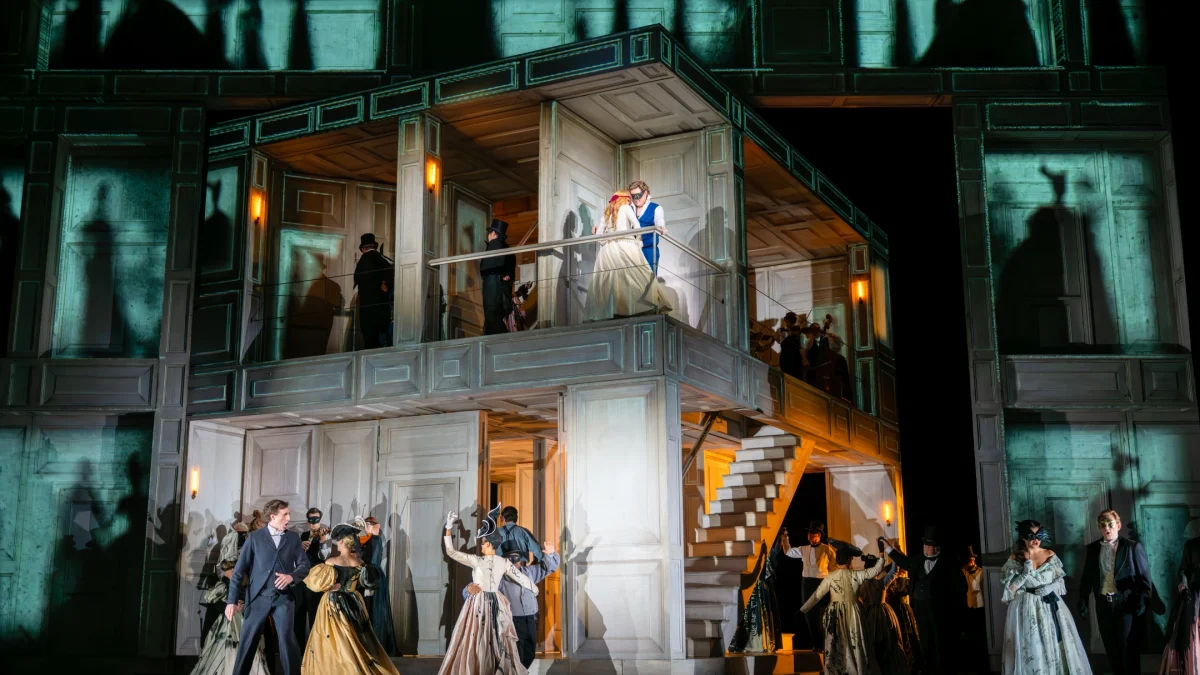
First seen at Covent Garden in 2014 and revived here by Greg Eldridge, Holten’s staging dispenses with any notion of Don Giovanni as simply a swaggering libertine. Instead, he inhabits a world increasingly shaped by his own compulsions. Es Devlin’s magnificent revolving two-storey house is central to that conceit: an elegant yet labyrinthine structure of rooms, corridors, staircases and shadowy recesses, forever turning to expose another corner and another secret. Its relentless movement seems to mirror Giovanni himself, a man incapable of standing still because stillness might require introspection.
Even during the overture, the past begins closing in. Luke Halls’s ingenious video projections send the names of Giovanni’s innumerable conquests crawling across the façade, eventually invading almost every surface. The effect is initially playful, then steadily more oppressive. These women cannot simply be catalogued, seduced and discarded; their presence has become inscribed upon the very fabric of Giovanni’s existence.
Anja Vang Kragh’s sumptuous mid-19th-century costumes provide a glamorous counterpoint to the gathering darkness, while Bruno Poet’s lighting shifts the atmosphere from seductive warmth to something altogether more sinister. Holten and his designers understand the visual possibilities of the Royal Opera House stage exceptionally well. Images appear and dissolve, walls are transformed by ink and blood, figures materialise in unexpected corners of the mansion, and Devlin’s structure spins between scenes with almost cinematic fluidity. It is an unusually complete marriage of physical scenery and projection, the technology enhancing rather than overwhelming the drama.
At its centre is Gordon Bintner’s compelling Don Giovanni. His is not a peacocking, obviously predatory seducer, but something more interesting: a jaded Lothario whose appetites have long since ceased to provide satisfaction. Bintner possesses the physical ease and self-assurance necessary to make Giovanni’s magnetism credible, yet allows fissures to appear in that immaculate surface as the evening progresses. His resonant bass-baritone comes thrillingly into its own at full force, while his lighter, more insinuating singing reveals why so many of the characters remain susceptible to him even when they know precisely what he is.
The genius of Mozart and Da Ponte, of course, lies partly in their refusal to allow darkness to have the stage entirely to itself. Roberto Tagliavini makes a splendid Leporello, his rich bass matched by instinctive comic timing. Master and servant operate almost as a dysfunctional double act, with Leporello veering between admiration, exasperation, moral horror and reluctant complicity. His delivery of the celebrated Catalogue Aria, detailing his master’s 2,065 conquests across Europe, is deliciously judged. Beneath the comedy sits something more psychologically astute: Leporello may deplore Giovanni’s behaviour, but he too struggles to escape his orbit.
Aigul Akhmetshina is magnificent as Donna Elvira, bringing a combination of vocal power, emotional intensity and dramatic intelligence to one of Mozart’s most fascinating women. Elvira is no straightforward abandoned lover. She knows Giovanni’s character intimately, rails against his duplicity and repeatedly attempts to thwart him, yet remains painfully vulnerable to the very man she understands she should despise. Akhmetshina makes those contradictions entirely convincing. Her voice has richness and authority across its range, and her performance gives Elvira both dignity and fire.
Rachel Willis-Sørensen’s Donna Anna provides a different kind of intensity. Grief over the murder of her father is transformed into a determination to see his killer brought to justice, and Willis-Sørensen brings formidable vocal presence to the role. Opposite her, Bogdan Volkov’s Don Ottavio is beautifully sung. It is easy for Ottavio to appear dramatically becalmed amid the opera’s more volatile personalities, but Volkov makes his constancy a strength. His two great arias provide islands of lyrical repose, sung with sweetness, control and an affecting sincerity.
Giulia Semenzato is an enchanting Zerlina, her bright, agile soprano ideally suited to the role. She gives the young bride rather more nous than her apparent innocence might suggest, deftly negotiating Giovanni’s advances while managing the entirely understandable suspicions of her fiancé. Dingle Yandell is a robust, characterful Masetto, his clarion bass-baritone lending the role welcome substance. As the Commendatore, Andreas Bauer Kanabas brings imposing vocal weight to a character whose influence extends far beyond his relatively brief appearances.
Indeed, the Commendatore provides one of the evening’s most memorable pieces of theatre, albeit not entirely by design. When Giovanni violently smashes the stone head of the murdered man’s statue to smithereens, the production’s physicality briefly escapes the confines of the stage. From my perch above the orchestra pit, I watched fragments skid over the edge, one small piece actually striking a viola below. Mozart may have written plenty of danger into Don Giovanni, but presumably not quite that much.
In the pit, Stefano Montanari drives the Orchestra of the Royal Opera House with terrific momentum. His approach emphasises the extraordinary kinetic energy embedded in Mozart’s score, moving swiftly between the fizzing ensembles, moments of exquisite intimacy and the ominous music associated with the Commendatore. The opera’s tonal shifts can be treacherous: too much emphasis on its comedy diminishes its menace, while excessive solemnity robs it of the wit that makes the darkness so effective. Here, the two coexist with invigorating immediacy.
Holten’s production becomes increasingly compelling as Giovanni’s apparently impregnable world begins to disintegrate. The women who have haunted the peripheries multiply; the visual clutter accumulates; reality itself seems progressively less secure. What initially resembles a sumptuous playground becomes a prison constructed from memory, appetite and consequence. Giovanni may move endlessly from one woman to another, but he cannot outrun the evidence of what he has done.
That interpretation reaches its apogee in the opera’s extraordinary final confrontation. The Commendatore returns and offers Giovanni one last opportunity to repent. His refusal is crucial. Faced with the possibility of salvation, Giovanni would sooner accept annihilation than surrender the identity upon which his entire existence has been built.
Holten resists a conventional descent into the flames of hell. Instead, Giovanni’s punishment is rendered psychologically. The colour, people and abundance that have defined his world fall away until he is confronted with the emptiness beneath them. It is a striking conclusion because it returns us to the production’s central idea: Giovanni has spent his life attempting to fill a void through ceaseless acquisition, only to discover that appetite without connection ultimately leaves him with nothing.
Yet Don Giovanni would be a lesser work if it offered only moral instruction. What makes it inexhaustible is Mozart’s refusal to make matters quite so simple. The music repeatedly lends beauty, vitality and even tenderness to a protagonist whose actions ought to make him irredeemable. We are invited to condemn Giovanni while simultaneously being swept along by the sheer life force Mozart gives him. That tension, between attraction and revulsion, pleasure and punishment, is why the opera continues to provoke rather than merely instruct.
More than a decade after its Covent Garden premiere, Holten’s production has lost none of its theatrical potency. Devlin’s extraordinary set remains a technical marvel, but its real achievement is conceptual: every turn of the house reveals another facet of a man who has devoted his life to surfaces while assiduously avoiding what lies beneath them. Combined with Halls’s projections, a fine ensemble cast and Montanari’s propulsive account of Mozart’s score, it makes for a richly absorbing opening to the Royal Opera’s ambitious new season.
Seductive, unsettling and frequently very funny, this is Don Giovanni on a grand scale. For all its visual splendour, however, the production’s most arresting spectacle is ultimately the gradual unravelling of the man at its centre. Giovanni spends the evening relentlessly pursuing the next object of desire. Holten’s production understands that his tragedy is not simply that retribution finally catches him, but that nothing he acquires has ever been enough.
Don Giovanni is at the Royal Ballet and Opera London WC2 9DD until Oct 15; rbo.org.uk