
TL;DR
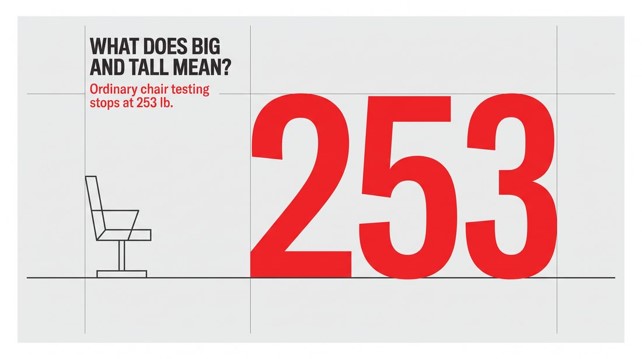
- The ordinary office chair standard, ANSI/BIFMA X5.1, tests to an occupant of 253 lbs. Above that it says nothing.
- There is a separate standard for larger occupants, ANSI/BIFMA X5.11, written for up to 400 lbs, the 99.5th percentile American male.
- The difference is not a badge. X5.11 swivel testing runs at a 400 lb load against 250 lbs, and seat impact at a 200 lb bag against 125 lbs.
- Any chair described as big and tall without a stated capacity and a standard behind it is describing its upholstery.
Short version: “big and tall” is a category with an actual engineering definition, and most of the chairs sold under the phrase are not tested to it.

The proportions are the easy part. What matters is which standard the mechanism was tested against.
Buy from somewhere that publishes the capacity
The single filter that removes most of the market is asking for a number.
A chair built for larger occupants should state its weight capacity plainly, and the better commercial listings state the standard alongside it. Curated selections of big and tall office chairs tend to lead with capacity figures, typically ranging from 300 lbs at the entry point up to 500 lbs, because for this category it is the specification that determines whether the chair is fit for its buyer.
Where no capacity is published, the safe assumption is that the chair was built to the general-purpose standard and given a wider seat.
What the two standards actually test
This is the part that is genuinely worth knowing, because the gap between the two is large.
ANSI/BIFMA X5.1 covers general-purpose office chairs and is built around an occupant of up to 253 lbs. ANSI/BIFMA X5.11, listed among the furniture performance standards that BIFMA maintains, covers large occupant office seating and is written for occupants above 253 lbs and up to 400 lbs, which corresponds to the 99.5th percentile American male.
The test loads move accordingly:
| Test | X5.1 general purpose | X5.11 large occupant |
| Swivel cycling load | 250 lbs | 400 lbs |
| Tilt mechanism load | 225 lbs | 350 lbs |
| Seating impact bag | 125 lbs | 200 lbs |
| Drop test, functional and proof | 225 / 300 lbs | 250 / 350 lbs |
X5.11 also introduced seat width measurement and structural durability requirements that X5.1 does not contain.
A chair passing X5.1 has demonstrated nothing about its behaviour at 350 lbs. It may well cope. It has simply not been asked to.
The components that fail first
When a chair is used beyond what it was tested for, the failures are predictable and they arrive in a known order.
The gas lift. The most common failure by a distance. It stops holding height and sinks slowly through the day. A class 4 cylinder is the one to ask for.
The base. Nylon bases flex and eventually crack at the spokes. Cast aluminium or steel is the upgrade, and it is usually the difference between a chair lasting three years and ten.
The tilt mechanism. It develops play, then a knock, then it stops locking where you set it.
The casters. Underspecified wheels flat-spot under load and then drag, which is a small irritation that people notice daily.
None of these are visible in a product photograph, which is precisely why the standard matters as a proxy.
Where design and specification meet
The reason this category has a reputation for looking institutional is that the engineering demands mass, and mass has historically been styled as bulk.
That is no longer the constraint it was. Higher-capacity chairs are available in leather and in restrained profiles that sit comfortably in a study rather than announcing themselves as equipment. The principle that governs it is the same one behind any well-resolved interior, where the pieces that do the hard work are chosen to recede rather than perform, an idea explored in this piece on why refined interiors feel effortless.
Two practical notes. Seat width above 24 inches is the point at which the chair reads as generously proportioned rather than oversized. And a mid-back profile in this category is often more elegant than a high-back and meets the same structural specification.
What to ask before buying
Four questions, and the answers are either immediate or they are a warning in themselves.
- What is the stated weight capacity, in pounds?
- Which BIFMA standard was it tested to, X5.1 or X5.11?
- What class is the gas cylinder, and what is the base made of?
- What does the warranty cover, and for how long, and does it exclude the mechanism?
A supplier who can answer all four quickly is selling a specified product. One who answers with adjectives is selling a shape.
Capacity is not the same as fit
Weight capacity is a structural rating and it is not a comfort rating, and conflating the two is the mistake this category invites.
A 500 lb chair is built not to fail. Whether it fits your frame is a separate question involving seat width, seat depth, backrest height and armrest span, and none of those are addressed by the capacity figure at all. A chair rated well above your weight can still be the wrong chair for you in every dimension that determines whether you want to sit in it.
Use the standard to shorten the list. Use a trial period to choose from what remains.