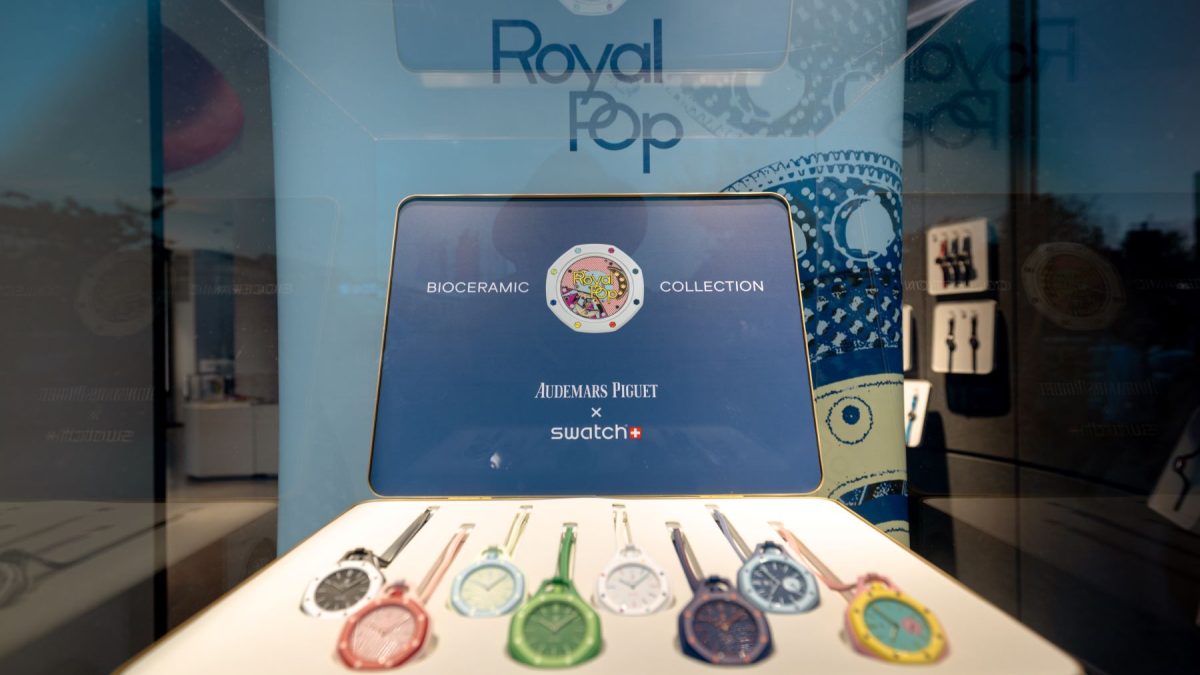
There are perhaps five watch houses whose design language is recognizable from across a room, and Audemars Piguet sits comfortably among them. The octagonal bezel it introduced in 1972 became shorthand for a certain kind of quiet wealth — a silhouette that, until this year, started around $20,000 and climbed steeply from there. Then, on May 16, that silhouette appeared in a Swatch boutique window for around $400, and the luxury market got one of its most instructive case studies in years.
An icon, reinterpreted sideways
The Royal Pop’s masterstroke was refusing to be the product everyone predicted. Rather than shrinking a five-figure wristwatch into Bioceramic, the two brands revived a format from before the wristwatch existed: a 40 mm octagonal pocket watch, mechanical and self-winding, issued in eight colorways whose names — Otto Rosso, Lan Ba, Otg Roz among them — each count to eight in a different tongue. It was witty, historically literate and completely impractical, which is arguably the most luxurious combination of qualities there is.
The market responded on cue. Boutiques from Fifth Avenue to Ginza saw overnight lines and one-per-person rationing; within days, secondary prices touched several multiples of retail, with the navy Lan Ba leading the frenzy. Then came the correction. As rolling restocks reached stores and buyers realized the piece was not a hard limited edition, resale premiums deflated through early summer. The speculators exited. What remained was more interesting: actual collectors, holding an object they genuinely liked, asking a practical question the launch never answered.
The wearability problem — and the market’s answer
A pocket watch, however charming, spends its life unworn. And an unworn watch, as any collector will admit, slowly stops being loved. The Royal Pop’s pop-out construction turned out to be the loophole: because the watch head releases from its housing by design, independent specialists moved quickly to build precision conversion cases that seat the piece on the wrist without so much as touching it — no drilling, no adhesive, no compromise to originality or future value.
The category has matured with remarkable speed. The reference execution comes from Helvetus, whose fitted case pairs with a color-matched FKM rubber Royal Pop strap for each of the eight editions, engineered around the two crown layouts in the collection and finished to a standard closer to the straps found on five-figure sports watches than to fashion accessories. A lifetime warranty on the rubber underlines the point: this corner of the aftermarket is not making novelties, it is making equipment.
That distinction matters, because the conversion trend has quietly become the dominant way the Royal Pop is actually worn. Scroll the collector forums and the wrist shots outnumber the pocket shots comfortably. The piece Swatch and AP designed as a conversation about horological history is living its daily life as a wristwatch after all — the market simply built the missing bridge itself.
What the Royal Pop actually proved
Skeptics warned the collaboration would dilute one of the last great untouchable brands. The early evidence points the opposite way, as it did when the MoonSwatch preceded a measurable rise in demand for the watch that inspired it. Millions of people under thirty now recognize an octagonal bezel on sight and know precisely which manufacture drew it first. Some fraction of them will, in time, buy the real thing. That is not dilution; that is the longest sales funnel in luxury.
For the collector holding a Royal Pop today, the calculus is pleasingly simple. The hype has cooled, the object remains excellent, and the ecosystem around it — chains for the romantics, conversion cases and straps for everyone else — has made it a piece you can genuinely live with. In a market that too often confuses scarcity with substance, a $400 mechanical watch people actually wear might be the most subversive luxury statement of the year.