The 100-Year Journey of America’s Wealthiest Families
Now that Elon Musk has become the world’s first trillionaire, this topic feels especially timely. In the United States, even the largest fortunes rarely stay within one family for more than three generations. Families like the Rockefellers, Carnegies, Vanderbilts, Astors, and Morgans show how wealth tends to spread out over time through philanthropy, taxes, inheritance, investments, and economic changes. Today’s wealthiest Americans, including Elon Musk, Larry Ellison, Larry Page, Sergey Brin, and Jeff Bezos, collectively control nearly $2.65 trillion in assets, representing approximately 8.2% of the U.S. economy. Most have publicly committed to donating substantial parts of their wealth. If preserved through charitable foundations, these fortunes could generate trillions of dollars in philanthropic spending over the next century while maintaining principal. The article analyzes the economic compromises between estate taxation and perpetual foundations, concluding that the true legacy of great wealth is frequently measured less by inheritance than by its long-term impact on society, education, research, innovation, and opportunity. This creates a fascinating economic question. Should society prefer immediate taxation or perpetual charitable investment?
America has always been fascinated by wealth.
From the railroads of the Gilded Age to the artificial intelligence and technology empires of today, every generation wonders the same thing. What happens to great fortunes after their creators die? The question is more relevant than ever. In 2026, the five wealthiest Americans collectively control nearly $2.65 trillion in assets. Their fortunes exceed the annual economic output of many nations and represent one of the largest concentrations of private wealth in modern history. Yet history suggests something surprising. Despite the immense fortunes accumulated by industrial titans such as John D. Rockefeller, Andrew Carnegie, Cornelius Vanderbilt, J.P. Morgan, and the Astor family, very little of their original wealth remains concentrated within their descendants today. Instead, most of those fortunes gradually flowed into universities, charitable foundations, public companies, taxes, real estate markets, investment funds, and the wider economy. The story of wealth is often less about accumulation and more about distribution.
The Wealth Titans of 1901
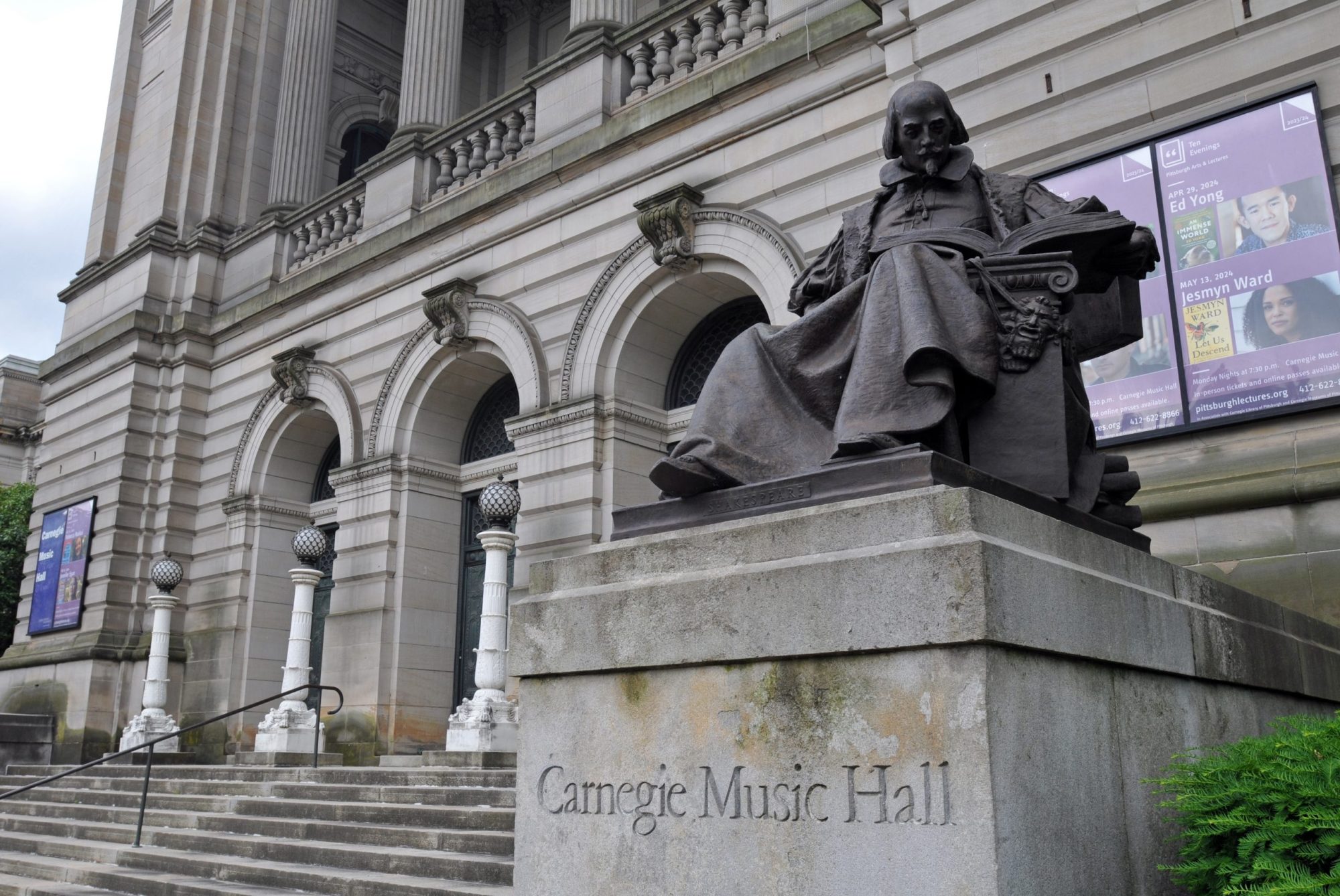
At the beginning of the twentieth century, America was dominated by industrial fortunes. The nation’s wealthiest individuals established empires in oil, steel, railroads, banking, and real estate. The leading fortunes included:
- John D. Rockefeller
- Andrew Carnegie
- William Rockefeller
- Cornelius Vanderbilt II
- Russell Sage
- J.P. Morgan
- John Jacob Astor IV
- Henry Huttleston Rogers
- Collis P. Huntington
- James J. Hill
Measured relative to the size of the economy, Rockefeller remains one of the wealthiest individuals in American history. At the height of his power, Standard Oil controlled roughly 90 percent of U.S. oil refining. His wealth represented a larger share of national output than that of any modern billionaire. Yet despite that immense fortune, the Rockefeller family today controls only a small fraction of the economic power once concentrated in a single individual. The same story applies to the Vanderbilts. The Vanderbilt family became the classic example of wealth dissipation. Within a few generations, much of the earliest railroad fortune had been divided, spent, donated, taxed, or diluted among descendants. Andrew Carnegie took an even more direct approach. He intentionally gave away most of his wealth before his death, funding libraries, universities, educational programs, and philanthropic institutions that continue operating more than a century later. These examples reveal a pattern echoed throughout American history. Great fortunes rarely remain intact.
The Billionaires of 2026
Today’s wealthiest Americans built fortunes very differently. Rather than railroads and steel mills, modern fortunes are rooted in software, digital services, artificial intelligence, cloud computing, and technology infrastructure. The wealthiest Americans include:
- Elon Musk, at over $1 Trillion
- Larry Ellison
- Larry Page
- Sergey Brin
- Jeff Bezos
Together, these five individuals control approximately $2.65 trillion in wealth. That figure represents nearly six percent of the entire U.S. economy. If these fortunes remained intact and under unified family control for generations, they could become the largest dynastic fortunes in modern history. However, that appears unlikely. Most of today’s leading billionaires have publicly committed to giving away substantial portions of their wealth:
- Larry Ellison has pledged to donate the vast majority of his fortune.
- Larry Page and Sergey Brin are signatories to the Giving Pledge.
- Jeff Bezos has publicly stated that he intends to give away most of his wealth.
- Even Elon Musk has indicated that much of his wealth should ultimately serve humanity rather than simply enrich future generations.
The result may be a fundamentally different wealth transfer than previous generations experienced.
How Long Do Billionaire Fortunes Last? The 3-Generation Rule
To understand what may happen over the next century, it helps to examine how large fortunes typically evolve. Studies of wealthy families frequently find that approximately:
- 70 percent of wealth disappears by the second generation.
- 90 percent disappears by the third generation.
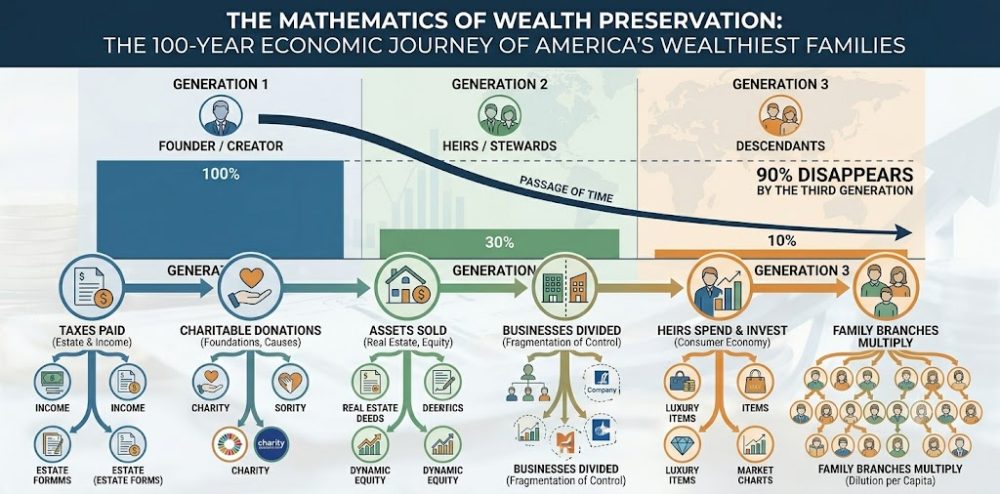
This does not mean the money literally vanishes. Instead, it becomes distributed throughout the economy:
- Taxes are paid.
- Charitable donations are made.
- Assets are sold.
- Businesses are divided.
- Heirs spend and invest.
- Family branches multiply.
Over time, wealth becomes fragmented across hundreds or even thousands of individuals. If today’s top five fortunes followed a typical historical pattern, only about 10 percent of their combined wealth might remain under family control after one hundred years. Starting with approximately $2.65 trillion, that would leave roughly $190 billion still under descendants’ control a century from now. That sounds enormous. However, context matters. A hundred years from now, the U.S. economy itself will likely be dramatically larger. As a percentage of national wealth, those fortunes would have much less influence than they do today.
Is it Better to Tax Estates or Fund Foundations?
The Foundation Model
There is another path. Instead of distributing wealth directly to heirs, many billionaires establish charitable foundations. This model keeps the principal while spending investment income. The Rockefeller Foundation remains one of the most successful examples: * The first assets were invested. * Annual earnings funded charitable programs. * The principal remained largely intact. The result was a philanthropic institution capable of operating for generations. Suppose a foundation begins with $2.65 trillion. If it earns 5 percent annually and spends only investment earnings, it could distribute approximately $132.5 billion annually without reducing principal. Over the course of a century, that foundation would generate roughly $13.25 TRILLION in charitable spending. Meanwhile, the founding principal would remain available to support future generations of philanthropy.
The Estate Tax Debate
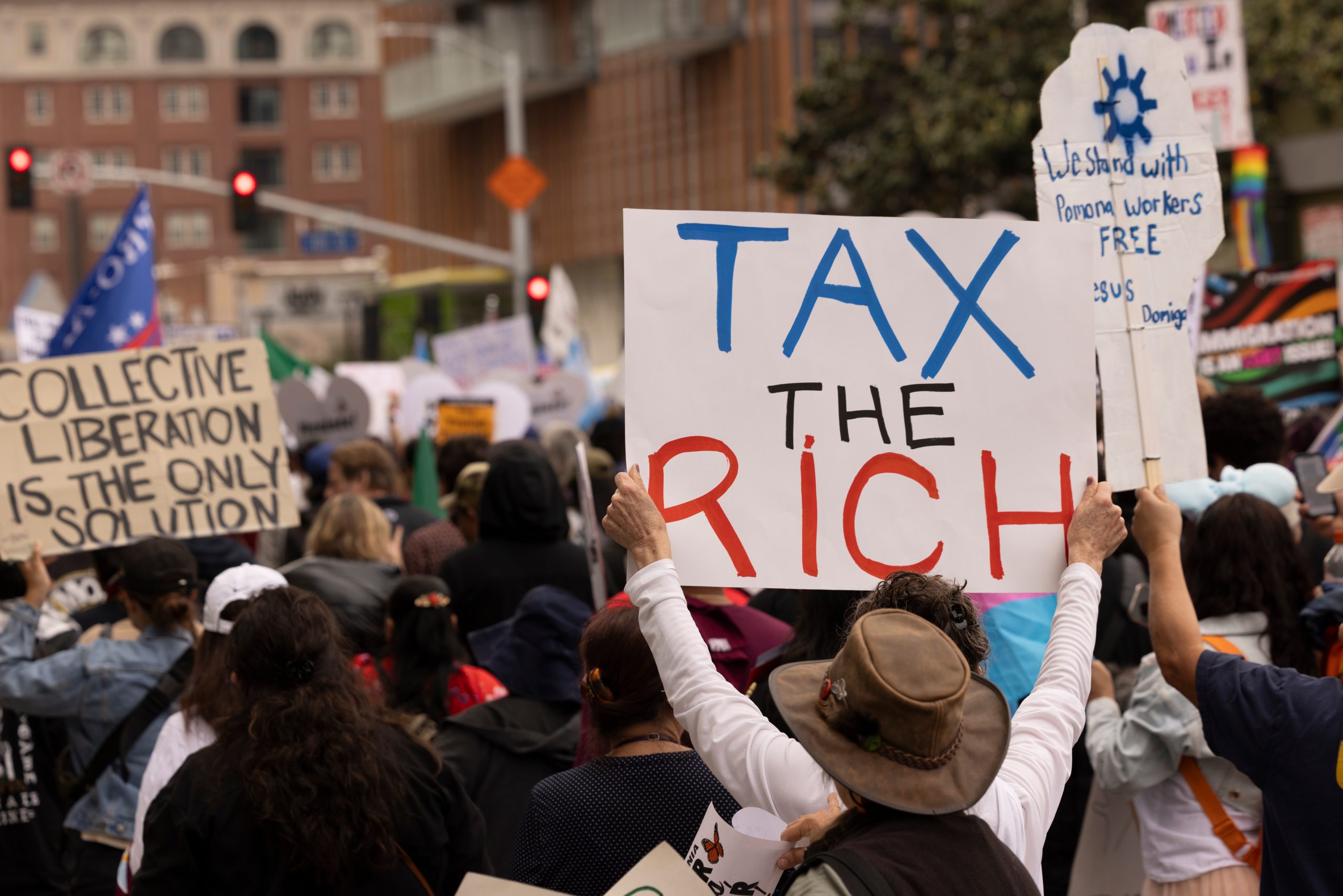
One argument frequently raised by legislators is that large fortunes should be subject to substantial estate taxation. Supporters maintain that concentrated wealth creates economic inequality and that estate taxes return resources to the public. Certain critics argue that large endowments and foundations may generate greater long-term social benefits. Consider a simple example where a billionaire leaves behind a $2.65 trillion fortune:
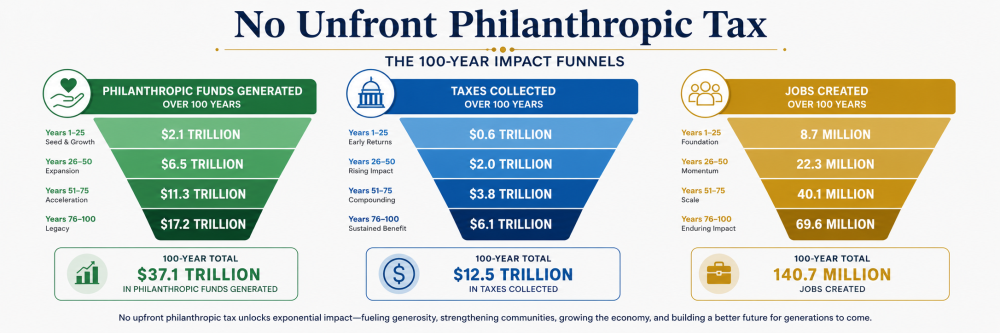
Option One
- The entire amount enters charitable foundations.
- Annual investment earnings support charitable causes.
- Principal remains intact.
Option Two
- The government immediately taxes 50 percent of the estate.
- The remaining half enters foundations.
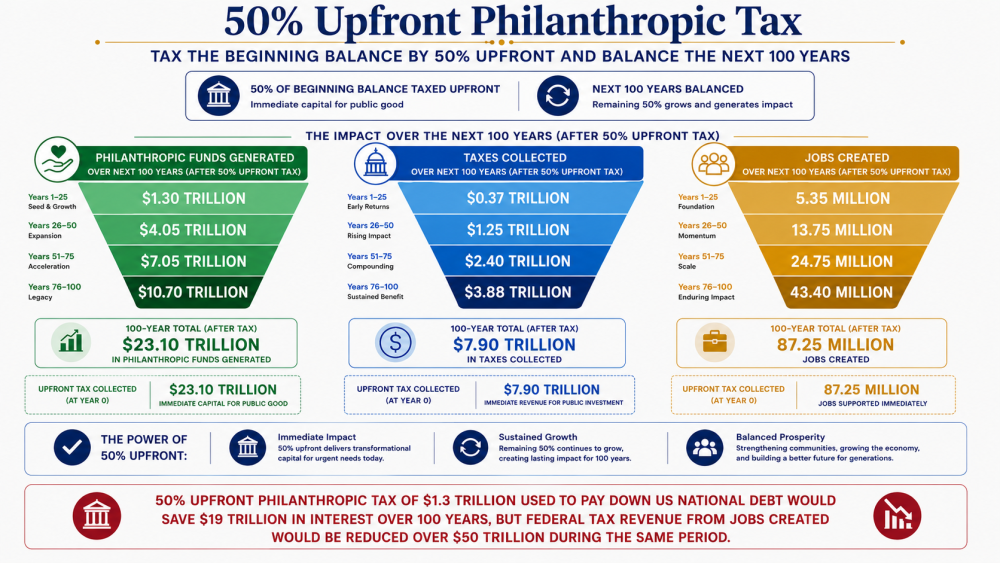
The Impact of Inheritance Options on $2.6 Trillion Tax Revenue over 100 years
At first glance, Option Two appears more beneficial. The government receives approximately $950 billion immediately. However, there is a hidden cost. Because the principal is halved, future investment income is halved. Over the next hundred years, charitable spending will have declined dramatically by 50%.
The Cost of Reducing Principal
If the full $2.65 trillion remains invested, annual charitable spending is approximately $132.5 Billion. Over the next 100 years, $12.5 trillion will flow into education, healthcare, scientific research, poverty reduction, environmental initiatives, and other charitable causes, with the principal remaining in balance. If 50 percent of the principal is taxed first, annual charitable spending falls to approximately $6.625 billion, half of option 1. Over the next 100 years, only about $6.25 trillion will be distributed. The difference is staggering: more than $6.25 trillion in future charitable activity is set to disappear. In effect, every dollar removed from principal permanently reduces future charitable capacity. This is the central economic argument behind large perpetual foundations.
The GDP Perspective

Another useful way to evaluate great fortunes is to compare them to national output. Today, $2.65 trillion represents approximately 8.2 percent of U.S. GDP. That figure sounds extraordinary. Yet economies grow. If nominal GDP expands by roughly 3% percent annually over the next century, the U.S. economy could eventually exceed one quadrillion dollars. Under that scenario, a preserved $2.65 trillion principal would represent only a fraction of one percent of GDP. The fortune would remain large in absolute terms; however, its relative economic influence would decline dramatically, to under 0.4% of GDP after 100 years, at a 3% annual growth rate. This illustrates an important truth about capitalism: even when wealth is preserved, economic growth gradually reduces its relative concentration. The economy often grows faster than old fortunes.
Where Does the Wealth Really Go?
Many people imagine wealth transfers as a battle between heirs and the government. Reality is more complex. Large fortunes typically flow into multiple channels simultaneously:
- Some wealth remains with descendants.
- Some become philanthropic capital.
- Some support universities and research institutions.
- Some enter public equity markets.
- Some funds private businesses.
- Some is paid in taxes.
- Some financial real estate development.
- Some is spent on consumption.
Over time, the money spreads throughout the economy. Rockefeller’s wealth did not disappear; it became hospitals, universities, research centers, foundations, businesses, and investments. Carnegie’s fortune became libraries, educational institutions, and philanthropic organizations. The wealth transformed rather than vanished.
The New Philanthropic Era

Today’s billionaires appear increasingly focused on philanthropic impact. Unlike many industrial-age fortunes, modern wealth makers often discuss solving global problems:
- Artificial intelligence safety.
- Climate change.
- Medical research.
- Education.
- Poverty reduction.
- Scientific discovery.
- Space exploration.
- Longevity research.
These themes increasingly shape modern philanthropy. As a result, future historians may remember today’s billionaire fortunes less for what heirs inherited and more for what foundations funded. The next century could witness trillions of dollars flowing into causes that previous generations could scarcely imagine.
The Ultimate Legacy Question
The most important question is not how much money remains. The more important question is what the money accomplishes. A fortune can be measured in dollars, a legacy cannot. Rockefeller’s legacy isn’t merely his remaining family wealth. It includes medical breakthroughs, universities, and philanthropic institutions. Carnegie’s legacy includes thousands of libraries and educational programs. The same principle will likely apply to today’s technology billionaires. One hundred years from now, descendants may control only a fraction of the founding fortunes. Yet the wider impact could be far greater. The true legacy of great wealth may ultimately be measured not by the principal preserved but by the opportunities created.
Conclusion
History teaches a remarkably consistent lesson. The largest fortunes rarely remain concentrated forever. Over generations, wealth spreads through philanthropy, taxes, investment, inheritance, and economic growth. The fortunes of Rockefeller, Carnegie, Vanderbilt, Astor, and Morgan transformed America long after their creators passed away. The same process is likely already underway for today’s technology billionaires. Regardless of whether through family trusts, charitable foundations, public investment, or economic activity, the approximately $2.6 trillion controlled by America’s wealthiest individuals will eventually become part of a much larger story. The question is not whether the money will move—history suggests it always does. The question is where it will create the greatest impact over the next hundred years.
Key Takeaways: The Trillion-Dollar Wealth Shift
- The 3-Generation Rule:** Historically, 90% of family wealth dissipates by the third generation due to taxes, division among heirs, and spending.
- The Modern Blueprint:** Tech titans like Musk, Bezos, and Gates are bypassing traditional inheritance, choosing perpetual charitable foundations instead.
- The Economic Impact:** Preserving $2.65 trillion in foundations could yield $132.5 billion annually in philanthropic spending without touching the principal
Ask the JustLuxe Luxury AI Concierge: Wealth, Legacy and Philanthropy
A trillion-dollar fortune raises questions that extend far beyond inheritance. Explore how historic fortunes evolved, how modern billionaires approach philanthropy, and how families can transform private wealth into a lasting social, cultural, or entrepreneurial legacy.Experience It
- Create an Around-the-World Private Jet Itinerary
Create a private jet itinerary featuring Aman Resorts, Four Seasons Private Jet, African safaris, Antarctica expeditions, Monaco, Kyoto and the Maldives. - Plan a Family Legacy Yacht Expedition
Build a multi-generational itinerary aboard a private yacht or expedition ship that combines luxury, education, philanthropy and unforgettable experiences for children and grandchildren. - Experience Exclusive VIP Global Events
Receive VIP recommendations for the Monaco Grand Prix, Art Basel Miami Beach, Pebble Beach Concours d’Elegance, Wimbledon, The Masters, Cannes Film Festival and the Academy Awards. - Curate the Ultimate Collector’s Weekend
Combine private Napa Valley wine tastings, Geneva watch boutiques, rare automobile auctions, private museum tours and Michelin-starred dining. - Stay in Iconic Suites Worldwide
Compare iconic suites at Burj Al Arab, Atlantis The Royal, Passalacqua, Claridge’s London, The Plaza New York and Amangiri. - Explore Historic Philanthropic Landmarks
Visit museums, universities, medical research centers and cultural landmarks whose existence was made possible through history’s greatest fortunes.
Compare Historic and Modern Wealth
- Compare the Rockefeller, Carnegie and Vanderbilt approaches to generational wealth.
- How are technology fortunes different from the industrial fortunes of the Gilded Age?
- Which historic American family preserved its influence most successfully?
- How do family holding companies help heirs retain control of businesses and investments?
- What can today’s founders learn from families whose fortunes disappeared?
Design a Modern Legacy Strategy
- Create a 100-year philanthropic plan for a technology founder.
- Compare a private foundation, donor-advised fund, and charitable trust.
- Build a family-governance plan for multiple generations of heirs.
- Explain how a family office coordinates investments, taxes, philanthropy and succession.
- Recommend ways to involve younger family members in charitable decision-making.
- Show how education, medical research and entrepreneurship could share a philanthropic portfolio.
These related JustLuxe stories examine philanthropy, inherited influence, luxury assets and the changing meaning of wealth.
Philanthropy and Social Impact
- Taxing the Wealthy: A New Era of Collective Philanthropy?
- Inside Modern Philanthropy with Jean Shafiroff
- Jane Weitzman on Luxury, Charity and Personal Legacy
Dynasties, Leadership and Inherited Influence
- John Elkann of Exor on Legacy, Leadership and Reinvention
- A Vanderbilt Legacy Reimagined at Elm Court
- Inside the California Estate of the Levi Strauss Heirs
- Inside Larry Ellison’s Art Collection
How Affluence Shapes Modern Luxury
- 250 Years of American Luxury: From Elite Privilege to Everyday Comfort
- Why Loud Wealth Is Returning to Luxury Culture
- The World’s Best Concierge Companies for the Wealthy
- Daniel Nadler: The Tech Billionaire with an Unexpected Creative Side
Authoritative Wealth and Philanthropy Resources
For additional research, these institutional resources explain charitable pledges, perpetual foundations, historic philanthropy, and federal estate taxation.
- The Giving Pledge: How the World’s Wealthiest Families Commit to Philanthropy
- The Rockefeller Foundation: More Than a Century of Philanthropic History
- Andrew Carnegie and the Origins of Modern Philanthropy
- How Andrew Carnegie’s Fortune Built More Than 2,500 Libraries
- Internal Revenue Service: Federal Estate Tax Overview
The JustLuxe Concierge Perspective
Great wealth rarely remains frozen in one family or one form. It becomes companies, foundations, universities, research, real estate, collections and opportunities. The defining luxury may not be possessing the fortune, but having the ability to determine what it accomplishes next. JustLuxe Luxury Concierge
. . . . .