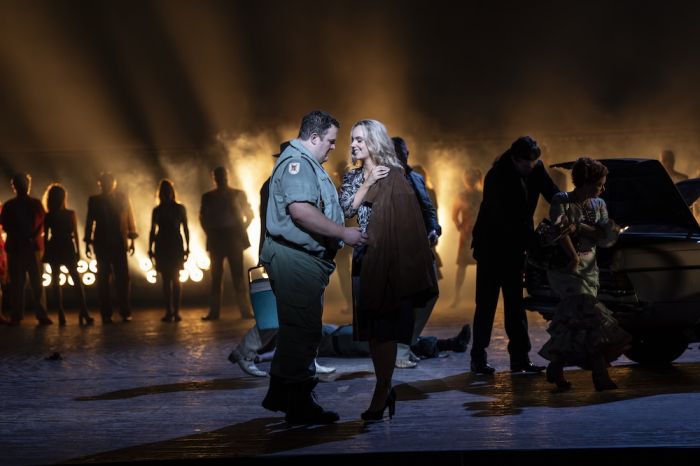


As the curtain rises at the London Coliseum for this revival of Georges Bizet’s Carmen, one is immediately drawn into the reimagined world conjured by veteran director Calixto Bieito, revived under the assured stewardship of Jamie Manton. Transposed to the shadowed final years of Franco’s Spain, this production abandons the sunlit romance of Seville for a world of tension, desire and defiance—a chiaroscuro landscape where freedom smoulders beneath the weight of oppression.
Everything here pulsates with tension. From the moment the prelude’s first tremor quivers through the pit of the Orchestra of English National Opera, the world of this Carmen is firmly rooted in social unrest, sexual politics and imminent danger. The ensemble—soldiers, smugglers and Carmen’s gang—move with kinetic, visceral force; the chorus is not decorative but elemental. The design by Alfons Flores places us in stripped-back spaces, angular and unromantic, while the lighting by Bruno Poet emphasises shadows, heat and urgency. What this staging does especially well is to renew the opera’s moral frisson. Carmen is no passive vamp; she is a force unleashed. Don José is undone by his weakness and obsession. The misogyny, the violence, the fatalism—they are all laid bare. The production refuses to inflate the spectacle into prettiness, and it is all the more powerful for it.
Irish mezzo-soprano Niamh O’Sullivan in the title role is magnetic. Her Carmen is seductive yet defiant; her lower register dark, textured and imbued with character. In the “Habanera”, she commands not only attention but nuance. The decision to have her embody moral and social independence fits beautifully with the production’s ethos. John Findon’s Don José delivers a credible, tortured trajectory—from dutiful corporal to enraged destroyer. There are moments when his voice strains, but the psychological arc is powerfully realised. Ava Dodd, as Micaëla, brings a freshness and purity of line that provides welcome contrast to the smouldering central drama.
The orchestra, under the baton of British-Irish conductor Olivia Clarke at the performance I attended, delivers luminous moments throughout: the prelude sparkles, the “Toreador Song” thunders, and the Spanish-inflected rhythms dance their incendiary shadows. The sung-in-English libretto, a hallmark of ENO, removes the linguistic barrier yet demands extra clarity, which the principals deliver with both dignity and intent.
At a time when opera companies often err on the side of safety, this revival reminds us that Carmen is not a sentimental idyll—it is a battleground. It confronts power, gender dynamics, violence and fate. The decision by ENO to continue presenting operas in English ensures immediacy; we hear the words, we understand the fall. The age guidance of 15+ feels entirely appropriate, given the production’s mature themes and unflinching portrayal of obsession and control.
No production is without flaw. Some voices in the ensemble occasionally struggle against the vastness of the Coliseum’s stage; the modern setting may leave traditionalists longing for Andalusian sun. At times, the intensity threatens to eclipse the lyrical intimacy that Bizet’s score also demands. Yet these are minor quibbles when set against the boldness and conviction of the evening.
In this striking and sensual revival, Carmen emerges as a timeless exploration of freedom and fatal attraction. Every note and gesture feels charged with meaning—an assertion of individuality against suffocating social constraint. Bieito’s vision strips away the familiar veneer of exoticism to reveal something more dangerous and immediate: a story of love turned lethal, of a woman who will not be possessed. The closing moments—devastating in their simplicity—linger long after the curtain falls. ENO’s Carmen is not merely a revival; it is a reclamation of the opera’s visceral power. For all its grit and darkness, it burns with vitality—a reminder that Bizet’s masterpiece, a century and a half on, still has the power to seduce, shock and utterly enthral.
English National Opera, London Coliseum, St Martin's Lane, London WC2N 4ES until 5 November 2025