The modern workplace is a space filled with invisible demands. Notification loops, fragmented workflows, and algorithmic tasking have left workers navigating a subtle cognitive drain. As productivity software evolves at hyperspeed, the irony is that humans increasingly struggle with the biology of attention itself. This tension has prompted a new frontier in workplace design, one that treats the office as a form of cognitive interface rather than a backdrop for work.
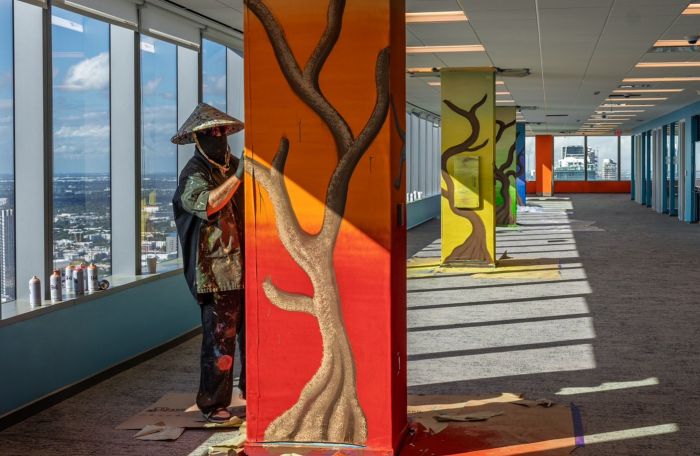
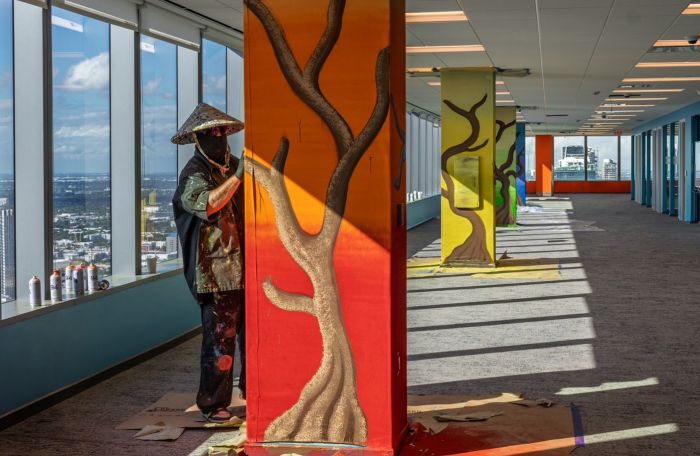
The corridor of painted tree-columns creates a sequence that functions almost like a neural pathway. Each color transition registers as a quiet perceptual cue: a reminder of movement, momentum, or reset. Far from aesthetic flourish, these interventions serve as analog interfaces that guide how attention expands and contracts throughout the day.
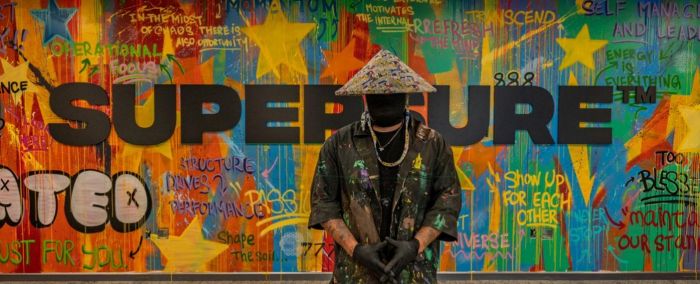
At the heart of the space is the mural where SUPER SURE spans the wall in monumental scale. Beneath the surface is a grammar of stars, directional strokes, and behavior-oriented language. Read collectively, the mural becomes a kind of spatial code: an operating system of reminders designed to stabilize the mind in an space otherwise saturated with digital noise.
The project signals an emerging direction for high-performance industries. As AI accelerates, companies may find that their competitive edge depends not only on computational efficiency but on the design of spaces that protect human cognition. Super Buddha’s work suggests that architecture can function as a form of soft engineering. It can be a system that subtly shapes attention, steadies mood, and allows deeper work to surface in a world that increasingly interrupts it.